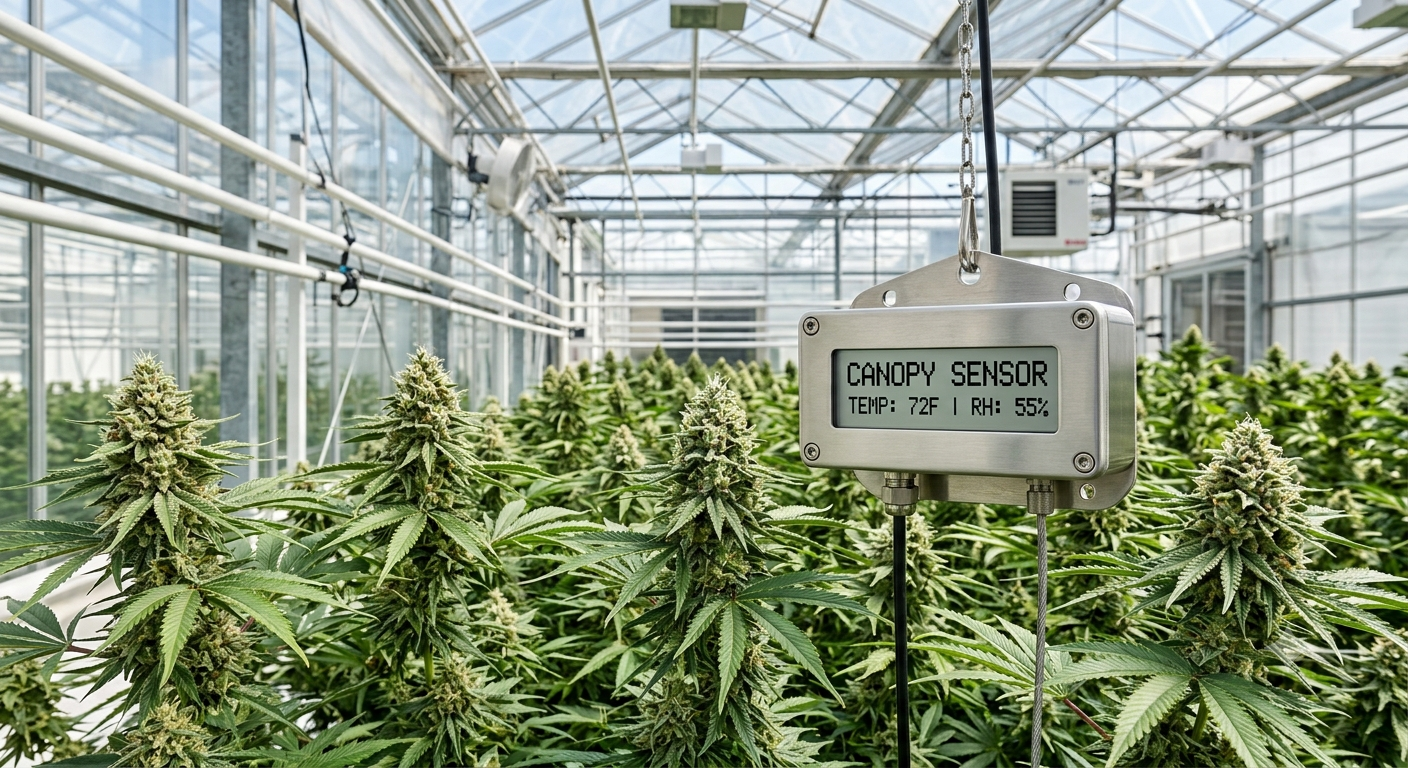
A greenhouse sits in an awkward middle ground. It is not a sealed indoor room with a fixed lighting load, and it is not an open field you leave to the weather. Most climate problems we see start right there, with growers running a greenhouse like one or the other. This is for commercial cultivators trying to hold stable temperature, humidity, and airflow under glass, and it covers the specific places that go wrong.
We have built and run HVACD for cannabis for over a decade, and the same handful of mistakes keep showing up. None of them are exotic.
The Sensor Is Lying to You
Start with the most common one, because it makes every other problem invisible.
Your dehumidifier can be sized correctly, your setpoints can be right on paper, and you can still miss your humidity target every single night. The usual reason is sensor placement. Mounted on a perimeter wall or out near a vent, a sensor reads the room. It does not read the canopy. And the canopy, with dense buds and overlapping leaves, runs a different climate than the air three feet away.
The fix costs almost nothing and changes everything. Put the sensor in the canopy, right next to the plants, suspended from the ceiling on a chain so you can raise it as they grow. Want to check whether yours is off? Take a handheld meter to canopy height, compare it against what your mounted sensor reports, and see how far apart they are. Usually it is far enough to matter.
One reading is not enough either. Greenhouses develop hot and cold pockets, so a spread of sensors beats a single point of truth.
Night Humidity Is Where the Rot Happens
During the day, with lights or sun and warm air, humidity behaves. The problem comes after.
When the lights cut and the greenhouse cools, the air can hold less water. Same amount of moisture, colder air, and relative humidity climbs. Let it reach 100% and you hit the dew point, water condenses on cool leaves and on the steel, and you have built the exact conditions bud rot and powdery mildew want. This matters more for cannabis than for most crops, because the rules limit how much you can spray against these molds. Prevention is basically the only tool you have. Botrytis (gray mold, bud rot) and powdery mildew spread fast once they take, and infected plants slow down, shrivel, and can die.
The thing about mold is that it can't develop in just any conditions. It needs high humidity or dew point condensation to get going. Hold humidity down at all times and it never gets the opening.
That means running active dehumidification, not leaning on your air conditioning to pull double duty. Using HVAC to manage moisture is inefficient. The unit is built for temperature, it only strips water as a side effect, and to get enough moisture out you end up running it continuously and alternating heating and cooling just to keep the dehumidification going. That path means bigger systems, higher upfront cost, and higher energy and maintenance bills. Pair real dehumidification with horizontal airflow fans so the air keeps moving and no stagnant humid pocket forms inside the canopy.
You should not have to become a part-time mechanical engineer to grow good cannabis.
Solar Load Swings Harder Than You Think
This is the mistake that catches growers coming from an indoor background. Indoors, the heat load is steady and predictable. A greenhouse is not.
Sun pours heat in during the day, sometimes a lot of it. Then a cloud passes, or the sun drops, and that gain vanishes almost instantly. If your climate strategy assumes a steady state, every one of those swings is a temperature shock to the crop, and shocks stunt growth. In extreme cases, California greenhouse operators have dealt with radiant temperatures hitting 120 degrees, amplified by wildfire conditions. One low-tech recourse without adding AC capacity is shade cloth or a washable whitewash on the glass, both of which cut radiant temperature. The catch is that both also cut the PAR light reaching your plants, so you are trading heat control against light. Shade cloth at least can be pulled back during peak sun and removed as it sets.
The real answer for a commercial operation is automation that ties the pieces together. Roof vents, shade curtains, heaters, and chillers working off one controller, transitioning between cooling and heating before the swing hits the plants rather than after.
Cold Nights, Leaky Glass
Two more, and they are quick, because they often get skipped entirely.
People assume the heat the greenhouse banked during the day carries the plants through the night. Clear glazing is a poor insulator, though. Heat bleeds out fast once it gets cold outside, and cold nighttime dips invite root pathogens and push plants into survival mode. Supplemental heating, including root-zone systems, keeps the floor of the night temperature where it belongs. In colder climates a heating system is not optional. An inefficient one is expensive at best and dangerous at worst, and early spring is the time to inspect and service it, not the dead of winter.
Then there is the open system. Passive ventilation, cracking the roof vents and running exhaust fans, is cheap to operate. It also throws the door open to outdoor weather, temperature swings, pests, and stray pollen. And every time you vent, you lose the things you paid for, your heat and your injected CO2, which means more heating and more CO2 to put back. A tighter or sealed design holds your CO2, keeps contaminants out, and gives you the control that open ventilation surrenders. For a market where a failed contaminant test can sink a harvest, that control is the whole point.
Frequently Asked Questions
Where should I put my climate sensors in a greenhouse?
Why does my greenhouse humidity spike at night?
Can I just use my air conditioner to control humidity?
Do I really need heat in a greenhouse at night?
What is the advantage of a sealed greenhouse over an open one?
How do solar heat swings affect a greenhouse differently than an indoor room?
What Ties It Together
If there is one thread through all five, it is this. A greenhouse rewards growers who treat the climate as one integrated system and punishes the ones who treat temperature, humidity, airflow, and CO2 as separate problems with separate boxes. Separate AC and dehumidification units fight each other, form microclimates, and leave the condensation gaps where pathogens move in. One coordinated system does not.
You should not have to become a part-time mechanical engineer to grow good cannabis. That is the part most growers end up resenting, and fairly. Get the climate handled as a system, and your team can go back to doing the work that actually moves quality: the genetics, the process, the plants.
Sources
This article draws on Harvest Integrated's own published greenhouse and climate-control guidance:
- Controlled Cannabis Greenhouse Performance at Commercial Scale, Harvest Integrated
- How to Choose the Best Grow Room Climate Control System, Harvest Integrated
- Indoor Cannabis Terroir Influencer #2: Humidity, Harvest Integrated
- Hot Gas Reheat in Cannabis Cultivation and Curing, Harvest Integrated