
Why HGR matters, how it works, and why purpose-built integrated DX changes the conversation
Cannabis cultivation is not comfort cooling.
That distinction matters because comfort systems are designed to make people feel acceptable within a fairly wide band of temperature and humidity. Cannabis rooms and curing spaces are different. They are process environments. They demand tighter control, faster recovery, and better management of latent load, especially when sensible load changes quickly. If the equipment cannot manage temperature and moisture as separate but related control problems, the room starts making decisions for you.
That is where hot gas reheat becomes important.
In cannabis, hot gas reheat is not just another HVAC feature. It is one of the most practical ways to keep removing moisture from the air without dragging the room temperature below target. When paired with purpose-built integrated DX equipment, it becomes a major control lever. When bolted onto comfort equipment as an aftermarket modification, it can introduce real compromises in reliability, capacity, control, and warranty exposure.
To understand why, it helps to start with the physics.
The core problem: removing moisture usually means cooling the air too much
Air is dehumidified when it is cooled below its dew point. Once the coil surface is colder than the dew point of the entering air, moisture condenses out of the airstream and drains away as liquid water. That is the latent work.
The problem is that the same coil that removes moisture also drops the air temperature. In many cannabis operating conditions, especially at lights-off or during drying and curing, the room needs moisture removal but does not need more cooling. In fact, too much cooling may make the room less stable, not more.
This is the central conflict:
- The coil must run cold enough to condense water and remove latent load.
- The room may still need supply air that is warmer than the coil leaving condition.
Without reheat, the only way to pull more water is to keep cooling harder. That can work in some moments, but it is a blunt instrument. The room may overshoot temperature, relative humidity may swing, surfaces may approach condensation risk, and the entire space can become harder to control.
Hot gas reheat solves that problem by letting the system remove moisture first, then add sensible heat back to the air before it is delivered into the room.
What hot gas reheat actually is
Hot gas reheat uses heat already available in the refrigeration cycle.
In a direct expansion system, the compressor raises refrigerant pressure and temperature, creating hot discharge gas. Normally that heat is rejected at the condenser. With hot gas reheat, some of that heat is redirected through a reheat coil placed downstream of the evaporator coil in the supply airstream. The air is first cooled and dehumidified at the evaporator, then warmed back up at the reheat coil without adding any moisture back into it.
That distinction is everything.
Reheat does not remove moisture. The evaporator coil does that. Reheat simply raises the leaving air dry bulb after moisture has already been removed.
On a psychrometric chart, that means the air is first pulled down and left as the evaporator removes sensible and latent energy. Then reheat moves the air to the right at essentially constant humidity ratio. In plain English, the air gets drier first, then warmer, without becoming wetter again.
That allows the system to deliver air that is both drier and more usable.
How hot gas reheat fits into the refrigeration cycle
A simple way to think about the cycle is this:
At the evaporator coil, low-pressure refrigerant absorbs heat from the airstream. If the coil is below dew point, water condenses and latent load is removed.
The compressor then raises the pressure and temperature of that refrigerant, producing hot, high-pressure discharge gas.
In a standard system, that gas heads to the condenser to reject heat. In a hot gas reheat system, a controlled portion of that heat is routed through a reheat coil before final heat rejection, allowing the system to warm the dehumidified leaving air.
Then the expansion device drops refrigerant pressure and temperature so the cycle can begin again.
The value of hot gas reheat is not that it changes the fundamentals of refrigeration. It is that it changes what the system can do with the heat it already has. It gives the unit another meaningful actuator for controlling the delivered air condition.
That is why hot gas reheat is better understood as a control strategy than a hardware add-on.
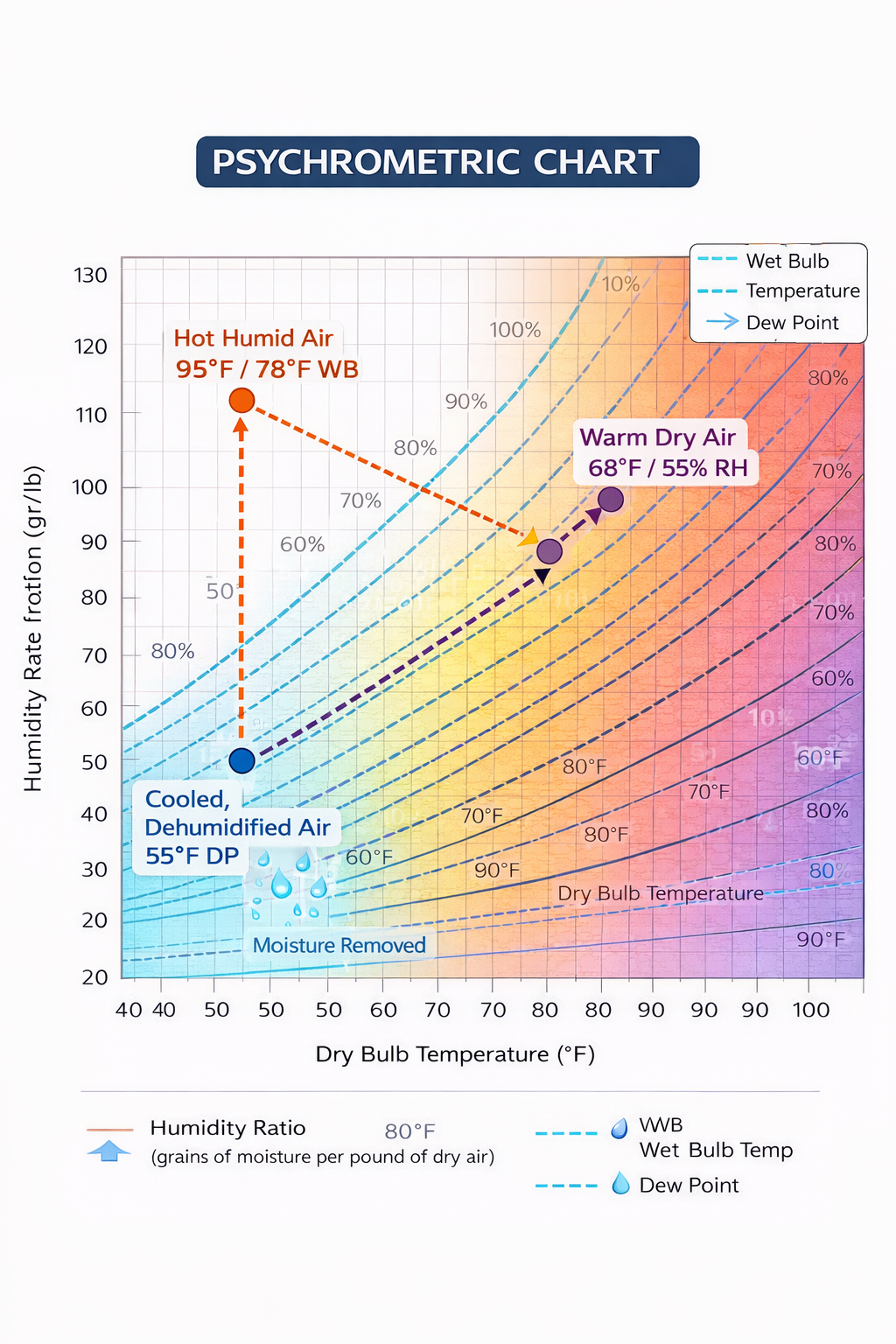
Why cannabis needs hot gas reheat more than comfort cooling does
In comfort cooling, humidity is often secondary. In cannabis, it is operationally central.
Flower rooms, dry rooms, and curing spaces all experience periods where moisture control remains critical even when sensible load is low or rapidly changing. This is especially obvious during lights-off transitions.
When lights are on, a cultivation room carries a large sensible load from fixtures, drivers, and the broader room environment. Plants are transpiring, irrigation may be active, and moisture is entering the airstream. The room often has both sensible and latent demand.
When lights go off, the sensible load can collapse quickly. But the room does not instantly become easy to control. Relative humidity may rise because dry bulb temperature falls. Plant and media moisture dynamics do not stop on command. Surfaces begin to move toward the new room condition at different rates. Dew point management becomes more important, not less.
This is where weak systems get exposed.
If a room needs moisture removal but the system can only deliver that by overcooling the space, operators are forced into compromise. Either humidity is allowed to drift upward, increasing condensation and pathogen risk, or the room is driven colder than desired in order to pull water. Neither is a real control strategy.
Hot gas reheat changes that operating mode. It allows the evaporator to stay cold enough to continue doing latent work while the supply air is reheated to a more useful condition before it re-enters the room.
That is why hot gas reheat matters so much in cannabis. It allows the system to remove moisture without treating temperature collapse as the price of admission.
Why “reheat equals control” is mostly true
That phrase can sound simplistic, but the idea behind it is sound.
A serious cultivation room needs more than raw tonnage. It needs control authority. That means the equipment must have enough independent levers to manage the room through changing conditions instead of simply reacting with all-or-nothing outputs.
Humidity control wants the evaporator cold enough, long enough, and stable enough to condense water.
Temperature control wants the delivered air condition trimmed so the room lands where it needs to land.
When hot gas reheat is integrated and modulating, those two objectives stop fighting each other as badly. The evaporator can stay focused on latent removal while reheat adjusts final supply temperature. That does not make the two completely independent, but it greatly improves the system’s ability to handle the room as a process environment rather than a comfort box.
This is especially valuable during:
- lights-off transitions
- seasonal shoulder conditions
- late flower humidity pressure
- dense canopy events
- irrigation-driven moisture spikes
- dry room and curing periods where moisture removal is needed without aggressive room chilling
Put differently, hot gas reheat does not create dehumidification capacity by itself. It makes existing latent capacity more usable.
That is a very important distinction.
Hot gas reheat does not fix weak latent capacity
This is one place where people get sloppy.
Adding reheat to a system does not magically turn it into a dehumidification machine. If the evaporator coil is not selected for meaningful latent performance, reheat only warms up whatever air condition the coil was already capable of producing.
That is why purpose-built integrated DX matters so much in cannabis.
Real latent performance depends on more than the presence of a reheat coil. It depends on:
- evaporator coil depth
- refrigerant circuit design
- face velocity
- fin spacing
- entering air condition
- suction control
- compressor staging or modulation
- airflow turndown
- leaving air logic
- control sequencing across different load conditions
Comfort cooling equipment is often selected around occupant comfort sensible heat ratio, not around the aggressive latent demands of a sealed or semi-sealed cannabis environment. Many comfort coils are simply not optimized to do heavy latent lifting through the full range of operating conditions cannabis facilities create.
That means a comfort unit with a retrofit reheat kit may gain another lever, but it still remains limited by the coil and refrigeration platform it started with.
The result may be better than nothing, but it is not the same thing as a purpose-built latent-capable cultivation system.
Purpose-built integrated DX with hot gas reheat versus aftermarket retrofit
This is where the industry needs more honesty.
There is a major difference between a factory-engineered, purpose-built integrated DX system with hot gas reheat and an aftermarket hot gas reheat kit installed on comfort equipment in the field.
They are not the same class of solution.
A purpose-built integrated DX system is designed from the start around cultivation or process loads. The evaporator coil, refrigerant circuit, compressor strategy, fan turndown, control sequence, reheat coil, and leaving air logic are engineered together. Ideally, the manufacturer has already accounted for how the system will behave at part load, at low sensible and high latent conditions, and across the operational transitions that matter most in cannabis.
An aftermarket hot gas reheat retrofit is a different proposition. It may add useful functionality, but it also changes the refrigeration circuit that the original manufacturer designed, tested, and warranted.
That brings several real concerns.

Installation and refrigeration design risk
Once the refrigerant circuit is altered in the field, the original system design has been changed. Additional valves, piping, controls, and reheat components can affect refrigerant distribution, pressure drop, velocity, and part-load behavior.
That matters because refrigeration circuits are not infinitely forgiving.
Oil return is one of the biggest concerns. Compressor oil is carried through the system by refrigerant velocity. If refrigerant slows too much, pools in the wrong place, or behaves unpredictably under part-load conditions, oil may not return consistently to the compressor. When oil stays out in the field instead of returning home, compressor life suffers. In the worst case, compressor failure follows.
That is not fear marketing. That is basic refrigeration reality.
Warranty exposure
This point should not be brushed aside.
As soon as the refrigerant circuit is opened and materially modified, manufacturer warranty questions become serious. In many cases, the original equipment warranty can be compromised or voided. That matters even more because compressor warranties may come from component manufacturers whose coverage extends beyond the unit manufacturer’s base warranty.
If the refrigeration circuit has been altered, the owner needs to understand exactly who is standing behind the equipment and under what terms.
Capacity limits
A retrofit reheat kit may add reheat, but it does not create more latent coil than the unit physically has.
Comfort coils are often selected for comfort-duty sensible heat ratios. Many are relatively shallow compared with purpose-built coils designed for deeper latent work. Coil row count alone does not determine performance, but coil depth, face area, refrigerant circuiting, and airflow all influence how well the coil can dehumidify.
If the base unit started with limited latent capacity, retrofit hot gas reheat may allow the air to leave warmer, but it cannot transform a comfort coil into a true cultivation dehumidification platform.
Control limits
This is another place where retrofit approaches often show their limits.
If the base equipment lacks variable speed compressors, fan VFDs, stable suction control, good sensor architecture, and integrated control logic, then the added reheat can behave like a blunt instrument. Instead of smooth modulation, the room gets coarse sequencing, wider swings, short cycling, and more unstable behavior during transitions.
A room does not become process-grade because someone added a valve and a coil. It becomes process-grade when the refrigeration platform and controls were engineered to behave that way from the beginning.
That is the line growers, owners, and engineers need to understand.
Why hot gas reheat matters in curing too
Curing deserves its own discussion because this is where humidity control mistakes become expensive fast.
In curing, operators are not just trying to hit a relative humidity number. They are managing product temperature, water activity, moisture migration, enzymatic progression, microbial pressure, and the protection of secondary metabolites. That process can be destabilized by equipment that overcools the room every time it tries to remove moisture.
Hot gas reheat helps because it allows the system to continue condensing moisture at the coil while delivering air at a temperature more aligned with the curing target. That can support a more stable process window and reduce the tendency of the room to swing between wet, cold, and unstable conditions.
That said, hot gas reheat is not a curing philosophy by itself. It is a tool. The actual curing strategy still has to be built around the product goal, the target water activity path, the desired product temperature, the room loading pattern, the airflow pattern, and the time horizon of the process.
In other words, hot gas reheat can support curing extremely well, but it still has to be used inside a coherent process strategy.
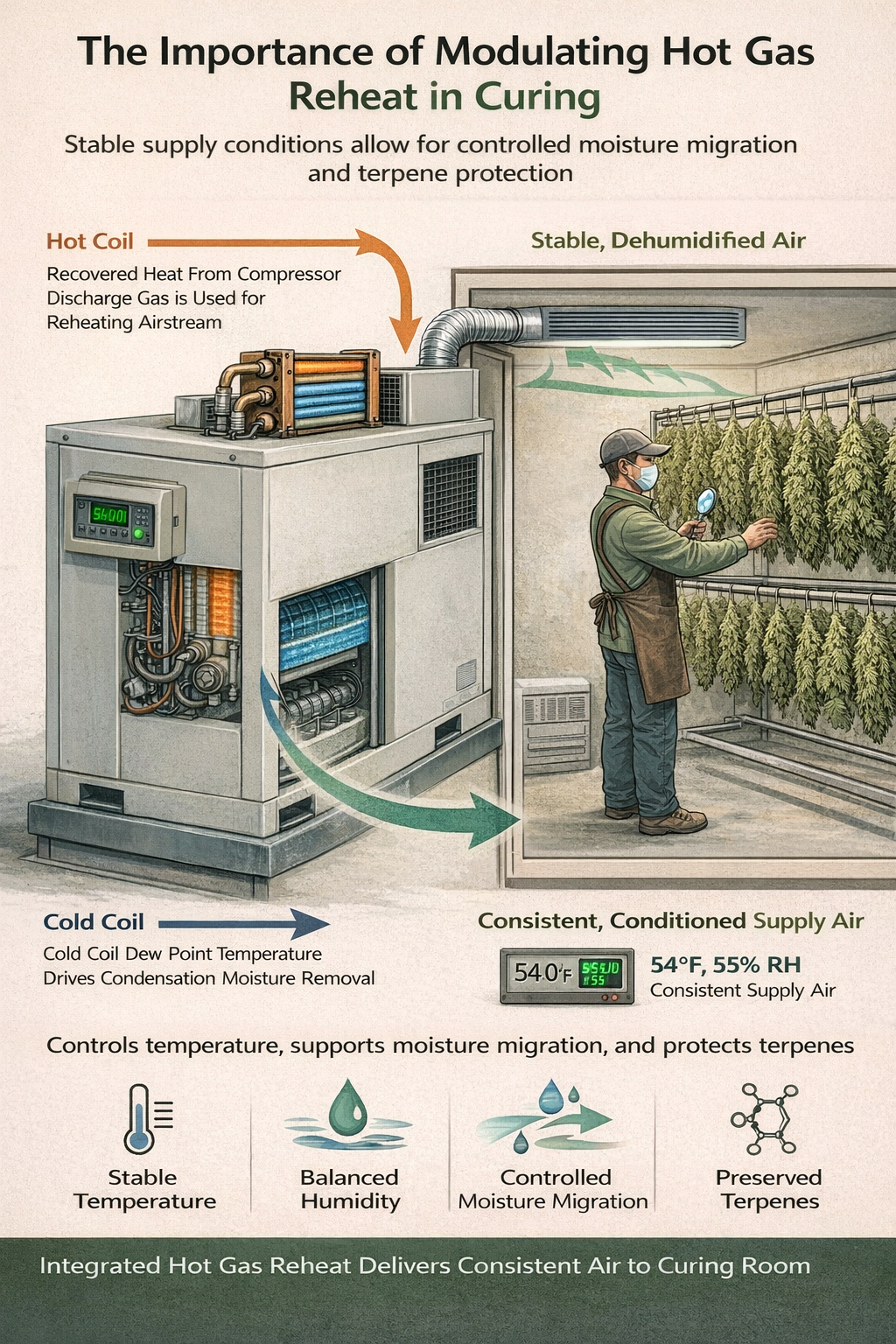
Best practices for real-world application
Hot gas reheat works best when it is treated as part of a total system rather than a box to check.
That means starting with the process target. What room condition is actually needed? What dew point must be controlled? How quickly do loads swing? How much sensible load disappears at lights-off? What is the room doing during irrigation? What is the expected latent burden late in flower or during drying and curing?
Once those answers are clear, the equipment and control strategy can be sized around reality rather than hope.
In practice, strong hot gas reheat application usually includes:
- a coil selected for real latent performance, not just comfort cooling
- compressor and fan modulation that can maintain stable operation across part-load conditions
- control logic built around dew point, temperature, and transition stability
- enough reheat authority to deliver usable supply air after meaningful latent removal
- air distribution that prevents dead zones and microclimates
- a clear understanding of the room’s operating modes rather than one fixed design point
It also requires humility. Hot gas reheat is powerful, but it cannot rescue poor duct design, bad sensor placement, weak airflow distribution, undersized equipment, improper sequencing, or rooms that were never mechanically thought through in the first place.
Common misunderstandings
One of the most common misunderstandings is that reheat is wasteful because it sounds like cooling and heating at the same time.
In a shallow comfort-cooling conversation, that criticism sounds clever. In a process-control conversation, it misses the point.
The real question is not whether the air is being cooled and reheated. The real question is whether the system can remove moisture while delivering the final air condition the process actually needs. In cannabis, that answer often has to be yes. If it is not, the room becomes unstable or operators are forced into compromises that cost yield, quality, labor, and reliability.
Another misunderstanding is that any hot gas reheat is equivalent to any other hot gas reheat. It is not. Factory-engineered, modulating, integrated hot gas reheat on a purpose-built cultivation platform is a very different animal from an aftermarket kit added to a comfort unit.
The words may sound similar. The mechanical reality is not.
The bottom line
Hot gas reheat is foundational because cannabis facilities often need to keep removing water from the air after the space has stopped asking for more cooling.
That is true in flower rooms, at lights-off, during late-stage environmental tightening, in dry rooms, and in many curing environments. When the system lacks a clean way to manage that conflict, the room becomes harder to control, surfaces approach condensation risk, microclimates intensify, and the biological and financial consequences start stacking up.
Hot gas reheat addresses that by allowing the evaporator coil to keep doing latent work while the leaving air is reheated to a more useful supply condition. On the psychrometric chart, it is simple. In real cultivation, it is powerful.
But the industry should be careful not to flatten the conversation. Not all hot gas reheat solutions are equal. Purpose-built integrated DX systems with factory-engineered hot gas reheat, latent-capable coils, modulation, and cultivation-focused controls are fundamentally different from aftermarket retrofit approaches on comfort equipment. The latter may add functionality, but they also introduce legitimate questions around oil return, warranty, latent limits, and control stability.
For cannabis, that distinction matters.
Because at the end of the day, hot gas reheat is not about adding heat. It is about preserving control.