Latent ≥ Sensible
A grow's moisture load equals or exceeds its heat load, the opposite of the ratio comfort cooling is built for
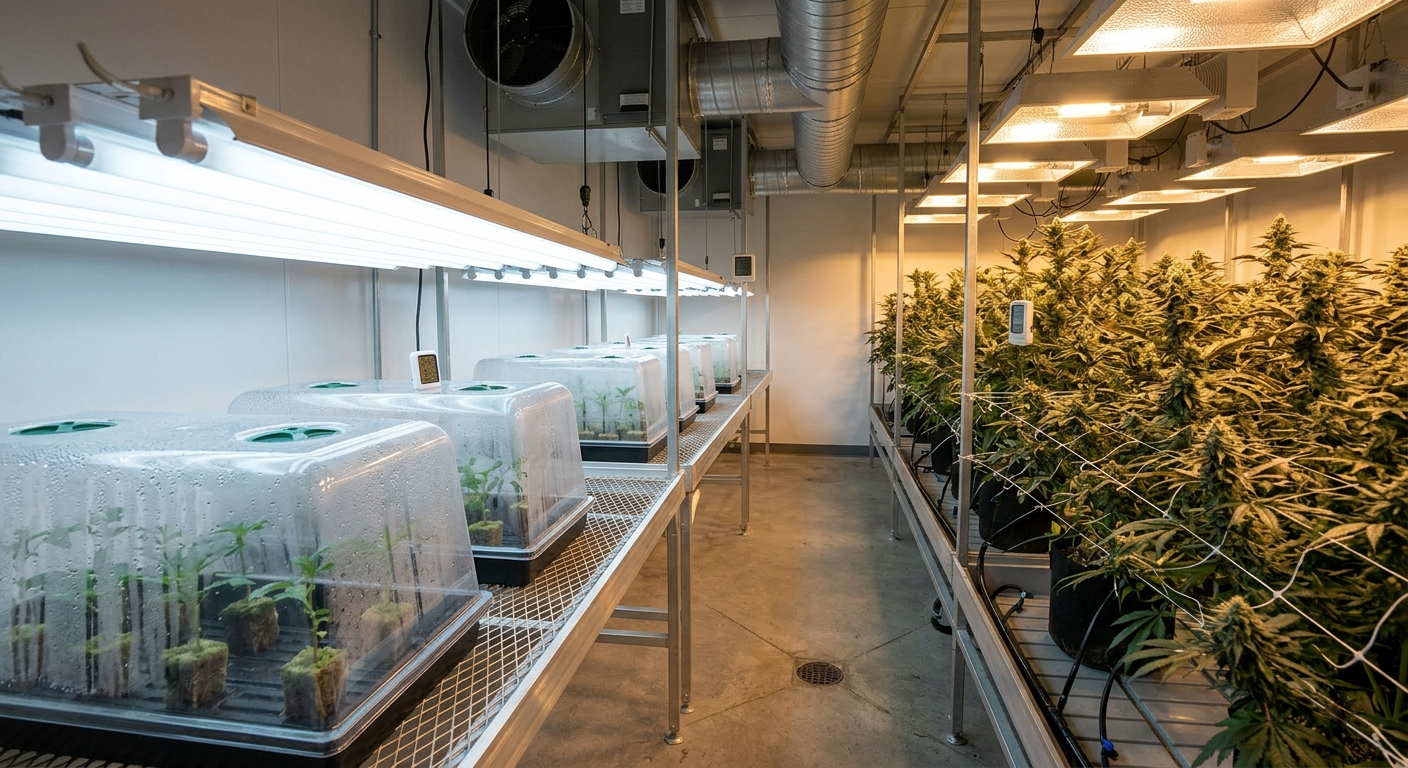
How target humidity shifts from clone to flower, and why one setpoint will not cover the cycle.
Read 10 min · For Cultivators, head growers, and facility operators
Grow room humidity control is a moving target by design. A rootless cutting and a week-seven flower room want opposite things from the air, and a single number held across the whole cycle will underserve one end and put the other at risk. The plant changes what it can do with water every few weeks. Your climate has to change with it.
We're Harvest Integrated, and we build and run the climate systems inside cannabis facilities. What follows is the stage ladder we work from: the humidity and VPD bands we publish for each phase, why our numbers move in the direction they do, and the part we see most rooms get wrong, which is not the target at all but the ability to hold it once the lights go off.
Humidity targets move through the cycle because the plant's relationship with water changes at every stage, from a cutting that can't replace what it loses to a dense canopy that has to be kept dry to survive.
A clone has no roots. It can't pull water from the medium to replace what leaves its tissue, so the air has to stop taking so much. Low drying power keeps the cutting from wilting and gives it room to put out roots.
By late flower the situation has inverted. The plant moves water well, and the risk has shifted from dehydration to the buds themselves. Dense flower traps moisture inside the canopy, and cannabis can't be sprayed clean in bloom, which leaves climate as the defense. Dry air is now the protection rather than the threat.
Everything between those two poles is a controlled walk from one to the other. Hold propagation humidity into flower and you get soft growth and mold pressure. Hold flower humidity in propagation and cuttings wilt before they root. The setpoint is not a fact about your facility. It is a fact about what the plants are doing this week.
These are the leaf VPD and relative humidity bands we publish for indoor cannabis, stage by stage, with the temperature range that typically lands you there.
30% RH45%57%70%85%
Bands are leaf VPD, calculated with the leaf running roughly 2°F below air temperature. Treat them as center-of-the-road targets and bias up or down to steer. Genetics, light intensity, and CO2 enrichment shift the ideal, so verify against your own room data and how your cultivars respond.
Read down the ladder and the shape of the cycle shows up immediately. Humidity falls, VPD climbs, and the temperature ceiling comes down at the end. Each step does a specific job. Propagation keeps drying power low to prevent wilt and drive root initiation. Veg holds a moderate pull that builds canopy, leaf area, and internode length, and you lean low to stretch or high to tighten. Early flower steps VPD up to signal the transition, control stretch, and start biasing the plant generative. Mid to late flower raises drying power to tighten buds, harden flower, and keep humidity below the line where botrytis gets interested.
Same room, same plant. The humidity you hold decides which crop you get.
RH is the number on the sensor, but it is the least stable of the three measurements that matter, because it moves whenever temperature moves even when the amount of water in the air has not changed at all.
That instability produces what we call RH illusions. A reading that looks fine while the moisture load is anything but, because the room warmed up and the same water now represents a lower percentage. Size or troubleshoot on RH alone and you will chase a number that keeps redefining itself.
Two other measurements tell the truth. Dew point tells you how much water is in the air, full stop, which lets you compare rooms honestly and confirm whether the system is removing water or just moving the room around a different temperature. Vapor pressure deficit tells you how hard the air is pulling water out of the plant, which is the plant-facing result of temperature and humidity meeting at the leaf.
The working rule is short: manage dehumidification to dew point, steer the crop with VPD, and treat RH as a readout. It is worth adding that you do not set VPD directly, and there is no such thing as a VPD sensor. VPD is calculated from air humidity and leaf temperature. You control temperature and moisture, and the plant experiences the gradient.
A grow's moisture load equals or exceeds its heat load, the opposite of the ratio comfort cooling is built for
The honest measure of how much water is in the air, independent of what temperature is doing
Water pulled per batch is a measurable output, proof of moisture removed rather than how the room felt
The hardest moment in the cycle is the one where cooling demand falls away but the canopy is still wet, and it arrives every night at every stage.
Air gives up moisture only when it is cooled below its dew point. Water condenses on a cold coil and drains away, which is the entire mechanism. The deeper you need to dry, the colder that coil has to run. Which sets up the central conflict of cannabis climate control: the same coil that removes your moisture also overcools your air.
With the lights on there is plenty of heat to absorb that overcooling. At lights-off there is almost none, and the room needs supply air warmer than a coil cold enough to condense water can produce. Without a way to add heat back, the only lever left is to keep cooling harder, which overshoots temperature, swings humidity, and pushes surfaces toward condensation. The room starts making decisions for you.
Hot gas reheat is the answer to that conflict. After the air is cooled and dehumidified at the evaporator, some of the compressor's hot discharge gas routes through a reheat coil downstream and warms the supply air back to a useful temperature before it enters the room. Deep moisture removal and a stable delivery temperature at the same time. Built into purpose-built integrated DX equipment it is a precise control lever, which is why every Harvest Integrated unit carries a fully modulating hot gas reheat coil. Bolted onto comfort equipment as an aftermarket fix, it can compromise reliability, capacity, control, and warranty.
The same problem shows up in dry and cure rooms in an even sharper form, where you need a great deal of moisture removed and very little cooling, or none.
A VPD that swings 0.4 kPa between lights-on and lights-off undoes your steering, no matter how carefully the stage target was chosen.
Uniform, stable conditions across the whole room are where the gains come from. A plant that lurches between states never settles into the behavior the target was supposed to produce, and a stage plan built on a midday snapshot is not a plan. Check stability across the full 24-hour cycle.
Room uniformity is the other half of it. Read temperature and humidity where the plants live, mid-canopy, in several spots per room. A sensor by the door is measuring the door. The plant is not experiencing the room average the way a dashboard does. It experiences the microclimate at the leaf, through its boundary layer, inside a canopy that can be very different from the condition at the wall or in the aisle. If your room is not uniform, your recipe is not uniform, and if your sensors are lying, your stage notes are lying with them.
Three moves put the targets to work. Measure at canopy height. Set the stage center, then bias low or high depending on whether you want to steer vegetative or generative that week. Then hold it, day and night.
The plants tell you the room has drifted before the numbers make it obvious, and four symptoms cover most of what you will see.
Often VPD too high
The air is pulling water faster than the roots can supply it. The plant curls to cut surface area and may close its stomata, which stalls growth. Raise humidity or drop temperature slightly to bring VPD back into the stage band.
Often VPD too low
Low drying power lets the plant coast. You get lush but weak vegetative growth and humidity that is running higher than it should. Nudge VPD up with more dehumidification or airflow, especially heading into flower.
Often humidity too high
Condensation and stagnant, humid pockets are where pathogens start, and late bloom is when you have the fewest options left. Hold late-flower VPD in the 1.2 to 1.6 range and kill the microclimates with even airflow.
Often extreme or swinging
Both ends of the range stop the plant. Too high closes stomata, too low removes the transpiration pull, and a VPD that lurches between day and night never lets the plant settle. Check the full 24-hour cycle before touching anything else.
When a comfort air conditioner can't keep up with humidity, the common fix is to wheel in portable or wall-mount dehumidifiers, and that fix creates the exact instability that erases stage targets.
A standalone dehumidifier dumps the heat it generates back into the room. The air conditioner comes on to remove that heat, then cycles off, then back on. The two pieces of equipment fight each other, short-cycling the air conditioner, swinging temperature and humidity, and wearing hardware out early. The swings and microclimates that result are precisely what a stage plan can't survive.
Integrated HVACD avoids the fight by handling cooling, dehumidification, and reheat as one coordinated process, sized for the real latent load of cultivation. One system, one set of controls, one decision about how cold the coil runs and how much heat goes back, instead of two appliances arguing over the room.
There is an energy dimension too. The crude way to hit a humidity target is brute force: overcool hard to wring out moisture, then reheat back to temperature. It works and it burns energy twice, which is part of why energy codes restrict simultaneous overcool-and-reheat operation. Our Harvest Air Wheel takes a different route. It is a rotary enthalpy wheel coated in a silica desiccant, the same material in the packets that keep shoeboxes dry, and as it rotates between two airstreams it transfers both heat and humidity from the wetter, warmer stream to the drier one. The air arrives pre-conditioned and the system does far less brute-force work. The general point holds regardless of brand: the cheapest pound of moisture to remove is the one you move with recovered energy instead of raw compressor tonnage.
Because moisture drives the design, the questions you put to a vendor look different from a comfort-cooling spec.
Worth naming
Humidity control is not only about protecting the crop from mold. Wet air slows transpiration and nutrient movement and keeps media wetter than intended, which means a loose room is quietly working against your fertigation plan at the same time it is inviting pathogens. Failed yeast-and-mold tests have forced recalls and destroyed batches across regulated markets. Dehumidification is contamination control and crop steering at once.
Propagation runs 70 to 80% RH, vegetative 60 to 70%, early flower 55 to 62%, and mid to late flower 45 to 55%. Those pair with leaf VPD of 0.4 to 0.8, 0.8 to 1.1, 1.0 to 1.3, and 1.2 to 1.6 kPa. Use them as center targets and bias up or down to steer, since cultivar, light intensity, and CO2 enrichment all move the ideal.
A rootless cutting can't replace the water it loses through its leaves. Keeping drying power low prevents wilt and lets the cutting put energy into root initiation instead of defending itself. Once roots establish, the plant can handle a stronger pull and the target steps down.
Not without giving something up. A number high enough for propagation is mold-friendly in late flower, and a number low enough for ripening will wilt cuttings and stress early veg. Rooms that hold a single setpoint usually end up split between stages by room rather than by target, which works only until two stages share a room.
Use all three measurements, each for its own job. Manage dehumidification to dew point because it reflects the water present in the air. Steer the crop with VPD because it describes how hard the air pulls water from the plant. Treat RH as a readout, since it shifts whenever temperature shifts even when nothing about the moisture load has changed.
Sensible load drops away when the lights shut down while the canopy keeps releasing moisture. Comfort-grade equipment satisfies the low temperature demand and stops before the water is removed, so RH climbs through the dark period. Holding a stage target overnight takes dehumidification capacity that does not depend on a cooling call to run.
The 45 to 55% RH band, paired with leaf VPD of 1.2 to 1.6 kPa, is where late flower belongs. Cannabis can't be sprayed clean during bloom, so climate is the defense. Even airflow matters as much as the room number, because condensation and stagnant humid pockets inside dense canopy are where pathogens start.
They add capacity, and they come with a cost. Each unit dumps its heat back into the room, which calls the air conditioner on, then off, then on again. That short-cycling swings both temperature and humidity, creates microclimates near the units, and wears equipment out early. It is workable as a gap filler and difficult as a strategy.
Hot gas reheat reuses the compressor's waste heat to warm supply air after it has been cooled and dehumidified, so deep moisture removal does not overcool the space. It earns its keep at lights-off and in dry and cure rooms, where the moisture demand is high and the cooling demand is near zero. It works best built into purpose-built integrated equipment rather than added to comfort gear.
More than one, and not by the door. Place them at canopy height in several spots per room so you are reading what the plants experience rather than a room average. Uniformity across the room decides whether a stage target means anything, and a single probe can hide the wet corner that eventually costs you a batch.
Knowing the stage targets is the easy half. Holding them through lights-off, across a full room, harvest after harvest, is what the equipment and the operating model have to deliver.
Harvest Air, the unit we build, is a single package designed with both cooling and dehumidification for cannabis environments. Variable speed compressors and a fully modulating hot gas reheat coil match the cooling and dehumidification load at every stage of the grow cycle, which is what lets a room step from one target to the next instead of overshooting between them. We put redundancy at the component level with multiple compressors, motors, and circuits, so a single failure does not spike humidity across a room. Units arrive at your site fully packaged and factory tested.
Climate as a Service is how we deliver it. Rather than buying equipment and inheriting the moisture problem, you pay one monthly amount covering purpose-built HVACD, 24/7 monitoring, parts, maintenance, and setpoints we guarantee by contract, including the humidity targets your crop and your compliance tests depend on. We hand you our controls and algorithms to run environmental itineraries for crop steering or curing, which is stage-based humidity management run as a program rather than adjusted by hand.
We have been building HVACD for cannabis cultivation for over a decade. Harvest Integrated exists because growers kept having to become makeshift MEPs just to keep an environment stable, and nobody should have to learn thermodynamics to hold 52% RH in week six.
"Harvest Integrated's HVAC as a Service isn't just a product. It's a game changer."
Aeron Brown, Co-Founder, Peach Hash & Co., Michigan, reporting a 30% increase in production
Tell us your canopy, lighting, stage mix, and target conditions. We will size the dehumidification on the moisture your rooms genuinely produce, model what it takes to hold each stage band through lights-off, and deliver it as one predictable monthly payment.
Or call us at 800.607.4758. Running your numbers first? Use the VPD calculator and crop-steering playbook.