15%
More energy consumed by a VRF plus standalone dehumidifier setup than by an integrated HVACD system in a head-to-head cultivation study
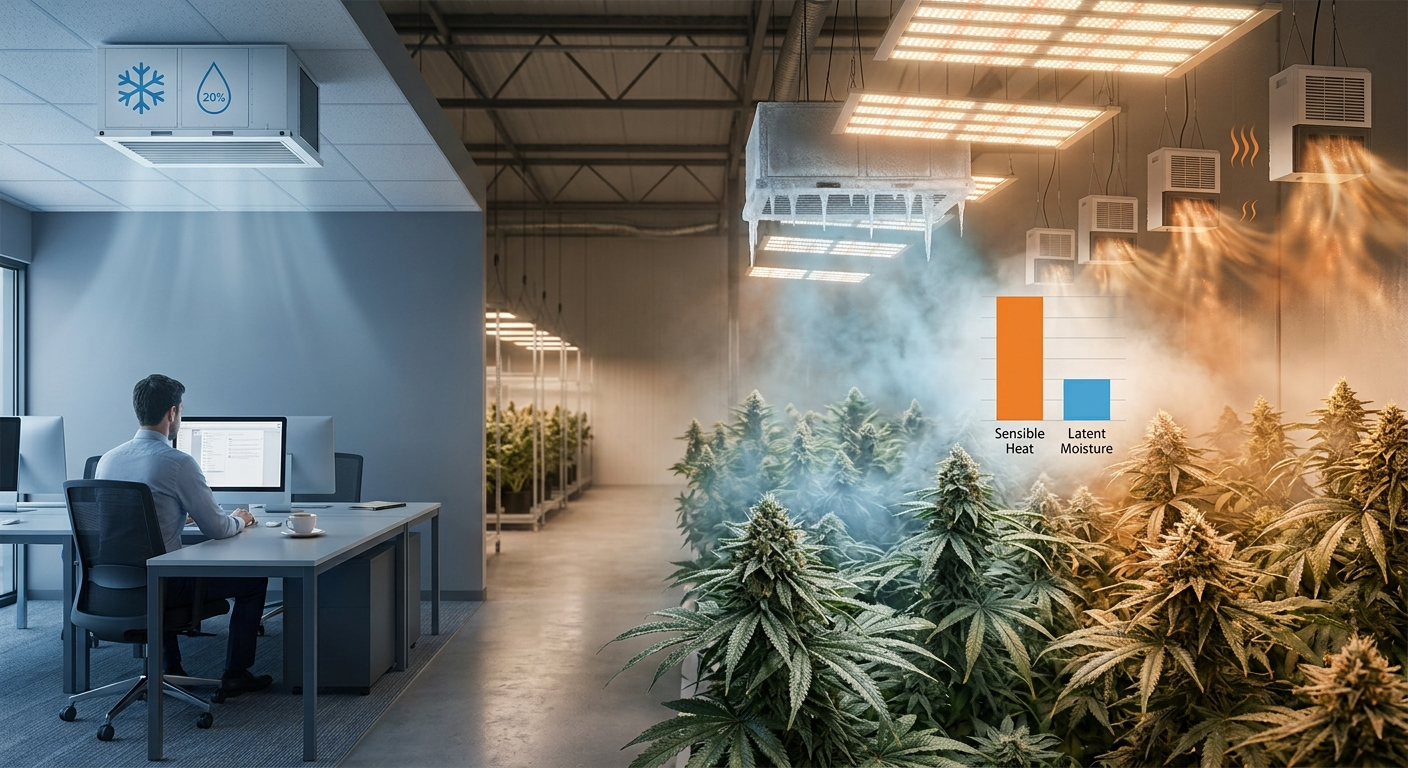
Why a system engineered for people can't hold the environment a canopy creates.
Read 9 min · For Cultivators, facility owners, and design teams
Cultivation HVAC and comfort HVAC solve two different problems. Comfort equipment is built to pull temperature down in a space where moisture is a rounding error. Cultivation HVAC, written more precisely as HVACD, is built to pull water out first and hold temperature second, against a load that flips twice a day and never stops running.
Off-the-shelf equipment fails a grow because it is aimed at the wrong load. That is a design mismatch, not an installation problem, and no amount of setpoint tuning fixes it. At Harvest Integrated we have spent over a decade building and running climate systems for cannabis cultivation, and the same conversation comes up on almost every project: the room isn't unstable because the tonnage is short. It is unstable because the equipment finished the job it was engineered to do and then stopped.
Sensible heat ratio is the fastest way to see the mismatch. SHR is the share of a space's total cooling load that goes toward lowering temperature rather than removing moisture.
Conventional packaged and split DX equipment, along with most chilled water systems, performs at its best when it is operating at or above an 80% SHR. In other words, roughly four fifths of the work is temperature and one fifth is water. That is the world office equipment was drawn for.
Grow rooms do not live there. For many cultivation spaces the SHR falls below 0.50, meaning more than half the cooling load is moisture. To condense that much water the coil has to run colder, and colder coils push refrigerant-based comfort systems past the range they were designed and rated for.
Performs most effectively at or above an 80% sensible heat ratio
Above 0.75 SHR, which almost any air conditioning unit can meet
Can fall below 0.50 SHR, beyond the capability of comfort equipment
Sensible, temperature Latent, moisture
Bars illustrate the published design thresholds for each condition, not metered results from one specific room. The third bar represents the "below 0.50" range cited in cultivation engineering literature.
A rooftop unit, a split system, or a VRF cassette is engineered around one occupant profile: people, sitting still, in a dry building, part of the day.
Under that brief, moisture removal is a side effect. The coil gets cold enough to condense some water on the way to hitting a temperature setpoint, and that is generally enough, because a person gives off a trivial amount of water compared with a canopy. High efficiency ratings on this equipment come partly from avoiding dew point, since cooling air without condensing moisture takes far less energy than cooling it with condensation.
The controls follow the same logic. A comfort thermostat reads dry bulb temperature. It has no view of vapor pressure, and it has no reason to keep the compressor running once the room hits the number. The equipment is also built around duty cycles that include downtime. Nights, weekends, shoulder seasons.
None of that is a flaw. It is a system doing exactly what it was specified to do, in a building that matches the assumption.
A flower room breaks every assumption in the comfort brief, one at a time.
Moisture is the primary load. Cannabis plants transpire nearly all of the water they take up. That water has to leave the room for transpiration to continue, which is what makes moisture removal the anchor of the design rather than a byproduct. A room running at production density typically calls for 150 to 200 pounds per hour of moisture removal per 1,000 square feet.
The control target is not temperature. What the crop responds to is vapor pressure deficit, the relationship between temperature and humidity that governs how fast plants transpire. When humidity drifts, water uptake and nutrient movement drift with it. Holding VPD is the reason the discipline gets written as HVACD, with dehumidification treated as a primary function.
The load swings on a schedule, hard. When the lights come on, most of the sensible load lands in the space almost instantly. Roughly twelve hours later the lights go off and the facility drops from a large sensible load to nearly none, while the plants keep releasing moisture.
Nothing gets a day off. Veg, flower, and dry rooms run around the clock, every day of the year, in air that stays wet.
A comfort system doesn't fail at lights off because it ran out of capacity. It fails because it already finished the job it was designed to do.
The mechanism is simple and it repeats every single night of every single cycle.
With the lights on and a low canopy, a standard air conditioner can hold its own. Sensible demand is high, the SHR sits above 0.75, and the room looks stable on a controller screen. The trouble starts in lights-off mode, when the standard air conditioner satisfies the very low sensible demand and shuts off before the latent moisture has been removed.
Now the room has a compressor that is off and a canopy that is still transpiring. Relative humidity climbs, VPD slides out of range, and the plants sit outside their target band for hours. Repeat that across a flowering cycle and the outcome shows up as uneven canopy, mold and mildew pressure, and inconsistent quality between batches.
This is why a grower with a comfort system can look at a perfectly reasonable temperature log and still lose the room. The thermostat was satisfied. The crop was not.
Every facility that goes with comfort cooling ends up bolting standalone dehumidifiers into the grow space, and that is where the two systems start working against each other.
Standalone dehumidifiers convert moisture into heat and reject it straight back into the room as hot dry air. Air leaving a portable unit runs about 25°F warmer than the air going in. That heat calls the air conditioner back on. The air conditioner removes it, often overshoots the setpoint, and the resulting overcooling drives relative humidity back up, which restarts the dehumidifier. Two pieces of equipment, one room, opposite instructions.
More energy consumed by a VRF plus standalone dehumidifier setup than by an integrated HVACD system in a head-to-head cultivation study
Swings in temperature and relative humidity, occurring multiple times per hour, recorded on the non-integrated system
How much warmer the discharge air from a portable dehumidifier is than the air it pulls in
There is a control problem underneath the energy problem. Standalone dehumidifiers were built for applications where the level of environmental control matters far less, so they often can't tie into a building management system or coordinate with the cooling equipment in any meaningful way. Each one becomes an island making its own local weather.
The install economics rarely get counted either. Units typically hang from the ceiling, which means two people and a lift. Each one wants a dedicated 30 amp 240V connection plus a trap and drain line for condensate. And because every dehumidifier adds sensible heat, the cooling equipment often has to be upsized to carry it. The same comparison study that measured the energy penalty also found the integrated system carried the lowest total cost, which cuts against the common assumption that purpose-built equipment is the expensive option.
The utility invoice is the easiest number to see and usually not the expensive one.
When VPD moves, stomata open and close to regulate transpiration. Constant swings signal trouble to the plant, and the plant can slow or shut down transpiration in response, which pulls directly on yield. Steady conditions produce predictable transpiration rates and more consistent expression from the same genetics.
Then there are the microclimates. Every standalone dehumidifier is exhausting warm dry air into its own corner of the room while the cooling diffusers are dropping cool humid air into theirs. Plants near a dehumidifier see one environment and plants near a diffuser see another. Room-level consistency becomes very hard to reach, and the uneven zones are where problems start.
Equipment life is the third bill. Frequent on and off operation is hard on compressors, and comfort equipment forced into continuous, high-moisture duty tends to fail early and live short compared with its rated life. A system chosen on lowest initial cost often gets replaced on someone else's schedule.
Worth naming
Reheat is not the villain in this story. A grow room genuinely needs reheat, because air cold enough to condense the moisture out is too cold to put back over a canopy. The question is never whether you need reheat. It is where the heat comes from. Recovering it from the dehumidification process costs nothing extra. Making new heat with electric resistance or gas means paying twice, once to cool the air and again to warm it back up.
An integrated system handles temperature and moisture as one coordinated process instead of two devices reacting to each other.
Harvest Air, the packaged unit Harvest Integrated builds for cannabis cultivation, is a single unit designed with both cooling and dehumidification for this specific environment. Variable speed compressors and a fully modulating hot gas reheat coil let the unit match the cooling and dehumidification load at every stage of the grow cycle rather than toggling between on and off. That modulation is the difference between holding a band and chasing one.
The units carry multiple compressors and EC fans, which puts redundancy at the component level and removes the need to buy a second unit as backup for a room that can't afford downtime. They arrive fully packaged and factory tested, which takes field piping and charging risk off the jobsite. Building pressurization and CO2 purge are built into the unit rather than added as separate systems, and filtration options run from MERV 8 through MERV 13 and HEPA for facilities managing pest and pathogen pressure.
The Harvest Wheel handles efficiency from a different angle. It is a rotary heat exchanger used for indirect air-to-air economization, rated at 85% efficient, and its job is to cool and dehumidify without running compressors. The most efficient compressor is the one that stays off.
You can separate a cultivation system from a repackaged comfort system with six questions, and none of them require an engineering degree.
Ask for a heat load calculation that accounts for latent load and the low sensible heat ratio of a grow room, not a tonnage rule of thumb borrowed from commercial cooling.
Daytime numbers do not describe the night. If the sizing exercise only shows one load condition, the hardest hours of the cycle were never engineered for.
Recovered from the process, or purchased again through electric resistance or gas. This single answer moves operating cost more than almost anything else on the spec sheet.
Find out whether redundancy lives inside the unit or requires a second unit sitting idle, and how fast the room drifts while a part is being replaced.
Trending and logging are how you troubleshoot a bad batch. Equipment that can't report data leaves you guessing about what the room was doing at 3 a.m.
Separate equipment, controls, and service vendors means finger pointing when the room drifts. One party accountable for the environment changes how problems get solved.
Cultivation HVAC, usually written as HVACD, is climate equipment engineered around moisture removal, continuous operation, and vapor pressure deficit control for plants. Comfort HVAC is engineered around temperature control for people in a mostly dry building. The gap is not quality or brand. It is the load the equipment was drawn to serve.
You can, and many facilities do, but the two devices work against each other. Dehumidifiers reject warm dry air into the room, the cooling equipment turns on to remove that heat, overcooling raises humidity again, and the loop repeats. A comparison study of cultivation systems measured 15% higher energy use for that arrangement versus an integrated unit, along with temperature and humidity swings of roughly 10% several times an hour.
Sensible load collapses almost instantly when the lights shut down, but the canopy keeps transpiring. A standard air conditioner sees the low temperature demand, satisfies it, and shuts off before the moisture has been pulled out. Nothing is left running to remove water, so relative humidity climbs and VPD drifts until the lights come back on.
It is a much bigger number than most people expect. A room operating at production density typically calls for 150 to 200 pounds per hour of moisture removal per 1,000 square feet. Plants transpire close to all the water they take up, so irrigation volume and moisture load track each other closely.
The sticker often looks higher, and total cost frequently is not. A head-to-head cultivation study found the integrated HVACD system carried the lowest total cost of the options compared. Comfort systems tend to get under-specified, then need added dehumidifiers, extra electrical work, upsized cooling to carry the dehumidifier heat, and earlier replacement.
VRF is a high efficiency comfort cooling product, engineered for offices and hotels where the design load is sensible. It earns its efficiency rating partly by avoiding dew point, which is the opposite of what a grow room needs. Pushed into moisture removal it runs outside its efficient range and still needs supplemental dehumidification to hold the space.
It reuses heat already produced during dehumidification to warm the air back up before it returns to the room, and modulating means it can dial that heat up or down instead of switching between full on and full off. In the Harvest Air unit it works alongside variable speed compressors so capacity tracks the load at each stage of the cycle rather than overshooting it.
Possibly, because a temperature log is not a VPD log. If the crop shows uneven canopy, mildew pressure in specific corners of the room, or quality that varies batch to batch while the thermostat looks clean, the likely culprit is humidity behavior between setpoint checks. Trending both temperature and relative humidity through a full lights-on and lights-off cycle is the fastest way to confirm it.
Start with a load calculation on the rooms as they exist today, including canopy, lighting, irrigation, and both lights-on and lights-off conditions. That analysis tells you whether the path is replacement, supplementing the existing system, or phasing rooms over successive harvests. Harvest Integrated works with ownership and design teams on exactly this question, including facilities already in production.
Knowing which system a grow room needs and being able to buy it are two different problems, and the second one is why a lot of facilities settle for comfort equipment.
Purpose-built cultivation HVACD carries a real upfront number, and capital that goes into mechanical equipment is capital that does not go into canopy, genetics, or a new room. Climate as a Service is how Harvest Integrated takes that trade off the table. Instead of buying the equipment and inheriting a decade of repair risk, you pay one monthly amount covering purpose-built systems, 24/7 monitoring, parts, maintenance, and guaranteed setpoints.
That structure also changes who is responsible when a room drifts. We specify the equipment, we maintain it, and we control it, using our own controls and algorithms so cultivators can run environmental itineraries for crop steering or curing rather than adjusting equipment. The team behind that carries over 100 combined years of experience in environments where downtime is not survivable, and Harvest Integrated has been building for cannabis cultivation for more than ten years.
Tell us your room count, canopy, lighting, and target conditions. We will model the real sensible and latent loads across lights-on and lights-off for every stage of the cycle, show you where a comfort system would give up, and lay out what holding the environment costs as one predictable monthly payment.
Or call 800.607.4758