Twenty Years of Data Creates Better Facilities
One of the greatest advantages current emergin markets like Virginia have is something no other emerging cannabis market has had before it... Experience.
Over the past two decades, cultivators across North America have collectively built millions of square feet of cultivation space. Some facilities have been remarkably successful. Others have required significant modifications after only a few harvests. Together, they have generated an enormous amount of operational data that can now inform the next generation of facility design.
Today's owners don't have to guess.
They can benefit from thousands of harvests, years of environmental monitoring, advances in plant science, and a much deeper understanding of how buildings actually perform under real cultivation conditions.
That experience allows new facilities to make better decisions before construction even begins.
Designing Around Physics, Not Assumptions
One of the biggest lessons the industry has learned is that cannabis facilities should be designed around physics, not assumptions.
For years, many cultivation facilities were sized using conservative engineering assumptions or grower requests that didn't accurately reflect how rooms actually operated. Oversized systems increased first cost, occupied valuable floor space, complicated maintenance, and often operated inefficiently for years.
Today, we know much more.
We understand realistic transpiration rates.
We understand irrigation volumes.
We understand how different substrates influence latent load.
We understand how environmental setpoints change throughout the crop cycle.
We understand the impact of airflow, lighting intensity, and crop density on HVAC performance needs.
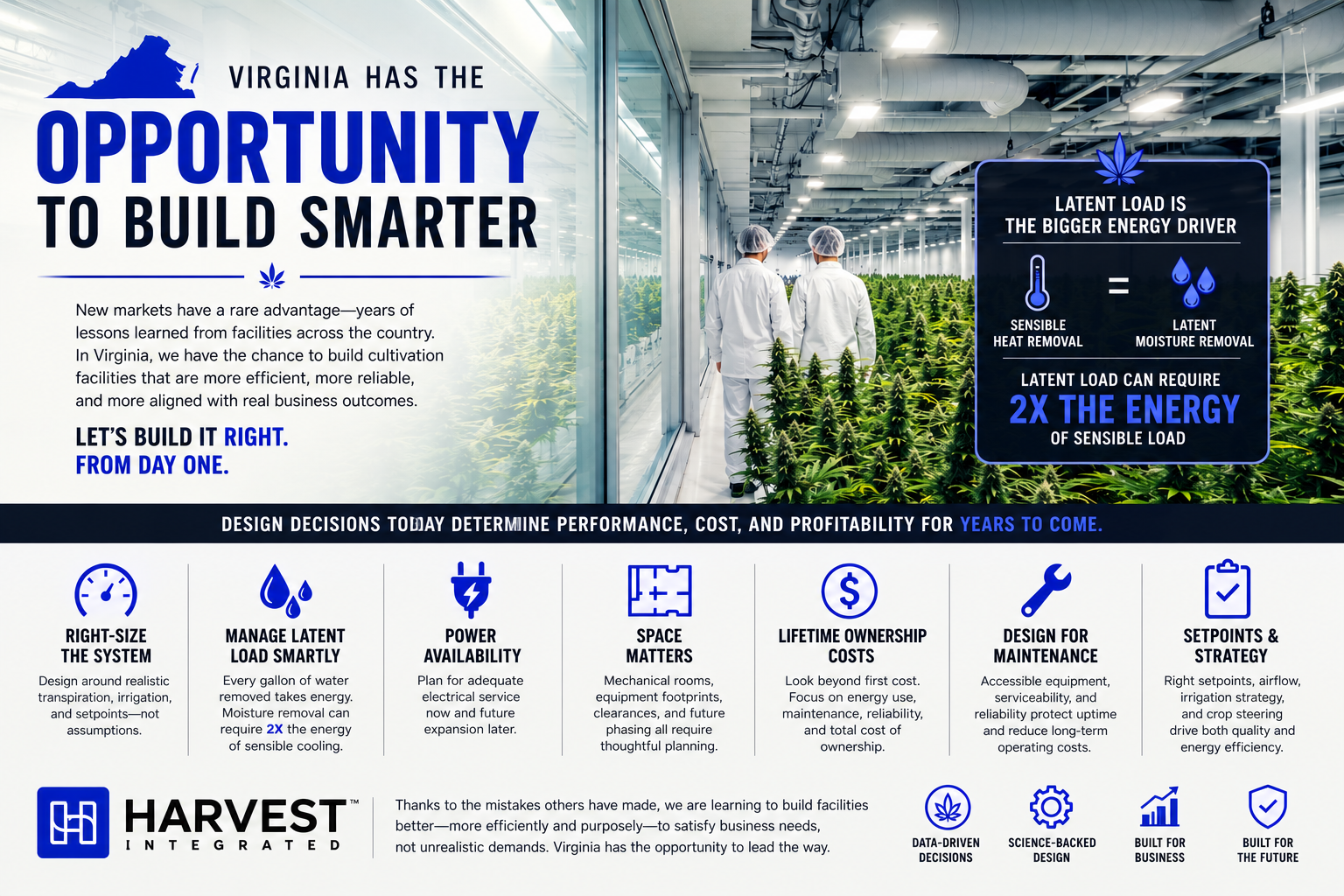
Perhaps most importantly, we understand the difference between sensible and latent loads.
Removing sensible heat is relatively inexpensive.
Removing moisture is not.
Latent cooling can require roughly twice the energy of sensible cooling, making moisture management one of the largest drivers of operating cost in indoor cultivation. Every unnecessary gallon of water that must be removed from a room represents additional electrical consumption over the life of the facility.
Understanding that relationship allows designers to optimize irrigation strategies, environmental control, and HVAC sizing together instead of treating them as independent systems.
Every Design Decision Has Long-Term Consequences
The decisions made during design affect a facility for decades.
How large should flower rooms be?
How many independent environmental zones are appropriate?
How much electrical service should be installed?
Is there sufficient utility capacity available for future expansion?
How much mechanical room space should be reserved?
Should redundancy be built into critical rooms?
How will future cultivation strategies change environmental demand?
These questions are no longer theoretical.
They can now be answered using operational data collected from facilities that have already solved these challenges.
The goal is not simply building a facility that works.
The goal is building one that performs efficiently for the next twenty years.
Optimizing Capital Allocation
The most successful projects are not necessarily those that spend the most money.
They are the ones that invest capital where it creates measurable value.
Sometimes that means installing an integrated HVACD system from day one.
Sometimes it means designing rooms differently.
Sometimes it means improving airflow.
Sometimes it means selecting more realistic environmental setpoints that maintain crop quality while dramatically reducing operating costs.
Sometimes it means reducing unnecessary latent loads through irrigation strategy instead of adding mechanical capacity.
Every dollar invested should improve crop quality, reduce risk, lower operating costs, or increase profitability.
That's the advantage of learning from an industry that has already invested billions of dollars discovering what works—and what doesn't.
Building Facilities That Support the Business
At Harvest Integrated, we believe environmental systems should support the business—not the other way around.
Mechanical systems should enable consistent production, maximize crop quality, reduce maintenance, minimize energy consumption, and provide flexibility as cultivation practices evolve.
Success isn't measured by the size of the HVAC system.
It's measured by pounds harvested, grams per square foot, product quality, uptime, operating cost, labor efficiency, and return on invested capital.
Virginia and other evolving markets have the opportunity to build facilities around those outcomes from the very beginning.
That is what makes this market so exciting.