Cannabis Terroir: Mother Nature Indoors
Wine people have a word for what makes the same grape taste radically different when it’s grown on the next hillside: terroir. Climate, soil, sunlight, elevation, slope, wind, and the rhythm of the seasons all leave fingerprints on the fruit. A vineyard doesn’t just produce grapes. It produces a signature.
Cannabis does the same thing...arguably more intensely, because cannabis is a fast, responsive, chemically expressive plant. The difference is that indoor cultivation doesn’t inherit terroir. Indoor cultivation must manufacture it.
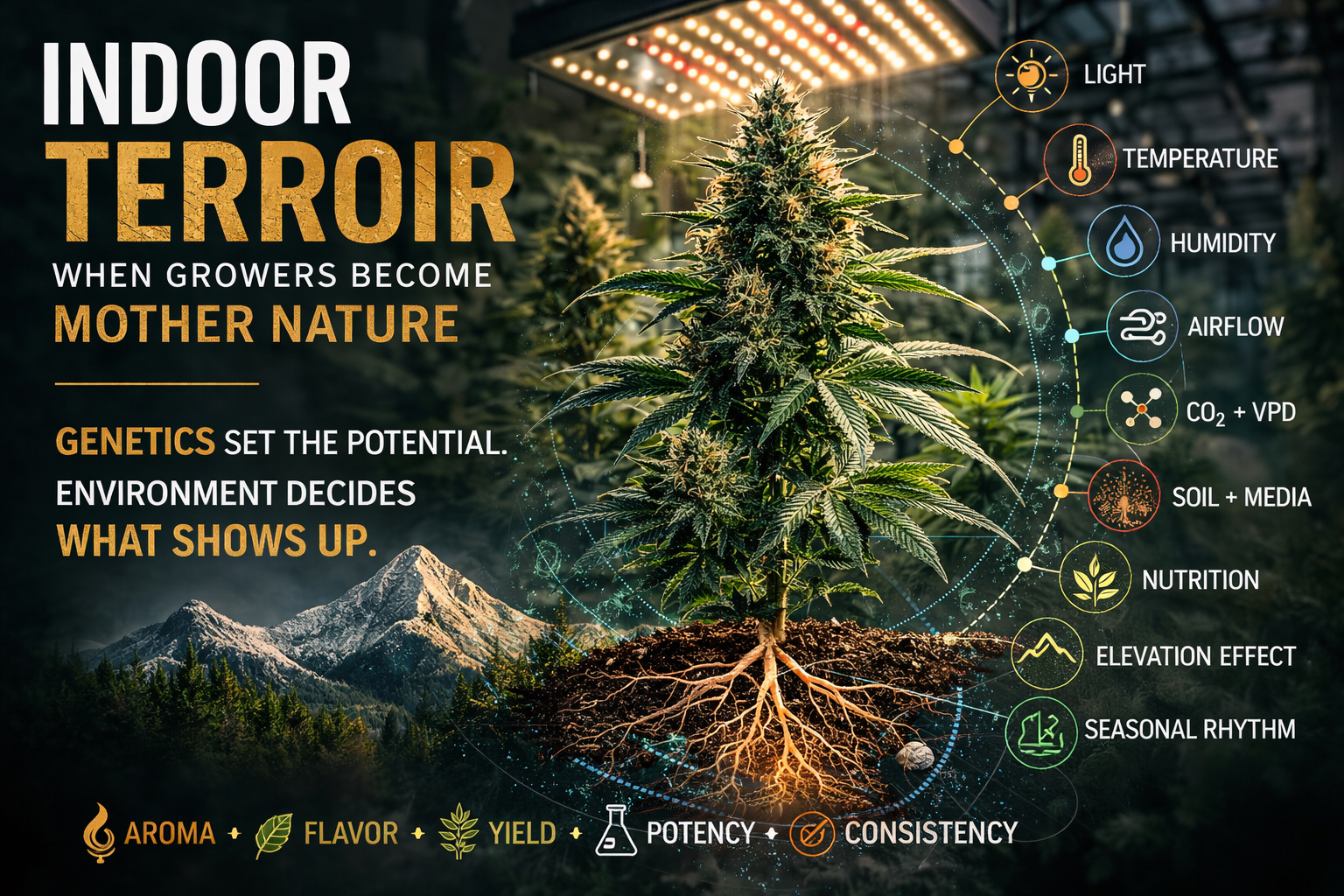
That is indoor terroir: the engineered environmental signature that shapes how a cultivar expresses itself: morphology, yield, aroma, cannabinoid profile, terpene ratios, and ultimately customer experience.
A mountain lesson: same genetics, different plant

Years ago on my farm in the mountains, we planted the same genetics on the same south-facing slope. Same general climate, same sun path, same grower, same intentions.
But the plants weren’t the same.
The ones grown about 600 feet higher in elevation behaved differently. Shorter, squatter, tighter internode spacing, a different posture and pace. The “what” (genetics) didn’t change. The “where” (environment) did. And the plant responded.
That’s the simplest working definition of phenotypic expression: what you can observe in the real world when genetics interact with environment. People like to say it’s “50% genetics and 50% environment.” It’s a useful reminder: genetics set the potential; environment decides what shows up.
Indoor growers aren’t just cultivating plants. They’re steering expression.

Why indoor terroir matters
Indoor commercial cannabis is often judged on two simple things:
- Quality (aroma, flavor, effect, burn, bag appeal) often translated as COA + sell through.
- Consistency (repeatable from batch to batch, predictable consumer experience) often translated as repeat purchase/brand loyalty
Terroir is the hidden engine behind both.
The “brand” in cannabis isn’t just packaging and marketing. In mature markets, the brand is the customer’s expectation that this cultivar from this operator will hit the same way every time. That expectation lives or dies on environmental control.
Outdoor growers react to nature. Indoor growers must produce nature—and do it in a way that’s stable, measurable, and repeatable across years, even with utility swings, operational variability, variable genetics, staff turnover, market compression and aging mechanical equiptment.
Phenotypic plasticity: the plant is always adjusting
Cannabis can’t run away from stress. It adapts. That capability is called phenotypic plasticity: the plant’s ability to change its growth and chemistry in response to conditions.
Plasticity is why cannabis can survive. It’s also why indoor environments are so consequential. The plant is always “negotiating” with your room.
Some cultivars are stable. Others are dramatic. Some respond to mild changes with major shifts in internode spacing, leaf morphology, flowering tempo, or terpene expression. In an indoor facility, every cultivar becomes a diagnostic tool: it tells you what your environment is really doing.
That’s the uncomfortable truth and the opportunity:
Every facility has its own signature per cultivar.
If you don’t design it intentionally; you still get one, you just don’t get to choose it.

The controllable variables of indoor terroir
Indoor terroir is not mystical. It’s a stack of controllable physics, plant physiology, and operational discipline.
1) Temperature: room, leaf, and root zone (not the same thing)
Most facilities control “room temperature” and assume it equals plant temperature. It doesn’t.
- Room temperature is what the sensor sees.
- Leaf temperature is what the stomata experience.
- Root-zone temperature is what drives water uptake, nutrient transport, and metabolic pace.
The plant responds to leaf temperature more directly than room temperature. Leaf temperature is shaped by energy from lights, airflow across the canopy, transpiration rates, and the temperature of surrounding surfaces.
Root-zone temperature has its own impact: warm roots can accelerate uptake and growth; cold roots can stall the plant even if the room “looks perfect.”
Indoor terroir becomes intentional when you treat these as separate dials, not one number on a wall.
Practical takeaway: stable leaf temps and root temps reduce “silent stress” and tighten consistency across runs.

2) Humidity and VPD: the steering wheel, not just a comfort setting
Humidity alone is not the target. Vapor Pressure Deficit (VPD) is.
VPD is the “drying power” of air relative to the leaf. It influences stomatal behavior, transpiration, calcium transport, nutrient movement, and the plant’s willingness to photosynthesize.
A simple way to think about it:
- High VPD (air is “thirsty”) can drive aggressive transpiration, risk stress, and demands control.
- Low VPD (air is “lazy”) can slow transpiration, reduce uptake, and invite pathogen pressure if other conditions align.
VPD only makes sense when it’s anchored to leaf temperature, not just room temperature. That’s why growers who measure leaf temperature (or estimate it reliably) tend to run tighter, more repeatable outcomes.
Indoor terroir signature shows up here: how your facility transitions between lights-on and lights-off, how it handles watering spikes, how it recovers after defoliation, and whether it can hold setpoints without oscillation.

3) CO₂ concentration and air velocity: feeding photosynthesis like a system
CO₂ is a substrate for photosynthesis. But concentration alone isn’t the whole story.
Around every leaf is a thin layer of still air called the boundary layer. If air is stagnant, CO₂ delivery slows and transpiration dynamics change. If airflow is appropriate, the boundary layer thins and gas exchange improves.
This is where air velocity becomes a terroir factor:
- It influences CO₂ assimilation
- It influences leaf temperature (convective cooling)
- It influences transpiration and uniformity across canopy zones
CO₂ + airflow is an engineered photosynthetic environment. Done well, it tightens yield and quality. Done poorly, it creates “microclimates” that express as inconsistent buds across the same room—top vs. bottom, wall vs. center, front row vs. back row.
Practical takeaway: if you want consistent expression and yield, you need controlled airflow.

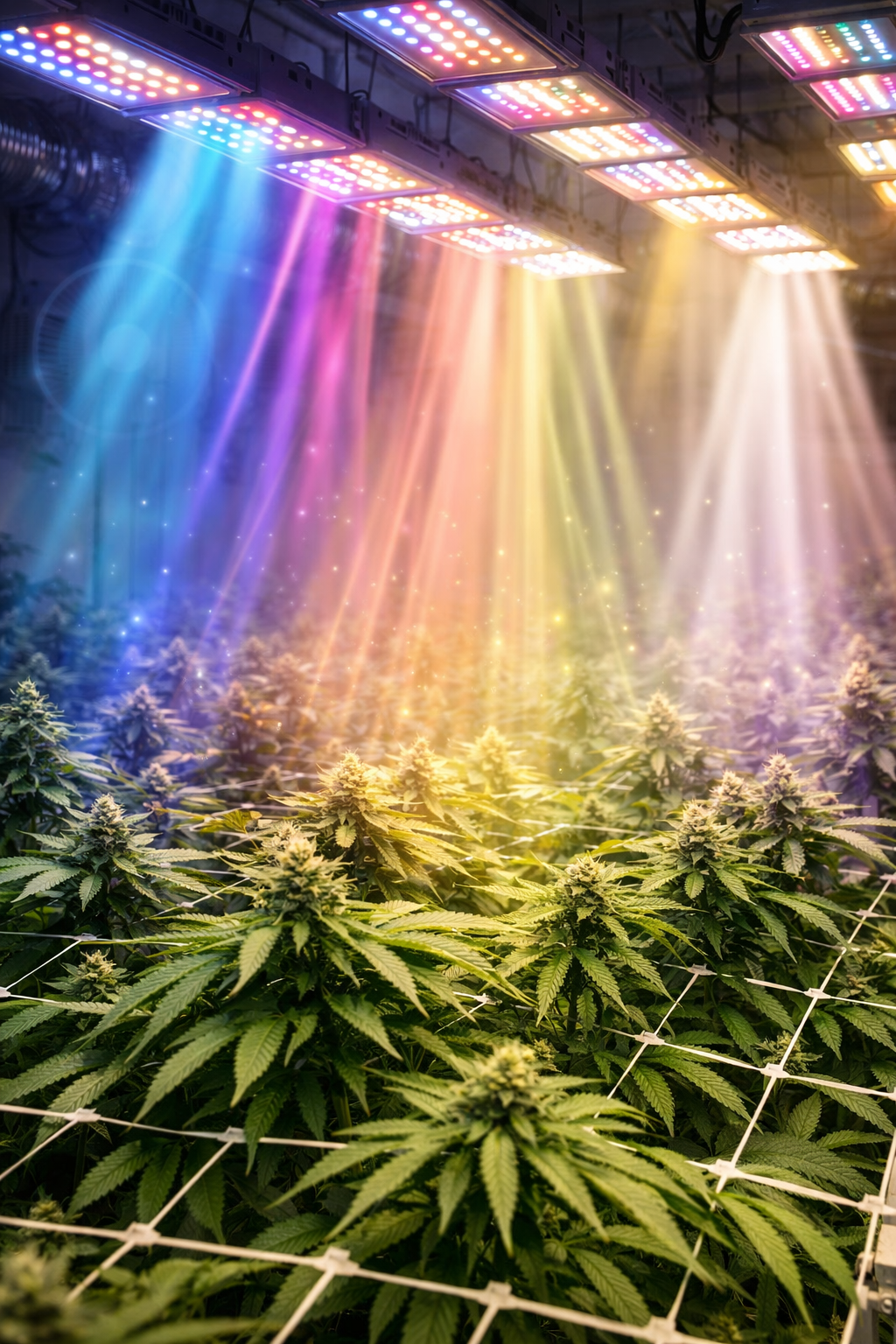
4) Light intensity, spectrum, and DLI: the primary fuel for secondary metabolites
If terroir is a signature, light is the pen.
Cannabinoids and terpenes are downstream products of a plant that has enough energy to build them and the right signaling to prioritize them. Light provides both:
- Intensity (PPFD) drives energy input and photosynthetic capacity
- Spectrum influences morphology, photomorphogenic responses, and chemical signaling
- DLI (Daily Light Integral) is the cumulative dose that often correlates better with outcomes than “PPFD at noon”
The same cultivar under different DLI and spectrum regimes can express as entirely different product. One facility produces loud, greasy, high-terp flower. Another produces the same cultivar as flat, airy, or harsh. Genetics didn’t fail, environment wrote a different outcome.
5) Water and nutrient strategy: quality, quantity, and timing
Water is not just hydration. It’s transport, signaling, and pressure control.
- Water quality (alkalinity, hardness, sodium/chloride load, contaminants) shapes nutrient availability and media behavior...and so does hw you move it around in your facility.
- Nutrient ratios and quality shape morphology and metabolic direction. "You are what you eat".
- Irrigation timing is a steering strategy: you can push vegetative vigor, tighten generative posture, or stabilize the plant through transitions.
Two facilities can run the same EC and still get different outcomes because one has stable root-zone oxygenation and the other doesn’t. Which leads to…
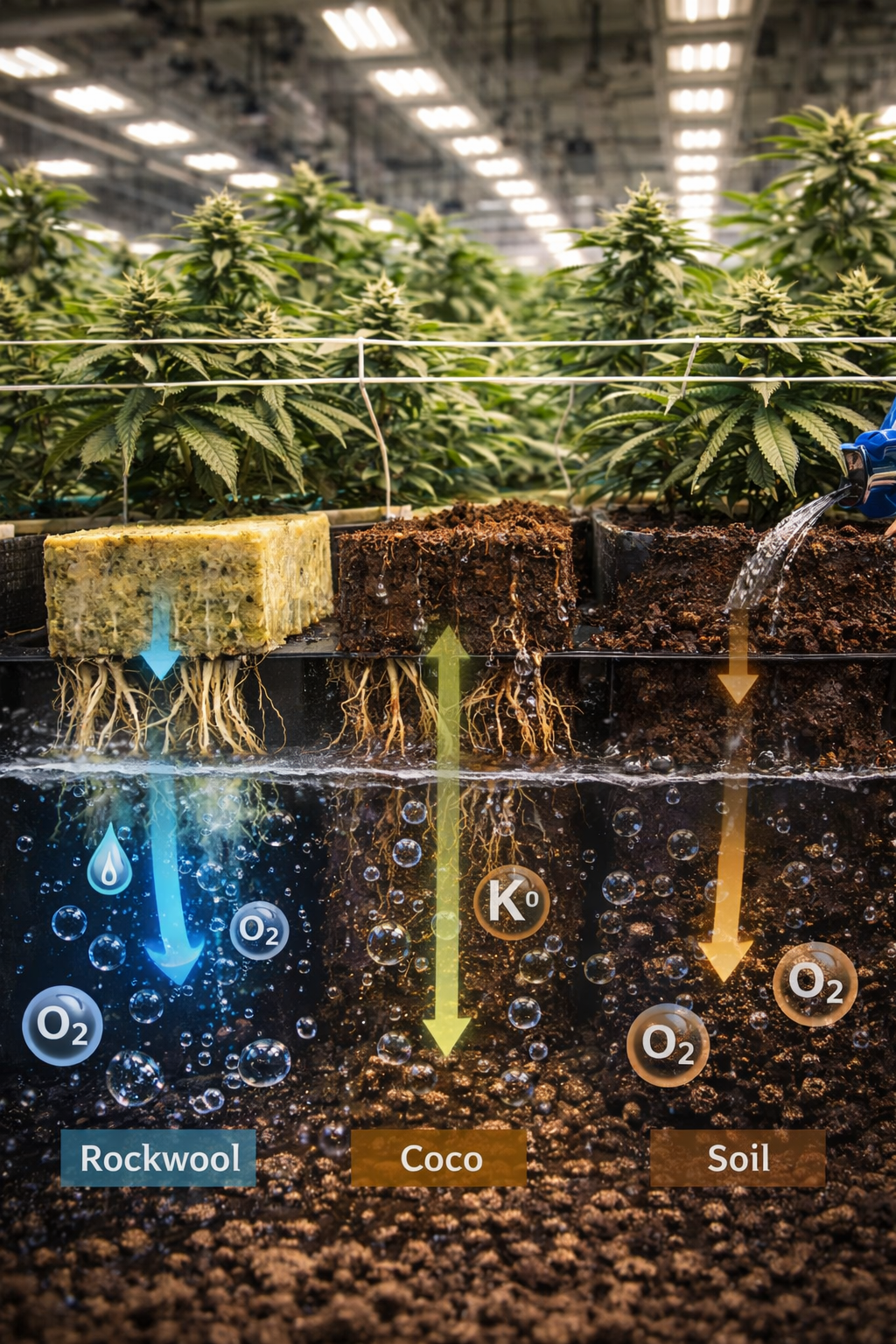
6) Media choice: rockwool vs coco vs soil isn’t preference, it’s physics and management
Media defines:
- Water-holding capacity and dry-back curve
- Oxygen availability to roots
- Buffering capacity and nutrient interactions
- Thermal behavior of the root zone
Rockwool can be extremely steerable but punishes inconsistent irrigation discipline. Coco has different buffering and cation exchange behavior. Living soil introduces biology as a major variable (and opportunity), but it changes the “control model.”
Your media choice is part of your terroir whether you admit it or not because it defines how the plant experiences water, oxygen, and nutrient delivery.
7) HVACD behavior: the hidden author of consistency
This is the part most growers only notice when it hurts.
“Climate” isn’t just temperature and humidity targets. It’s the ability to hold them without overshoot, oscillation, or lag during:
- Lights-on/off transitions
- Irrigation events
- IPM applicaions
- Defoliation and canopy changes
- Late flower maturation when loads shift
A room that hits setpoint but hunts all day produces a different plant than a room that is stable. That’s indoor terroir in action.
Even seemingly small things matter:
- How supply air enters the room (location, CFM, mixing, cyclng)
- Whether you create cold air “falls” onto the canopy or moves through it
- How you manage reheat and dehumidification simultaneously
- How quickly the system reacts to latent load spikes
And the same climate stability that drives phenotypic consistency is a byproduct of the people, the machines and the level of control you have.

8) IPM/IMM and microbial pressure: the biological side of indoor terroir
Every facility has a microbial and pest “fingerprint,” and it’s shaped as much by environmental physics as it is by cleanliness or product choice. Indoor terroir isn’t only what the plant becomes—it’s also what the ecosystem around the plant allows to thrive.
The uncomfortable reality is that many outbreaks aren’t caused by “bad luck.” They’re caused by repeatable anaerobic and stagnant zones that appear in the same places, run after run: corners with weak circulation, dense canopy pockets, under benches, behind dehus, under-return dead zones, and anywhere airflow loses the ability to mix and exchange. Those microclimates can become consistent breeding grounds for pests and for microbial risk.
This is why IPM/IMM is not separate from environmental control, it’s downstream of it.
Application strategy is environmental strategy. The most mature facilities aren’t the ones spraying the most; they’re the ones minimizing the number of applications while maximizing impact. And that often comes down to conditions at the time of application:
- Leaf temperature and stomatal behavior: impacts stress response and how the plant tolerates contact products.
- Droplet size and distribution: determines coverage, drift, and whether you’re actually contacting the target surfaces.
- Air velocity and canopy movement: can help penetration or cause immediate blow-off depending on intensity and direction.
- Humidity and drying time: impacts dwell time and efficacy. Too fast and you lose contact time; too slow and you may elevate microbial risk.
- Timing relative to lights: influences evaporation dynamics and leaf temperature swing, which can change both efficacy and phytotoxicity risk.
A strong IPM/IMM program treats the environment as the delivery system.
Then there’s the part many operators underweight: HVAC hygiene as a biological control layer. Coils, drain pans, condensate lines, and filters are not just maintenance items—they’re potential reservoirs. A facility that is “clean” in the grow rooms but ignores wet mechanical surfaces is leaving a biological backdoor open.
Key practices that become part of indoor terroir through consistency:
- Filter replacements and regular maitneence
- Routine inspection/cleaning of coils and drain pans to prevent biofilm buildup
- Condensate management that prevents standing water
- Cleaning equipment as needed, not just on a calendar
- Preventing cross-contamination between rooms with sanitary step-in, booties, Tyvek suits, and room-to-room protocols that assume contamination is transferable

The point: indoor terroir is a competitive advantage
Outdoor cannabis gets to talk about sun and soil. Indoor cannabis gets something different: the ability to build a repeatable signature on purpose.
The operators who win long term do three things well:
- Define the signature they want per cultivar (morphology, aroma intensity, effect profile, bag appeal, test targets).
- Engineer the environment to produce it (stable control across temperature, humidity/VPD, CO₂, airflow, and light).
- Operate with discipline so the facility expresses consistently (SOPs, calibration, maintenance, data review, and response plans).
Because the market doesn’t reward “pretty good.” It rewards predictable excellence.
Indoor terroir is how you stop hoping for a good year...and start manufacturing one.