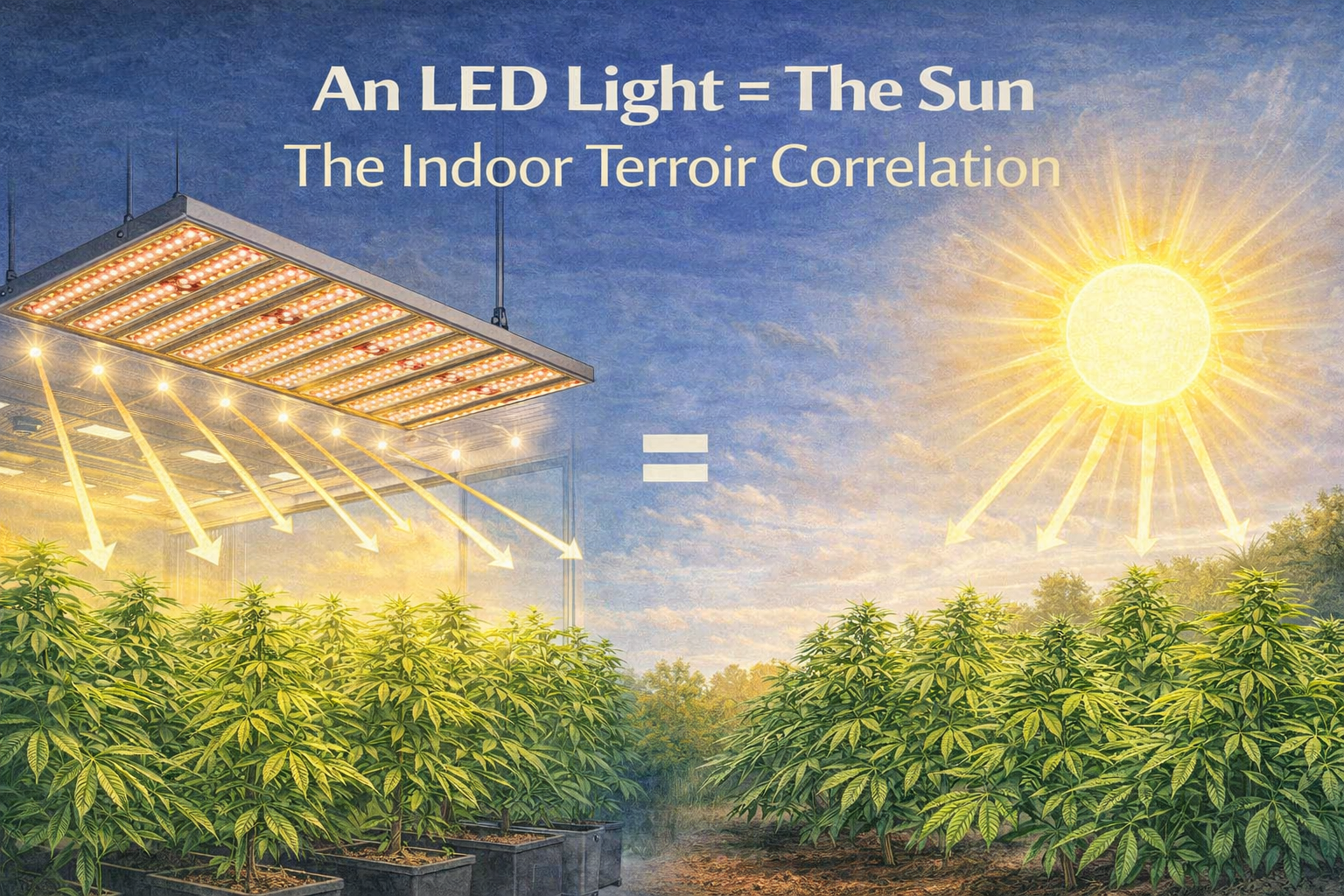
The visible trigger that drives every invisible response
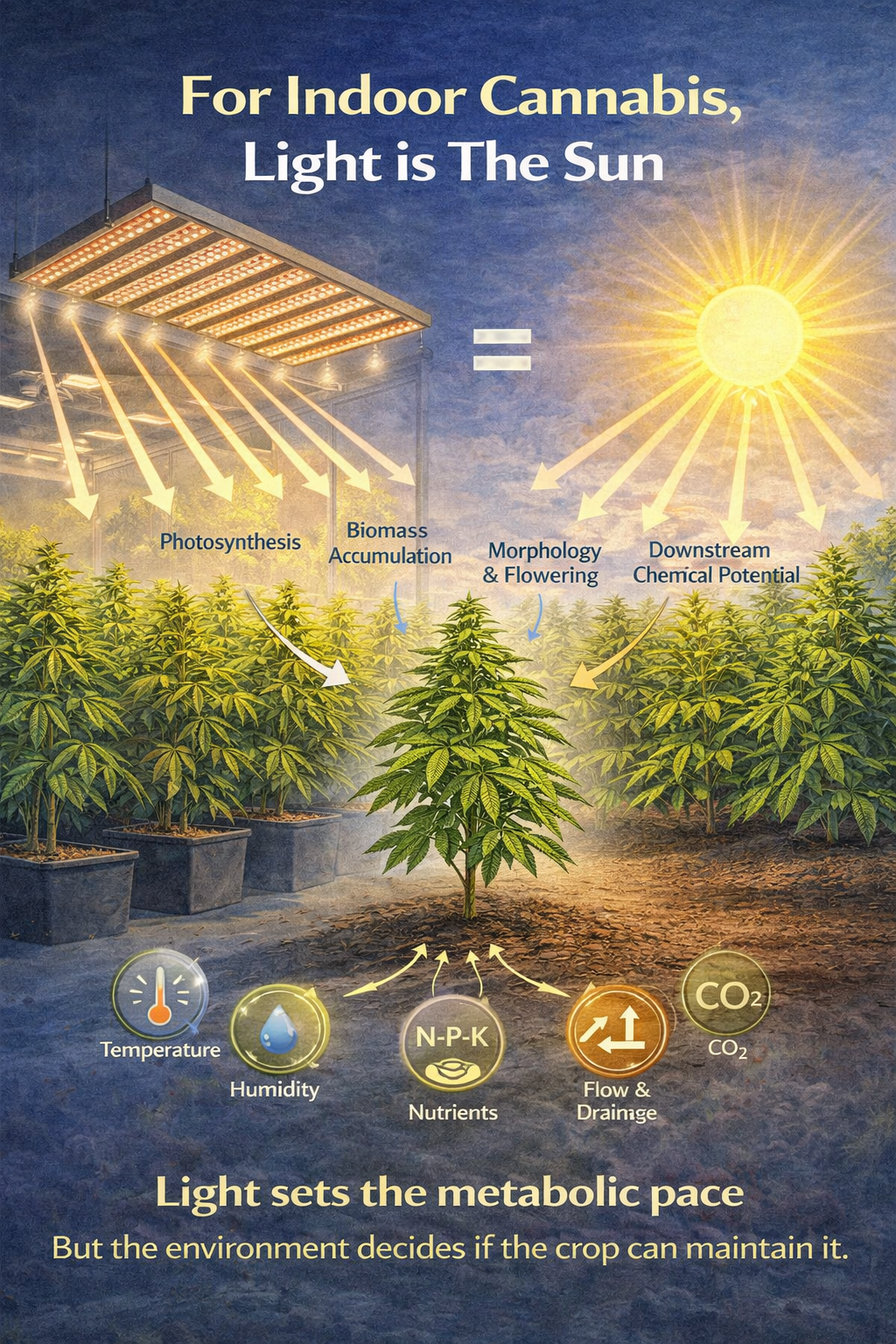
In indoor cannabis, light is the sun. That sounds obvious, but it is the right place to start because light is not just another input. It is the primary energy source driving photosynthesis, biomass accumulation, morphology, flowering signals, transpiration demand, and much of the downstream chemical potential of the crop. That makes light one of the most powerful terroir variables in a controlled environment. It is visible, measurable, expensive, and emotionally persuasive, which is exactly why it is so often oversimplified. More light usually means more yield, but only to the point that temperature, humidity, CO₂, airflow, root-zone function, and fertigation can keep up. Cannabis-specific studies now support that basic principle strongly. Indoor-grown cannabis has shown near-proportional yield increases with higher light intensity over large ranges and has shown that very high light can increase inflorescence yield and total specialized metabolite yield when the rest of the system is not limiting.
That is why light belongs in an indoor terroir series. Light does not act alone. It sets the metabolic pace, but the room decides whether the crop can maintain that pace. When people say “the lights are driving everything,” they are half right, photons are consumed at a rapid rate during photosynthesis and play a mojor role in phenotypic expression. Light is the dominant visible trigger, but its effect is only expressed through the invisible responses it creates: more photosynthetic demand, more CO₂ demand, more water movement, more latent load, more nutrient flow, and more need for environmental precision. If those other systems lag, then light becomes stress faster than it becomes value. Fluence’s cannabis lighting guidance makes that point clearly by emphasizing that PPFD, photoperiod, and DLI all matter, but the crop’s actual response depends on how the total environment supports that light dose. Other lighting providers and cannabis researchers echo this claim.
Bruce Bugbee was right: more light means more yield, until something else becomes limiting

The strongest modern cannabis lighting takeaway is the one Bruce Bugbee and others helped make mainstream: cannabis can use a lot more light than many growers historically gave it credit for. Various research papers show that cannabis yield, harvest index, and leaf photosynthesis increased with light intensity in an indoor environment, with yield continuing to climb across the tested range. Some have reported that indoor-grown cannabis yield increased proportionally with light intensity. Those papers are among the clearest scientific anchors for the industry intuition that high-performing cannabis can keep responding to more photons when the rest of the room is ready.
But the important qualifier is the one you want to drive home: to a point. Light is not a universal good. It is a forcing function. The more aggressively you light a room, the more aggressively the room must remove heat and water, deliver CO₂, maintain leaf temperature, and preserve root-zone function. Bugbee-style “more light = more yield” only holds while those other variables remain non-limiting. Once the crop cannot maintain gas exchange, water flow, or thermal balance, extra light stops being productive and starts becoming expensive stress. That is why the right lighting strategy is not just “buy the most photons.” It is “understand the limiting factors that dictate how many photons your room can handle.”
PPFD, PPF, and DLI are not the same thing

A lot of lighting confusion comes from mixing up the core metrics. PPF is the total number of photosynthetic photons the fixture emits each second, measured in µmol/s. PPFD is the photon density arriving at a surface, measured in µmol/m²/s. DLI is the accumulated light delivered over a full day, measured in mol/m²/day. DesignLights Consortium lays out these distinctions clearly, and they matter because fixture output, canopy intensity, and daily dose are related but not interchangeable. A high-PPF fixture is not automatically delivering good PPFD uniformity, and a great PPFD target on paper does not guarantee a suitable DLI if the photoperiod is wrong.
In indoor cannabis, PPFD is usually the most actionable number at the canopy during a given phase, but DLI is still extremely useful because it reflects the total photon dose the plant receives over the photoperiod. DLI is cumulative PPFD over 24 hours, and cannabis research has shown cannabis plants responding positively to very high DLIs. That makes cannabis unusual compared with many commercial crops and explains why growers are so interested in high-intensity LED systems. But again, the meaningful number is not just how much light the fixture can emit. It is how much useful light the room can support over time without collapsing environmental control.
Light is a yield lever, but also a water and CO₂ lever
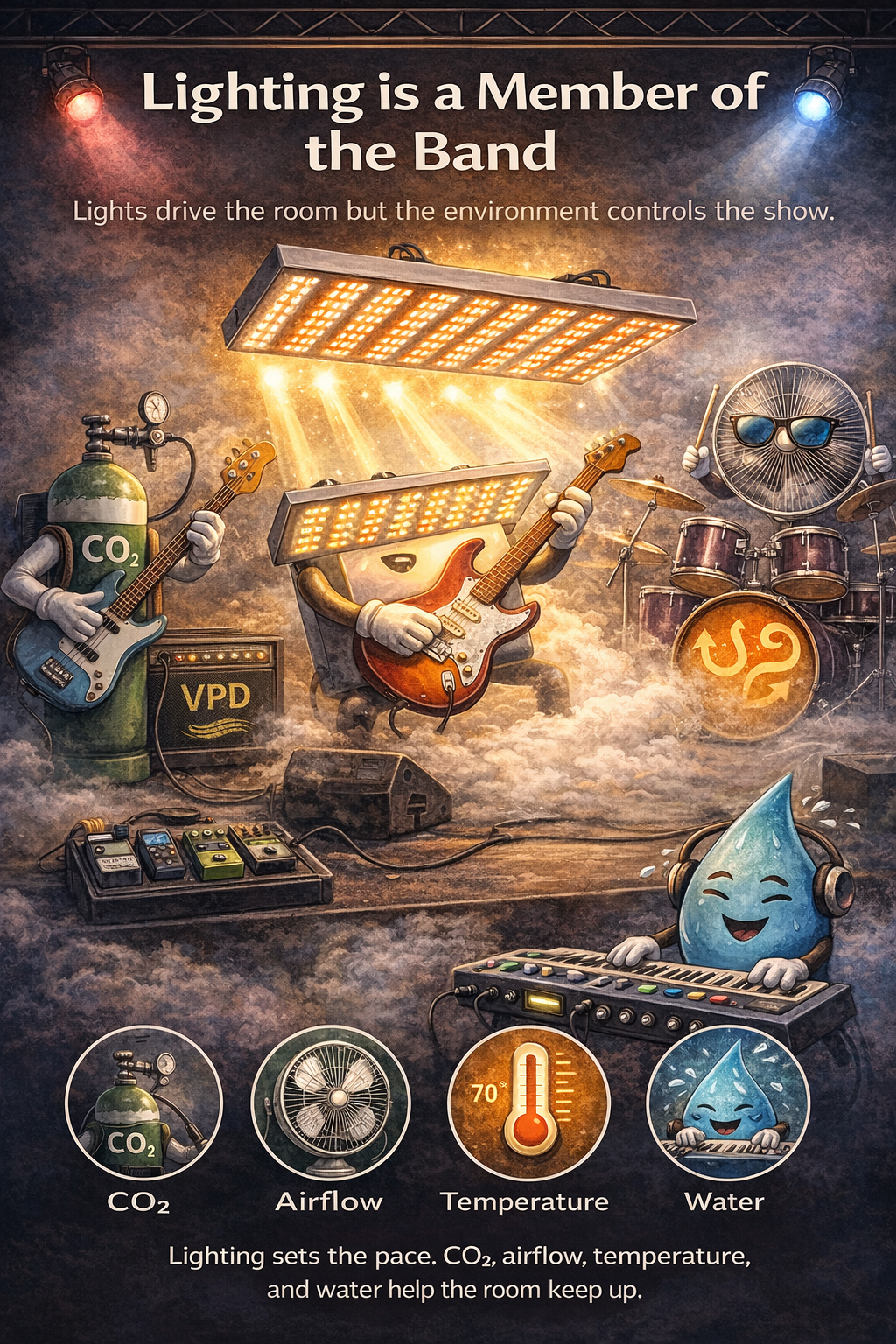
Every additional photon you ask the plant to use creates more metabolic demand. More light usually means more photosynthesis, but it also means more transpiration demand, more water movement, and more CO₂ demand. Supplemental lighting will increase water use along with plant production responses, which reinforces the systems argument: photons do not only create dry matter; they create hydraulic demand. That is one reason your point about photosynthetic conversion efficiency matters. It is not enough to throw photons at the crop. The real question is how efficiently those photons are converted into sellable flower, terpenes and cannabinoids, and that conversion efficiency is tied to CO₂ assimilation, leaf temperature, water movement, and overall plant health.
This is why lighting must be understood as an interconnected parameter, not a standalone commodity. If humidity and temperature drift, the smartest move may be to dim lights rather than force the room past what it can control. Dynamic-lighting research outside cannabis shows that intelligently modulated intensity can preserve biomass while responding to system constraints. We all know this; dim the lights when temperature control fails to reduce sensible loads; dim lights to reduce transpiration/moisture in the air to control humdity; that same logic applies operationally even if every facility’s exact dimming strategy is different: a dimmable room is a room with a pressure-relief valve. If you want to make a racing analogy...dimming the lights is like riding the brake. You might do it strategically to find the HVACD capacity to cool the room by 10F and trigger senescence like you might brake in the chicane of an F1 race. The key is that you are able to optimize the performance of you plant and your car when the straightaway appears.
Spectrum matters ... just not in the simplistic way the market often claims

Spectrum is where indoor cannabis lighting stops being simple sun replacement and starts becoming phenotype shaping. That is why it is one of the most interesting levers in the room. But it is also why it gets oversold. The old red-blue era trained growers to think about spectrum as if a few narrow peaks could explain everything that matters. The science does not support that reduction. What the modern work shows, and what serious commercial growers are increasingly seeing in practice, is more nuanced: spectrum is not usually the main driver of yield in the way total photon dose is, but it absolutely shapes morphology, developmental timing, canopy architecture, stomatal behavior, pigment expression, and in some cases the quantity and patterning of secondary metabolites.
Ben Matsuda at Grow Pros deserves real credit here for helping push that conversation forward in a more useful direction. In his 2025 paper, he frames spectral crop steering as a practical, wavelength-driven system for influencing morphology, metabolite production, developmental responses, and timing; not as a gimmick, and not as a fixed recipe. He organizes cannabis-relevant lighting into five working categories : UV-A, blue, full-spectrum white, deep red, and far red ; and argues that these categories should be treated as controllable steering tools tied to photobiology, engineering reality, and cultivar-specific production goals. That framework is valuable because it gives growers a more operational way to think about spectrum: not just as “what color is the light,” but as “what developmental signal am I trying to send, when, and why.”
That is the right frame for indoor terroir. Spectrum is not magic, but it is not neutral either. Broad-spectrum fixtures have generally proven to be more reliable than narrow red-blue concepts for building commercially useful crops, and the cannabis literature increasingly supports that broader view. Research has shown that light source affected plant morphology and cannabinoid production patterns. More recent work showed that white light with dual red peaks at 640 and 660 nm improved inflorescence weight and light-use efficiency compared with a narrower red-peaked spectrum, likely through better dry matter production and canopy-level light capture. In other words, spectrum is not just a color preference. It is part of the developmental language of the room.
That is also why Bruce Bugbee’s point has been so influential: the effect of color on photosynthesis is often overstated, while the effect of color on plant shape is often underestimated. That distinction matters. It pushes growers away from simplistic “best spectrum” arguments and toward a more mature question: what do you want the crop to become? Are you trying to suppress stretch, tighten internodes, improve branch architecture, influence anthocyanin expression, manage lower-canopy performance, or manipulate finish behavior? Do you wnt target 6hrvst a year? Those are not shopping questions. They are terroir questions.
Far-red is where this becomes especially obvious. Far-red is not just extra light. It is developmental leverage. A 2025 Scientific Reports paper on medicinal cannabis found strong cultivar-dependent responses to end-of-day far-red, including elevated THC concentration in one cultivar-treatment combination and a roughly 70% increase in total cannabinoid yield in another. Bold fndings and context needed for sure but, that is exactly the kind of result that makes spectrum feel less like horsepower and more like intent. But far-red is not a one-size-fits-all trick. A University of Tennessee thesis found decreasing dry-flower yield averages as far-red intensity increased in their tested setup...I'm sure we could find another experiment that shows the opposite. So the right conclusion is not that far-red always works. It is that far-red is powerful enough to demand precision. Timing, duration, baseline spectrum, cultivar, and total photon context all matter.
That is where the GrowPros, ThinkGrow and others offing spectrum based steering solutions line up with where the science is headed. Matsuda’s paper does not present spectrum as a set of universal commandments. It presents it as a programmable biology platform one where independent control of UV-A, blue, deep red, and far red can be used to steer structure, pigment, flowering transitions, and finishing behavior with more intent than traditional static fixtures allow. His proposed far-red scheduling logic, including short post-lights-off windows and early-day overlap strategies, reflects the fact that modern lighting is no longer just about delivering photons. It is about deciding which photons, when, and for what response.
That is why the strongest growers are becoming less interested in “what spectrum is best?” and more interested in “what spectrum is best for this cultivar, in this room, at this stage, under this climate, for this outcome?” Shorter flower times, stronger COAs, tighter morphology, more even canopy development, better multi-tier performance, improved coloration, and more deliberate finish behavior are all targets people are actively chasing. Some of those outcomes are already supported by published cannabis work. Others are being pushed forward first by disciplined commercial observation. Both matter. But they matter most when they are framed honestly. Spectrum should not be sold as magic. It should be used as a steering signal.
The cleanest conclusion is this: spectrum is a morphology and expression tool as much as it is an energy source. It is one of the clearest ways indoor lighting becomes true terroir. Total photon dose still does most of the heavy lifting for yield. But spectrum changes how that yield is built, how the canopy is shaped, how the crop transitions, and sometimes how quality is expressed. That is why programmable lighting has become so commercially important. The future is not just brighter fixtures. It is more intentional fixtures. Lighting has become programmable biology, not just a utility bill.
Novel spectrum applications are starting to move from theory into commercial practice
One of the more interesting recent examples is Fluence’s “Red Sandwich” approach, which pushes beyond the usual toplight conversation and treats spectrum, intensity, and distribution as one coordinated strategy. Fluence describes Red Sandwich as a system that balances high-red spectra through both toplighting and under-canopy lighting at the same time, with the goal of improving flower uniformity, reducing photobleaching, and using red photons more efficiently. That is an important evolution in the spectrum conversation because it reinforces the idea that spectrum is not just about what wavelengths are present. It is also about where those photons are delivered, how deeply they penetrate the canopy, and how evenly they are distributed across productive tissue. In other words, spectral strategy is becoming a layout strategy, not just a diode conversation.
On the more openly experimental side, ThinkGrow and Josh Barker at Miami Mango in Sacramento are part of the commercial wave giving growers real-world visibility into spectrum application instead of just trade-show theory. Public episodes and clips featuring Barker describe cultivar-specific spectrum tuning, inner-canopy lighting, and practical lessons around using dynamic lighting as a steering tool rather than a static fixture setting. That visibility matters. It gives the industry a closer look at how spectrum manipulation is actually being discussed inside production environments where morphology, finish behavior, and commercial outcomes all matter at the same time. The strongest way to frame this is not that every public result is already settled science. It is that commercial cultivation is now moving fast enough that spectrum is being tested as an intentional production lever in front of the industry, not just behind closed doors.
Fixture quality, design, and economics still matter

Even if lighting has become more commodity-like, fixtures are not all the same. Output matters. Efficacy matters. Spectrum matters. Diode quality matters. Build quality matters. Optical design matters. Thermal design matters. Warranty matters. Uniformity matters. DLC qualification matters. DesignLights Consortium notes that horticultural QPL listings require individual testing of permutations that can change performance, including spectral distributions. That matters because it reinforces a simple buyer truth: the spec sheet should be verifiable, not decorative.
Distance from canopy matters too. Secondary optics, mounting height, fixture spacing, beam angle, and room reflectivity all influence whether PPF becomes useful, uniform PPFD or just expensive hotspots. Libra Designs, BIOS and others who manufacture high quality lighting fixtures take this approach: lighting is not merely a fixture choice, it is a layout, distribution, and control strategy. Photons are like calories and are a commodity that your plants consume. The plant does not care how impressive the fixture looked in a booth. It cares what photon density and uniformity actually arrive at the canopy. Various thought leadership and commercial lighting articles emphasize distribution and uniformity repeatedly for exactly this reason.
Light should be selected with a purpose
In modern indoor cannabis, it is easy to find a good LED. The market is competitive, efficacy is higher than it used to be, and cannabis-specific options are abundant. The more important question is whether the grower knows what they want the light to do. Are they chasing maximum biomass under stable environmental control? Are they trying to manipulate morphology with spectrum? Are they trying to reduce stretch? Enhance color? Improve multi-tier uniformity? Support dimming and dynamic-response strategies? Lower wattage during weak latent windows? Those are terroir questions, not shopping questions.
In other words, know why you bought the light, how you will measure it, and how you will use it. A fixture is not a philosophy. It is a tool.
The limiting factor is rarely the light alone
Light feels like it should be the master variable because it is visible. Growers can stand in a room and feel its presence. But the strongest science and the best commercial experience both say the same thing: lighting only drives as hard as the room can support. High PPFD without good airflow leaves CO₂ stranded outside the boundary layer. High DLI without enough latent removal leaves the crop hydraulically bottlenecked. Strong spectra without temperature discipline create morphology you did not intend. More photons without root-zone capacity create stress rather than throughput.
That is why dimming matters, and why integrated controls matter. A room that can modulate light in response to HVACD performance, humidity excursions, or temperature constraints is not “giving up on yield.” It is protecting photosynthetic conversion efficiency under real-world conditions. The true win is to maximum wattage every minute but not at the cost of quality, which is why we often reduce our lighting inputs as a response to lack of environmental cotnrol. This response is learned because we all know it's better to have one pound of fwer you can sell versus 10 that are moldy. The limiting factor isn't the lighting its all the other stuff that cant keep up.
The business conclusion

Light is the most visible terroir parameter and one of the most expensive. That makes it easy to romanticize and easy to overspend on. But the science has gotten clearer. More light generally does produce more yield in cannabis often close to linearly over wide ranges, until another variable becomes limiting. Spectrum can shape morphology, developmental cues, and in some cases quality outcomes, but it should be applied intentionally rather than treated like magic. Fixture quality and layout matter because usable photons at the canopy matter more than branding. And the best lighting strategy is always the one the whole room can support.
In indoor terroir, the lights are the sun. Choose your star carefully. Because when the crop grows poorly, the problem may not be that the sun is too weak. It may be that the rest of the universe you built around it cannot keep up.