
Nutrients as a Driver of Indoor Cannabis Terroir

The chemistry of expression, and the discipline that makes chemistry matter
Nutrients are one of the most misunderstood variables in indoor cannabis because they are easy to see, easy to argue about, and easy to blame. Bottles, bags, feed charts, additives, booster schedules, and EC targets create the illusion that nutrition is mainly a product decision. It is not. Just get a few groers in a room and watch the passion unfurl about plant nutrition, but it's more than product loyalty or secret sauce. It is a systems decision. Plants do not care about brand mythology. They care about whether the elements they need are soluble, balanced, chemically available, delivered uniformly, and supported by an environment that lets them actually move through the plant. That is what makes nutrients a terroir factor indoors: not just what is in the tank, but how that chemistry interacts with water, media, light, temperature, airflow, humidity, root oxygen, and crop steering.
A good way to read the leading nutrient brands is not as religions, but as philosophies of repeatability. Athena frames its value around consistency, clean formulation, and simplified procedures for modern fertigation. Front Row Ag emphasizes EC-based mixing, dry-soluble efficiency, custom feed charts, water-quality awareness, and precision around concentration control. King Solomon positions itself around a streamlined two-part dry system with complete macro and micronutrition for both hydroponic and soil-based cultivation...and most of us consider the founder, Damian Solomon, to be somewhat of a coco whisperer with divine meda management skills. Different language, same deeper promise: fewer surprises in the stock tank, the injector, the drip line, and the root zone. That is the real battlefield in commercial nutrition.
Feeding is not static because the crop is not static

One of the cleanest scientific confirmations of what good growers already know came in a 2026 cannabis nutrient-uptake paper: vegetative nutrient uptake tracked whole-plant water use, nitrogen and potassium uptake peaked early, and calcium and magnesium uptake increased steadily over time. That matters because it reinforces a foundational truth: nutrition is dynamic. The plant’s appetite changes as the crop develops, and water movement is one of the strongest predictors of nutrient movement. A recipe that works early may become lazy, excessive, or incomplete later. Feed charts should behave more like stage-specific operating plans than fixed doctrine.
That also means “you are what you eat” is incomplete. In cannabis, you are what you eat and what you can transport. Nutrients do not just need to be present. They need to move from solution to root surface, through root membranes, into xylem or phloem pathways, and into tissues that are actively building plant structure and chemistry. Some nutrients move heavily with mass flow and transpiration. Some are more diffusion-limited. Some depend strongly on root energy status. A tank can be perfectly mixed and still be physiologically useless if the room is not pulling water through the plant correctly.
Light, temperature, and root energy decide how much nutrition the plant can really use

The nutrient conversation becomes more powerful the moment you stop treating it as separate from plant energy. That does not mean every cultivar wants the same numbers in every room. It does mean light intensity and temperature define the metabolic ceiling under which nutrition can be turned into biomass and expression. More light can justify more feed. More metabolic throughput can justify more aggressive delivery. But above the useful range, the plant loses efficiency and the room begins outrunning the crop.
This is why climate and nutrition are married whether the fertigation department admits it or not. Most cultivators know that low temperatures and high humidity slows transpiration and can reduce nutrient uptake and mobility. AROYA’s dryback guidance adds the root-zone side of the equation: letting substrate dry back supports oxygenation, root health, and nutrient uptake. Put those together and the systems truth becomes obvious. If the room is too soft, too wet, or too poorly dehumidified to keep water moving, nutrition on paper stops matching nutrition in practice. Feed is potential. Climate is permission.
pH decides whether the chemistry is available

pH is still one of the most important and most abused nutrient variables because it is often treated as a housekeeping number instead of a chemical gatekeeper. Most guidance recommends nutrient-solution pH in the 5 to 6 range for soilless culture, typically around 5.5, because that is where nutrients are most readily available and where the root environment tends to land in the productive zone. Outside that range, nutrients may still be physically present while becoming chemically less available or more toxic. When pH drifts outside the optimum range, plants may not be able to uptake all the nutrients in solution, or nutrient balance is disturbed.
That is the real meaning of lockout. Lockout usually is not “there is no food in the room.” It is “the chemistry, the water, the substrate, and the plant physiology are no longer aligned.” High pH tends to reduce the availability of several micronutrients. Low pH can push the system in the opposite direction, limiting some macros while increasing the availability of certain metals to the point of stress. pH also influences root health indirectly by shaping how smooth or antagonistic nutrient uptake becomes. A plant fighting chemistry at the root surface has fewer resources to devote to vigorous growth, stress response, and high-level expression.
Front Row Ag’s and Athena's public nutrient materials both reflect this practical reality. Front Row Ag emphasizes water quality, pH management, and highly available micronutrients across wide pH ranges, while Athena explicitly notes that pH and EC fluctuations are influenced by fertilizer chemistry, water quality, and solution temperature. That is important because it reminds cultivators that pH is never just about the nutrient line. It is about the nutrient line interacting with the actual water and environment in the facility.
EC is concentration, osmotic pressure, and steering pressure
EC is one of the most useful numbers in cannabis cultivation precisely because it is not a nutrient itself. It is a concentration signal. It tells you how many dissolved ions are in solution and, by extension, how hard the root system must work osmotically to pull in water. Lower EC generally makes uptake easier and tends to support softer, more vegetative behavior. Higher EC raises osmotic pressure and is often used as a more generative cue. AROYA states this directly: vegetative steering tends to be lower EC, higher water content, lower light intensity, and lower VPD, while generative steering tends toward higher EC, bigger drybacks, higher light intensity, and higher VPD. Athena’s crop-steering content mirrors that same operating logic by tying irrigation, dryback, and substrate EC to growth goals.
But a high EC does not automatically mean a high-performance feed. It may just mean a more stressed root zone. Front Row Ag’s own educational materials emphasize EC contribution and target-EC thinking because concentration only becomes useful when it is controlled intentionally. That is the right framework. EC should not be treated like a macho number. It should be treated like steering pressure. Too low and the crop may run too soft. Too high and salts accumulate, uptake slows, and the grower starts mistaking stress for discipline.
The more sophisticated way to think about EC is by stage, media, and climate together. Higher EC in a well-aerated, tightly controlled stone-wool room with disciplined runoff may behave very differently than the same nominal EC in coco with different buffering, water distribution, and oxygen recovery. That is one reason the cultivation media matters: substrate-specific traits such as aeration, water-holding capacity, and nutrient buffering significantly influence biomass production and resource-use efficiency. Nutrition does not live above the media. It lives through it.
HVACD has a vote in your nutrient program

This is the part too many feed conversations leave out. If the room cannot remove moisture, the plant cannot keep transpiring hard enough to support an aggressive nutritional strategy. Low VPD and high humidity slow transpiration. Slower transpiration reduces water uptake. Reduced water uptake changes nutrient movement. Calcium is the easiest example, but it is not the only one. In practical terms, an undersized or poorly managed HVACD system can make a perfectly reasonable nutrient program look broken simply by choking off the plant’s transport engine.
That same logic applies below the surface. Drybacks improve oxygenation and prevent root suffocation. When soils remain saturated too long, roots cannot function properly, root tissue declines, and root-rot organisms gain opportunity. That makes “wet feet” much more than an irrigation phrase. It is a climate phrase. If humidity stays too high at lights off, the room cannot pull moisture fast enough, dryback recovery slows, pore space stays water-filled longer, oxygen diffusion stays limited, and the plant starts paying for it in root energy, nutrient uptake, and disease pressure. That is not a nutrient-line failure. That is environmental throughput failure showing up as nutritional inefficiency.
Delivery matters as much as formulation
Not all nutrient failures begin in the root zone. Some begin in the mixing room. Fertigation only works if the chemistry stays soluble, compatible, and accurately delivered. Popular fertigation guidance warns that some fertilizer materials are incompatible in concentrated solutions and can react with minerals in irrigation water to form insoluble compounds and precipitates...Im looking at you Si. Not all fertilizers are compatible when mixed into stock solutions, the days of dumping random bottles into the reservoir are long gone. This is why commercial systems separate concentrates, watch stock-tank chemistry, and care about injector calibration more than hobby growers often realize.
This is also where product quality starts earning its keep. Front Row Ag emphasizes EC-based charts, chelation strategy, and stock-ready dry solubles. Athena leans into clean formulations and procedural consistency. King Solomon emphasizes a simplified two-part system with complete macro- and micronutrition and use across hydroponic and soil systems. An agnostic cultivator should read those claims the right way: not as proof that one line is magic, but as evidence that the serious players understand the same commercial problem. The question is never just “what ions are in this bag?” The question is “how reliably does this chemistry survive mixing, storage, injection, and delivery inside a real facility?”
How to actually read pH in, pH out, EC in, and EC out

Runoff is one of the best truth-tellers in the room because it reveals what the root zone is actually experiencing, not just what the feed chart intended. The pour-through method remains one of the cleanest practical protocols for soilless crops: fertigate thoroughly to container capacity, wait at least an hour so the solution in the pores comes into equilibrium with root uptake, place saucers under representative containers, apply a small amount of the same fertilizer solution to push pore water into the saucer, collect the leachate, and measure it with calibrated meters. Not pure water for that second push because it dilutes the sample and corrupts the reading but your baseline feed...can tell us a lot about what's going on.
For cultivators, the value is not in chasing one runoff number. It is in trend interpretation. If EC in is stable but EC out keeps climbing, you are stacking salts in the root zone. Sometimes that is deliberate. Sometimes it is telling you the crop is not drinking hard enough, runoff is too low, irrigation timing is off, or the room VPD is off. If pH in is stable but pH out drifts, the substrate, the water alkalinity, the fertilizer chemistry, the root activity, or the microbial population may be pushing the root zone away from the target. One reading is a snapshot. A trendline is a steering instrument.
A practical rule for commercial teams is simple. Measure pH in and EC in at the tank or injector. Calibrate often! Measure pH out and EC out from representative runoff or leachate, the same way, at the same crop stage, in the same zones, over time. Do not sample the hero plants. Sample the room honestly. Separate zones by cultivar, stage, or room behavior when needed. Nutrition becomes much more intelligent the moment you compare what you intended to feed with what the root zone is actually holding.
Soil growers are feeding a biology, not just a plant

For soil growers, the nutrient conversation has to widen. In mineral fertigation, much of the emphasis is on ionic delivery. In living soil, nutrient availability is also a biological process. The rhizosphere is not passive. It is the zone where mineral nutrients are obtained and where symbiotic relationships can increase plant health and production.Soil organisms contribute to nutrient cycling, nutrient retention, disease suppression, water dynamics, and soil structure. That means the nutrient line in a soil system is not just what is in the bag. It is also what the microbes can cycle, what the fungi can access, and what the plant is signaling for through its exudates.
Root exudates matter here because the plant is actively shaping its underground partnerships. Studies have shown how root exudates include sugars, amino acids, and organic acids, influence microbiota interactions and nutrient acquisition. Research also shows that fertilizer rate can change exudate quantity and composition, including sugars and phenolics, which in turn shifts rhizosphere microbial communities and fertilizer-use efficiency. That is a powerful reminder that overfeeding does not just waste money. In biological systems it can also distort the microbial economy the plant depends on.
Mycorrhizal fungi make the same point from another angle. Mycorrhizae facilitate water and nutrient absorption, increase effective root surface area, and receive sugars from the plant in exchange. That is why good soil growers often talk about “feeding the soil” as much as feeding the crop. They are not being mystical. They are describing a nutrient-delivery model where biology is part of availability. In that system, nutrition is partly chemistry and partly ecology.
Nutrients are also a cost-of-production variable
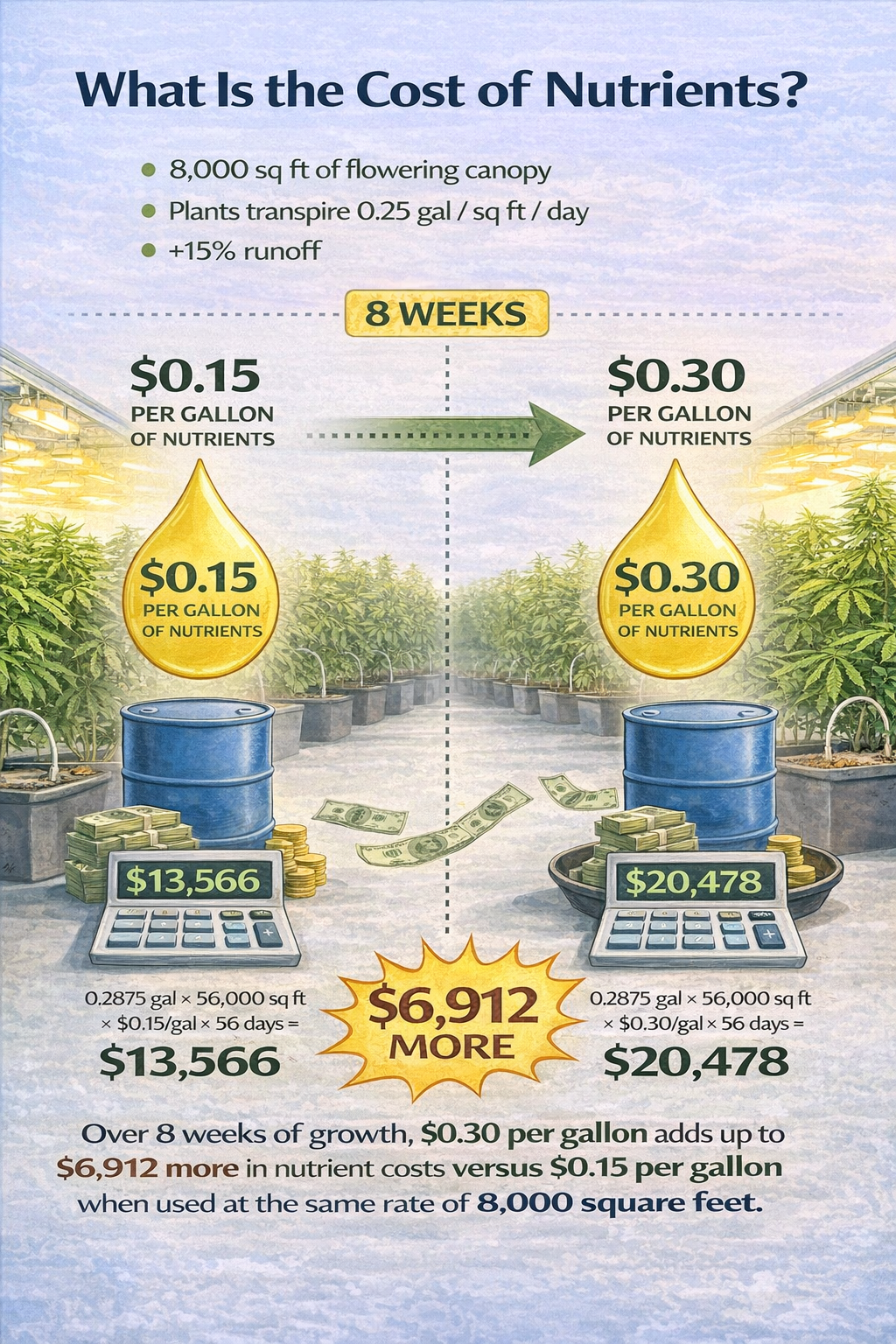
This is where the article needs to get blunt. Nutrients are not only a plant-health decision. They are a financial decision. If you run excessive runoff with no crop response, you are pouring money down the drain. If the plant cannot eat because the room is too humid, the root zone is too cold, the media is too saturated, or the pH is wrong, that money is still wasted. If you underfeed and leave production on the table, that is a different kind of loss but still a loss. Cost per bag is a weak metric by itself. Cost per successful crop is the one that matters.
The strongest nutrient programs are usually not the ones with the most hype. They are the ones that combine balanced chemistry, reliable solubility, clean delivery, stage-appropriate steering, substrate compatibility, and an environmental strategy strong enough to let the plant use the feed. A cheap recipe can become expensive if it precipitates, clogs emitters, stacks salts, or gets wasted in runoff. A more expensive line can be economical if it mixes predictably, supports cleaner operations, and helps the room hit its performance targets with less labor and less drift.
The room always has the final vote
This is the central truth. Nutrition does not operate independently of the environment. It is multiplied by it. The chemistry matters. The formulation matters. The water matters. The media matters. The support ecosystem matters. But the room still has the final vote. If the plant cannot transpire, roots cannot oxygenate, pore space cannot recover, and the climate cannot support sustained uptake, then the nutrient program will only perform at the level the room allows.
That is why nutrients belong in any serious conversation about indoor cannabis terroir. They are the building blocks of tissue, the raw material behind metabolism, and part of the signaling environment that shapes morphology, pacing, finishing behavior, and chemical potential. But they only become expression when the rest of the system is disciplined enough to turn feed into function. In indoor cultivation, the best nutrient program is not the one that looks smartest on a feed chart. It is the one the plant can repeatedly turn into quality, weight, and consistency.