
The invisible driver of root respiration, crop steering, and root-zone intelligence

Oxygen is one of the least discussed variables in indoor cannabis and one of the most important. It does not usually appear on dashboards beside temperature, RH, CO₂, or irrigation volume. Most facilities do not measure it directly in the root zone. Yet oxygen availability below the surface helps determine whether roots operate in a high-energy aerobic state or a stressed, low-efficiency hypoxic state. That distinction affects uptake, root vigor, dryback behavior, microbial ecology, stress tolerance, and ultimately the consistency of phenotypic expression. Crop-steering guidance makes this practical point clearly: drybacks matter not only because they lower water content, but because they increase oxygen availability in the substrate and support healthier root development.
That is why oxygen belongs in this terroir series. Water content is measured constantly. Oxygen almost never is. But oxygen is what lets roots convert carbohydrate into usable energy. If water is the carrier and media is the stage, oxygen is what makes the whole underground system metabolically possible. When oxygen is abundant enough, roots can actively absorb ions, maintain membrane integrity, expand, signal, and defend themselves. When oxygen is limited, the root zone becomes slower, more fragile, and more hospitable to the wrong biology.
Roots do not photosynthesize. They respire.

Leaves capture light and fix carbon. Roots spend energy. Root respiration uses oxygen to convert carbohydrates from photosynthesis into ATP, the energy currency that powers active transport and growth. Under oxygen-limited conditions, plants shift toward fermentation pathways, which are far less efficient and lead to the accumulation of metabolites like lactate, ethanol, and acetaldehyde. A recent hypoxia study found that low oxygen reduced root activity and nutrient absorption while increasing ethanol and lactic acid accumulation. That is the right mental model for growers: oxygen is not a luxury input in the root zone. It is the difference between efficient root metabolism and emergency metabolism.
The safe takeaway is that aerobic respiration produces dramatically more usable energy than anaerobic metabolism, and roots need that energy for nutrient uptake, cell maintenance, root-tip growth, and stress response. In practical terms, root-zone oxygen is an energy lever.
What happens at lights off matters more than many people realize
During the dark cycle, photosynthesis stops, but respiration continues. Roots are still metabolically active. They are maintaining tissue, growing tips, processing carbohydrates, and responding to the environment below the surface. If the substrate is left overly saturated into the night, oxygen limitation can emerge during a period when no photosynthetic recovery is occurring. That can soften root activity, reduce uptake efficiency, and increase vulnerability to root problems.
This is one reason late-day irrigation timing matters so much. The goal is not simply to avoid “too much water at night.” The goal is to preserve enough oxygen availability in the substrate during the dark cycle that respiration stays aerobic and efficient. Steering logic supports this indirectly through dryback management, and the broader hypoxia literature supports it physiologically. In other words, root-zone oxygen is not only a daytime issue. It is a 24-hour issue.
Oxygen is governed by substrate physics before it is governed by plant genetics
Oxygen reaches roots mainly by diffusion, and this is where substrate physics become everything. Gas diffusion in water is about 10,000 times slower than in air, and oxygen flux into water-filled pore space is far lower than into gas-filled pore space. Multiple plant hypoxia reviews make this point directly. Once pore spaces fill with water, oxygen resupply slows dramatically while roots and microbes continue consuming what is already there. That is why oversaturation is so dangerous: it is not just a water issue. It is a gas-exchange issue.
This is exactly why air-filled porosity matters. When macropores are air-filled, oxygen replenishment is fast. When those pores are water-filled, replenishment slows and oxygen tension falls. Dryback, then, is not only a water-management tactic. It is an oxygen-management tactic. Allowing substrate to dry back promotes oxygenation and helps prevent root suffocation and air porosity is one of the central advantages of a well-managed substrate. The point is that oxygen is just as important as water when it comes to managing the media and driving performance cues.
Dryback is really the conversation about oxygen recovery
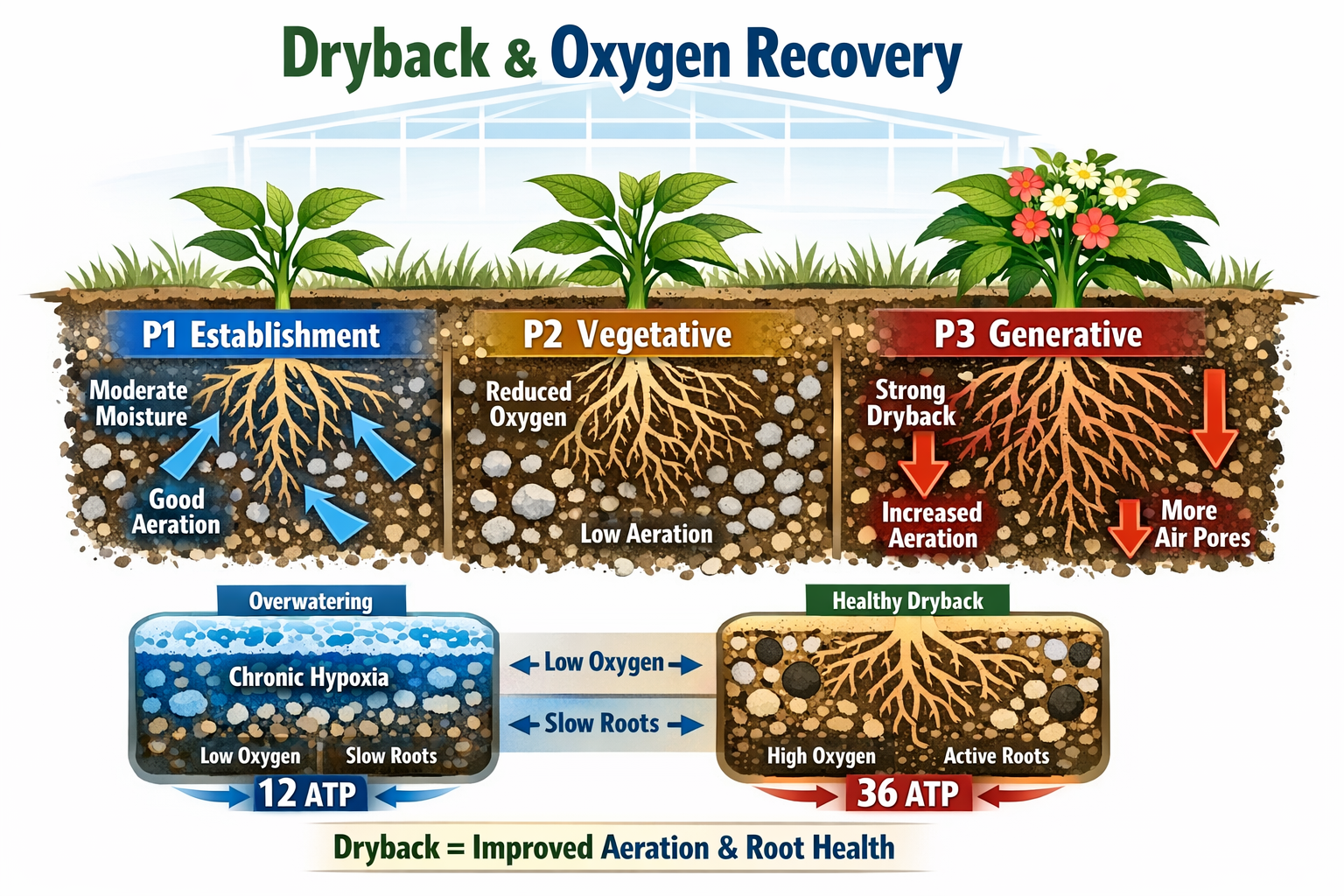
Growers often talk about overwatering as if the problem is just too much water volume. The more precise problem is often too little oxygen recovery time. If irrigation pulses are stacked too closely together, or if the room climate is too soft to pull water through the plant, the media may not regain enough air-filled pore space between events. That creates chronic hypoxia even if individual irrigation shots are not especially large. Mot fundamental crop-steering framework supports this interpretation by tying drybacks directly to oxygen availability and root health.
This is why P1, P2, and later steering phases are really about more than water. In establishment, moderate moisture with adequate oxygen encourages root expansion. In more vegetative steering, higher moisture can support softer growth, but only if oxygen recovery is preserved. In more generative steering, stronger drybacks increase air-filled porosity and often sharpen root-zone signaling. The plant does not just feel less water. It also experiences more aeration. That combination helps explain why drybacks can change morphology and pacing.
Does transpiration pull oxygen into the root zone?
This is the right question, and the accurate answer is: indirectly, yes — but mainly through substrate drying and pore re-entry, not because roots “suck in oxygen” the way leaves exchange gases.
Oxygen enters the root zone primarily by diffusion through air-filled pores. During the day, transpiration drives water uptake. As water leaves the substrate and the plant pulls moisture upward, pore space can reopen and air can re-enter the media. That increases the diffusion pathway for oxygen. So transpiration absolutely helps create the conditions for better root-zone aeration, especially when the room climate supports real dryback. But the dominant transport mechanism for oxygen in substrates is still diffusion, not bulk airflow or hydraulic suction.
That nuance matters because it connects the whole room. If VPD is too low, airflow is weak, humidity is too high, or dehumidification is undersized, transpiration slows. When transpiration slows, media dries more slowly. When media dries more slowly, air-filled porosity recovers more slowly. When air-filled porosity recovers more slowly, oxygen availability stays lower for longer. So yes, the above-ground environment strongly influences oxygen below the surface. It just does so through water movement and pore-space recovery, not by directly “blowing oxygen into the roots.”
Oxygen is also a microbial selection pressure
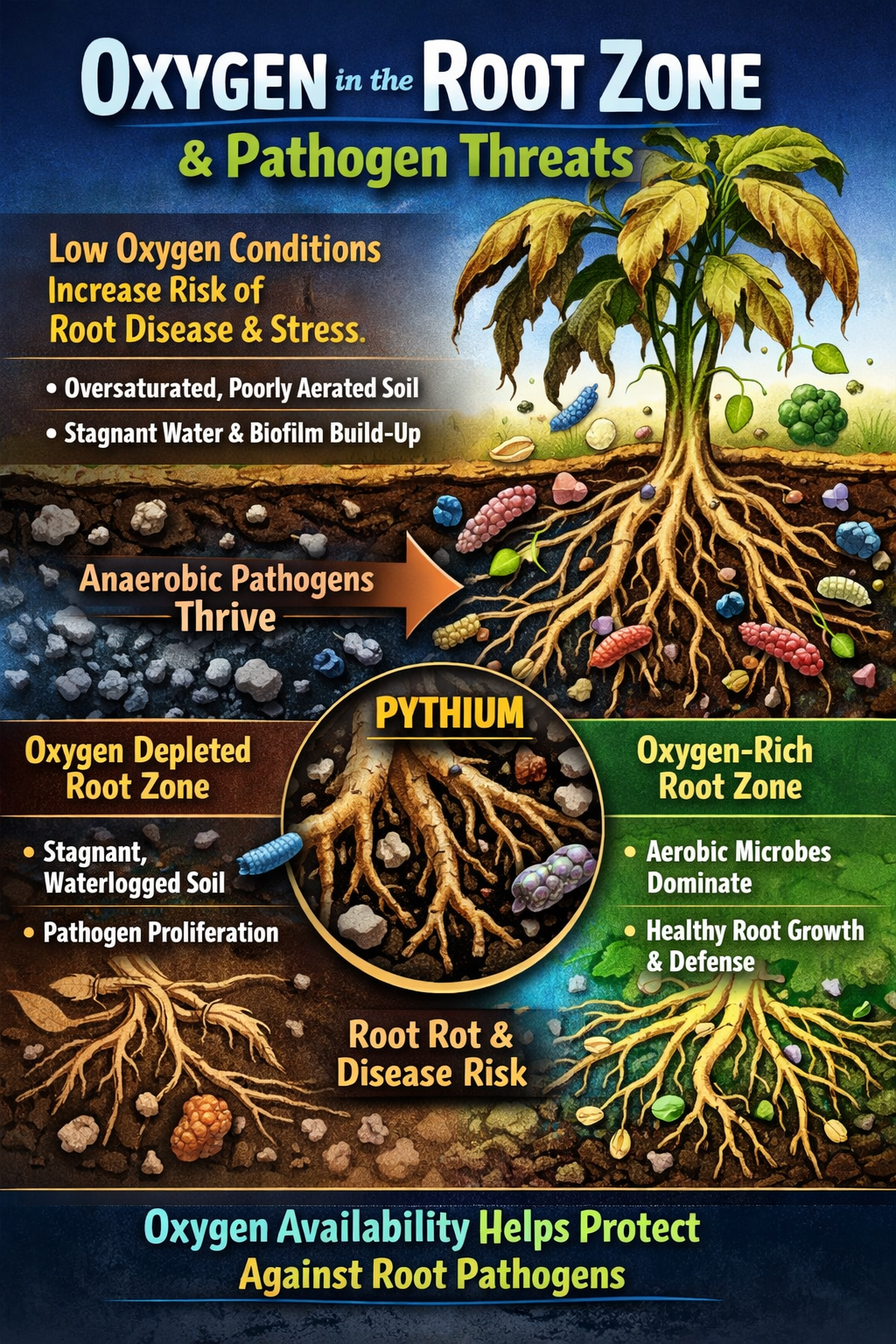
The rhizosphere is not sterile. It is an ecology shaped by water content, temperature, root exudates, and oxygen availability. Under more aerobic conditions, root-zone biology tends to favor organisms and processes associated with oxidative metabolism and stable nutrient cycling. Under stagnant, oxygen-poor conditions, the balance shifts toward organisms and processes that tolerate or exploit low-oxygen environments. The broad plant hypoxia literature is very clear that oxygen depletion changes plant-microbe interactions and root stress physiology.
This is where the common grower instinct is directionally right: many of the root problems that destroy performance are associated with saturated, poorly aerated root zones. It is safer scientifically to say that low-oxygen conditions favor disease pressure and plant vulnerability rather than to say all harmful pathogens are strictly anaerobic. Many important root pathogens are not obligate anaerobes. But it is absolutely fair to say that oversaturated, oxygen-poor media and stagnant irrigation systems create opportunity structures for disease, biofilm, and decline. Dramm’s greenhouse biofilm work and root-zone management literature both support that larger sanitation and stagnation point.
Oxygen supports nutrient uptake because roots need energy to absorb nutrients
Active nutrient uptake costs energy. When oxygen drops and ATP production softens, nutrient uptake often suffers. Hypoxia studies show this clearly. In one study, root hypoxia severely impaired nitrate uptake and distribution. Another found reduced root activity and nutrient absorption under low oxygen stress. That is why oxygen has to be viewed as part of fertility performance, not a separate topic. A plant with poor root-zone oxygen is not just at disease risk; it is less able to use the nutrients you are paying to supply.
That becomes especially important in high-performance cannabis because the plant is being asked to support high light, elevated CO₂, aggressive transpiration, and staged drybacks. Those programs all assume the root system can keep up. Oxygen is one of the variables that determines whether it can.
Oxygen, phenotypic expression, and secondary metabolism

The cleanest way to talk about oxygen and expression is not to claim that oxygen directly creates terpene or cannabinoid pathways in isolation. The stronger scientific position is that aerobic root function supports the whole plant energy economy that makes premium expression possible. Efficient root respiration supports nutrient uptake, helps stabilize plant-water relations, and maintains growth and stress-response capacity. Chronic hypoxia weakens that foundation. When the foundation weakens, the plant has fewer resources to devote to high-level performance and consistent finishing.
So oxygen is a terroir factor because it affects the hidden quality of the engine. A room with better root-zone oxygen recovery can maintain more consistent uptake, better dryback response, and more uniform plant energy status. That tends to show up as better vigor, better consistency, and fewer unexplained weak zones. Expression is never just a top-of-canopy story.
Dynamic media behavior means oxygen strategy must change through the cycle
The root zone changes as the crop matures. Root density increases. Pore architecture changes. Oxygen demand rises. Microbial populations shift. A substrate at transplant does not behave like the same substrate at week six. That means fixed irrigation recipes eventually become less intelligent. What worked when the media was lightly rooted may become too wet, too frequent, or too slow to recover later.
This is one of the reasons data platforms, sensors and substrate-management ecosystems matter so much. Even though most growers still do not directly measure oxygen concentration in the root zone, they can track the variables that most strongly control oxygen availability: water content, dryback depth, substrate temperature, EC behavior, irrigation timing, and climate response. Oxygen often has to be managed by proxy, but that does not make it less real.
Practical targets and metrics
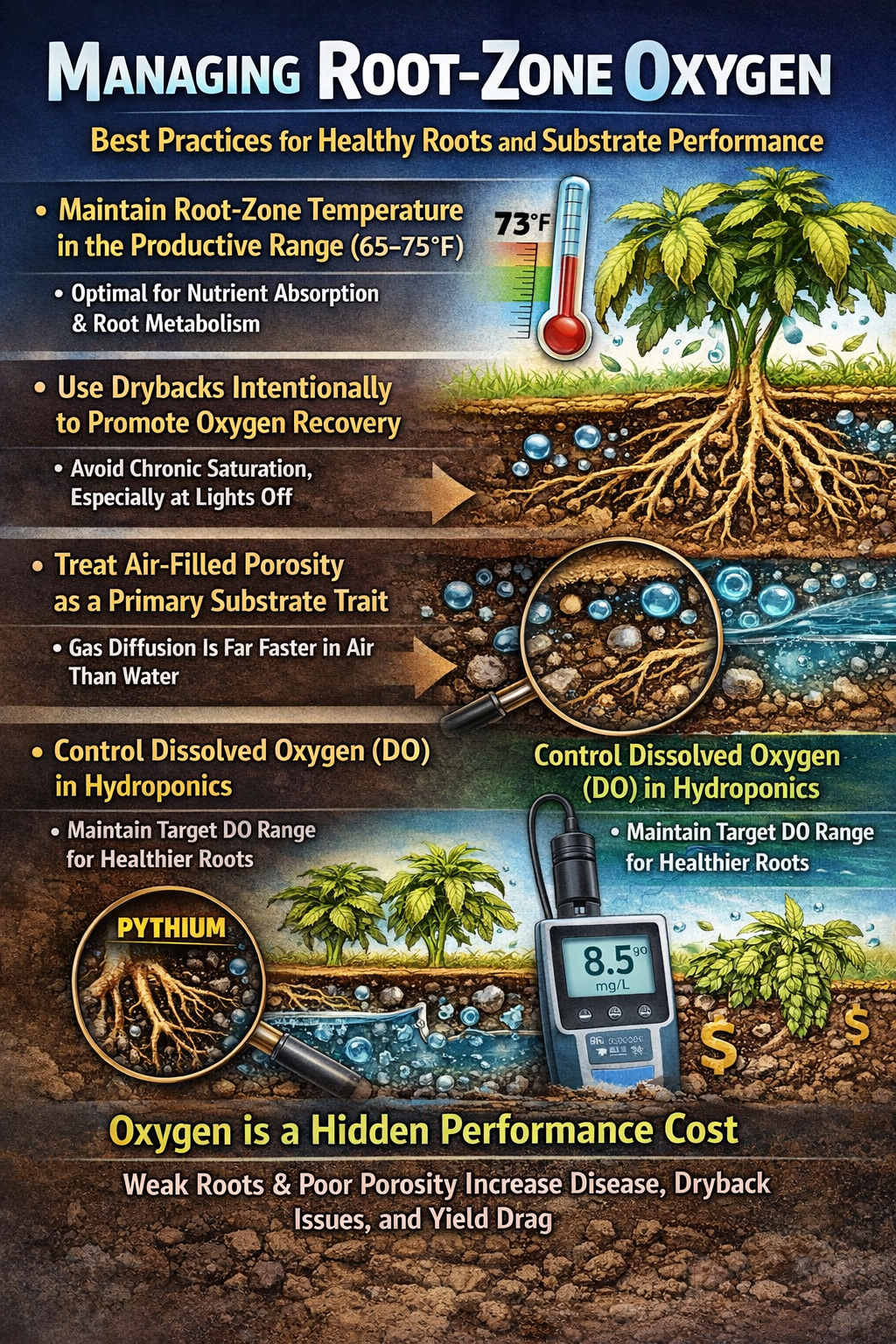
This is the tricky part, because root-zone oxygen in media is not as commonly measured directly as dissolved oxygen in hydroponic reservoirs. That means it is better to be precise about what we do know:
Maintain root-zone temperature in the productive range : popular ranges includes roughly 65–75°F for nutrient absorption and root metabolism, and temperature strongly affects respiration.
Use drybacks intentionally because drybacks promote oxygen recovery and root health.
Avoid chronic saturation at lights off because respiration continues while oxygen diffusion remains limited in water-filled pore space.
Treat air-filled porosity as a primary substrate-performance trait because gas diffusion is vastly faster in air than water.
If discussing dissolved oxygen in true hydroponic solution, each technology with have a desired/expected PPM and a rang of upfront and ongoing costs to provide oxygen to the water.
Oxygen is a financial variable, even if no one tracks it that way
Facilities rarely put “oxygen” on a KPI board, but they absolutely track its downstream consequences: root disease, inconsistent drybacks, poor nutrient efficiency, weaker vigor, slower recovery, lower uniformity, and unexplained yield drag. Those are all oxygen-adjacent costs. When the root zone stays too wet too long, the room pays for it in labor, crop inconsistency, and lost output.
That is why oxygen is not a side parameter. It is one of the hidden variables that makes the rest of the system honest. If water feeds the plant, oxygen empowers the roots to use that water well.
Dissolved Oxygen: Turning Oxygen from a Constraint into a Tool
In substrate cultivation, oxygen availability is usually managed indirectly through media structure, irrigation timing, drybacks, and environmental pull. But oxygen can also be influenced more directly through the irrigation solution itself. Roots can use oxygen dissolved in water as well as oxygen diffusing through air-filled pore space, and greenhouse research shows that oxygen-enriched nutrient solutions can improve root function and plant performance when hypoxia would otherwise limit the crop. Reviews of root-zone oxygen stress are clear that low oxygen reduces root respiration, mineral uptake, and water movement into the roots, while oxygen-enriched nutrient solutions can improve growth and help maintain aerobic root activity.
That matters because dissolved oxygen should not be viewed only as a hydroponic metric. It is also a performance angle for substrate growers who want cleaner irrigation water, stronger root-zone biology, and more resilient delivery systems. In true solution culture, workable dissolved oxygen levels are often discussed in the roughly 4–10 mg/L range, with higher-quality oxygenation often sitting near the upper part of that range. In substrate systems like coco and stone wool, dissolved oxygen is not the whole story because gas diffusion through air-filled pore space still dominates long-term oxygen supply but better-oxygenated irrigation water can still help support root respiration during and immediately after irrigation events.
Nanobubbles: An Advanced Oxygen Strategy, Not Just a Water Gimmick
Nanobubbles are especially interesting because they shift oxygen from being just a measurement problem to a controllable design tool. Recent agricultural reviews report that micro- and nanobubbles can increase dissolved oxygen, improve root-zone aeration, alter microbial dynamics, and in some irrigation systems reduce clogging and biofilm-related fouling. A 2025 drip-irrigation paper specifically reported that micro/nanobubbles reduced clogging from biofilms, organics, and sediment and improved emitter function, while broader reviews describe nanobubble irrigation as a way to alleviate hypoxic root-zone conditions and support crop performance.
That is where nanobubbles become especially relevant to indoor cannabis. They are not just about trying to spike oxygen numbers in water. They may also help keep irrigation lines, emitters, and delivery infrastructure cleaner and more functional over time, reducing one of the hidden risks in fertigation systems: biological buildup inside the plumbing. For operations that view oxygen as a performance lever, nanobubbles represent a more active approach to root-zone management — one that can support root respiration, system hygiene, and distribution reliability at the same time. The honest caveat is that most of the strongest published nanobubble data comes from broader agricultural and irrigation research rather than cannabis-specific trials, so it is best framed as a promising advanced tool rather than a universal prescription.
The Practical Takeaway

Most growers manage oxygen indirectly through media choice, dryback depth, irrigation timing, root-zone temperature, and climate control. That remains the foundation. But for teams chasing higher precision, dissolved oxygen and nanobubble technology open the door to managing oxygen more intentionally. In that sense, oxygen is not just something you hope is there. It can be designed, measured, supported, and even upgraded. And once you start thinking that way, oxygen stops being a hidden variable and becomes a real steering tool.
The business conclusion
Oxygen is the invisible driver of root energy status. Root energy status governs nutrient uptake, root growth, stress tolerance, and the consistency of crop steering responses. Because oxygen moves poorly through water and quickly through air, every irrigation decision is also an oxygen decision. Every dryback is an oxygen event. Every humidity problem above the canopy can become an oxygen problem below it by slowing transpiration and delaying pore-space recovery.
Indoor terroir is not built only with what the plant breathes above ground. It is also built with what the roots can breathe below ground. Oxygen does not need to be visible to be decisive. In a controlled environment, if you want consistent chemical expression and repeatable plant health, root-zone oxygen has to be engineered, protected, and respected.