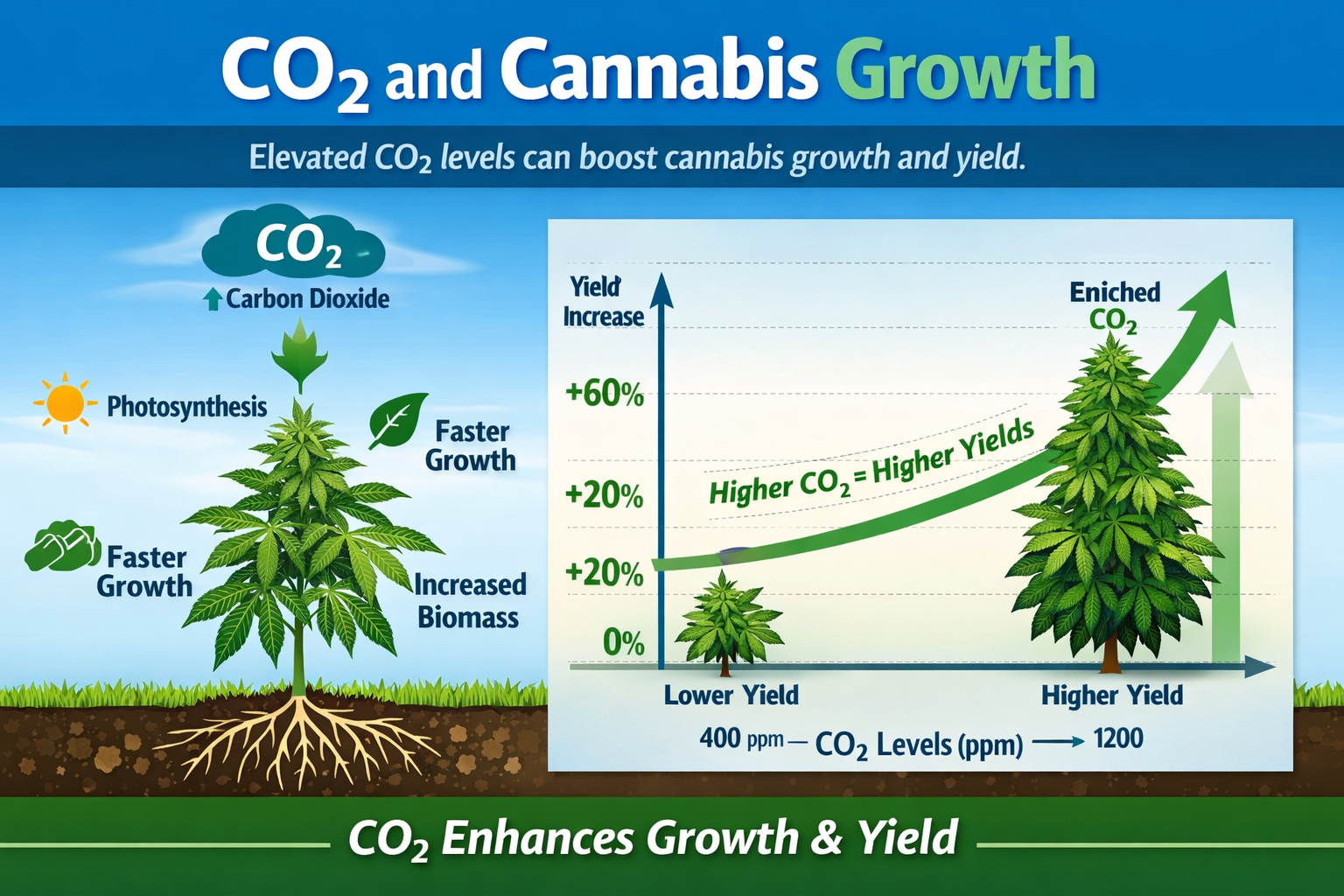
The invisible carbon stream that determines how fast a room can truly produce

If airflow makes the room behave like one environment, and temperature and humidity determine how hard the plant can work, CO₂ determines how much carbon is actually available to build biomass. In indoor cannabis, CO₂ is not a side input. It is the raw carbon feedstock for photosynthesis. It directly influences assimilation rate, water-use efficiency, growth pace, and the economic return on high light. That is why CO₂ belongs in any serious conversation about indoor terroir: it changes not just how much flower a room can make, but how quickly that room can move, how uniformly it can mature, and how effectively it can convert expensive environmental control into sellable or extractable flower.
At the biochemical level, cannabis is a C3 plant. Its photosynthetic engine depends on Rubisco fixing carbon into sugars that later support structure, respiration, flower formation, and secondary metabolism. Under ambient air, that engine is not fully saturated in high-light production rooms. Elevated CO₂ significantly increaseds net photosynthesis and dramatically improved water-use efficiency across multiple varieties; research has shown that raising CO₂ to 700 μmol mol⁻¹ increased photosynthesis by about 38–48% depending on cultivar, while water-use efficiency increased by roughly 157–191%. That is the core terroir point: CO₂ changes the pace of metabolism itself.
CO₂ is a terroir factor because it changes the pace of the crop
CO₂ is often described as “fuel,” and that metaphor is useful, but incomplete. In indoor cannabis, CO₂ is also a timing variable. More available carbon can increase photosynthetic throughput, support faster canopy development, and help a crop capitalize on high PPFD, provided the room is physically capable of supporting the increased demand. That means CO₂ can influence how quickly plants build leaf area, how aggressively they bulk flower, and how much dry mass they ultimately produce. The evidence for direct cannabis-specific “shorter harvest time” from peer-reviewed flowering studies is still limited, so that claim should be framed carefully but it is fair to say CO₂ can accelerate growth rate and improve the odds of a crop finishing strongly under a given schedule.
That distinction matters because cannabis production too often talks in absolutes. CO₂ does not automatically make every room finish earlier or heavier. What it does do, very consistently, is raise the ceiling on production rate when the rest of the environment can keep up. That is why CO₂ is a terroir factor, not just an additive. It changes the expression of the room, the photosynthetic conversion rates speed up and the plants require more inputs. Rooms that can actually deliver enriched, conditioned, moving air through the canopy have a different productive signature than rooms that merely dump gas into a space and hope the monitor number tells the truth.
CO₂ only works when it is delivered to the leaf, not just measured in the room

This is where a lot of money gets wasted. A sensor reading 1,200 ppm somewhere in the room does not mean the leaf is seeing 1,200 ppm. Plants deplete CO₂ at the leaf underside tte stomata, and without enough air movement, the boundary layer becomes CO₂-poor even while the bulk air still looks enriched. A boundary-layer overview explains the basic physics clearly: a thicker boundary layer slows the transfer of CO₂, heat, and water vapor between the leaf and surrounding air. Recent airflow research found that air velocity up to about 0.8 m/s enhanced exchange without negative effects on stomatal opening. The Cannabis Research Coalition and PIPP Horticulture have also been providing research data that shows airflow velocity impacts on transpiration while others are showing impacts on stomatal conductance and CO2 assimilation. That is why airflow and CO₂ are inseparable in serious cultivation.
For cannabis, that means enriched CO₂ has to be delivered in a moving airstream, not simply “present” in the room. The gas has to survive the path from tank to regulator to manifold to ductwork to discharge point to canopy, and then continue moving through the room with enough uniformity and velocity to keep refreshing the leaf boundary layer. Roughly 0.8 m/s at the canopy is a strong practical target for breaking the boundary layer and supporting exchange, while still remembering that uniformity matters more than one heroic spot reading. If CO₂ is not carried to the leaf in conditioned air with usable velocity, you are buying ppm the stomata never really see. This is one of the reason under canopy airflow is a popular solution because it allows facilities to delivery conditioned air to the undersides of the plants at consistent velocities to drive gas exchange.
Delivery losses are real, and they define whether CO₂ becomes terroir or waste
CO₂ is one of the easiest environmental inputs to leak, stratify, or short-circuit. It can be lost in poorly sealed rooms, door openings, loose duct connections, weak distribution design, bad injection timing, supply-to-return short cycling, and inadequate mixing. PlantCO2’s own system language is useful here because it focuses on engineered distribution, integrated controls, and tunable manifold systems sized to the room. CO₂ is not just a commodity gas; it is a delivery system problem.
This is where terroir gets practical. A room that enriches CO₂ through well-designed ductwork and manifold distribution, then carries that carbon in temperature-controlled air with sustained canopy velocity, will express a different phenotype than a room with the same nominal ppm but poor mixing and persistent leak paths. One room is feeding carbon to the crop. The other is feeding the monitor and the hallway.
Cannabis uses CO₂ hardest when light, temperature, and roots are all ready
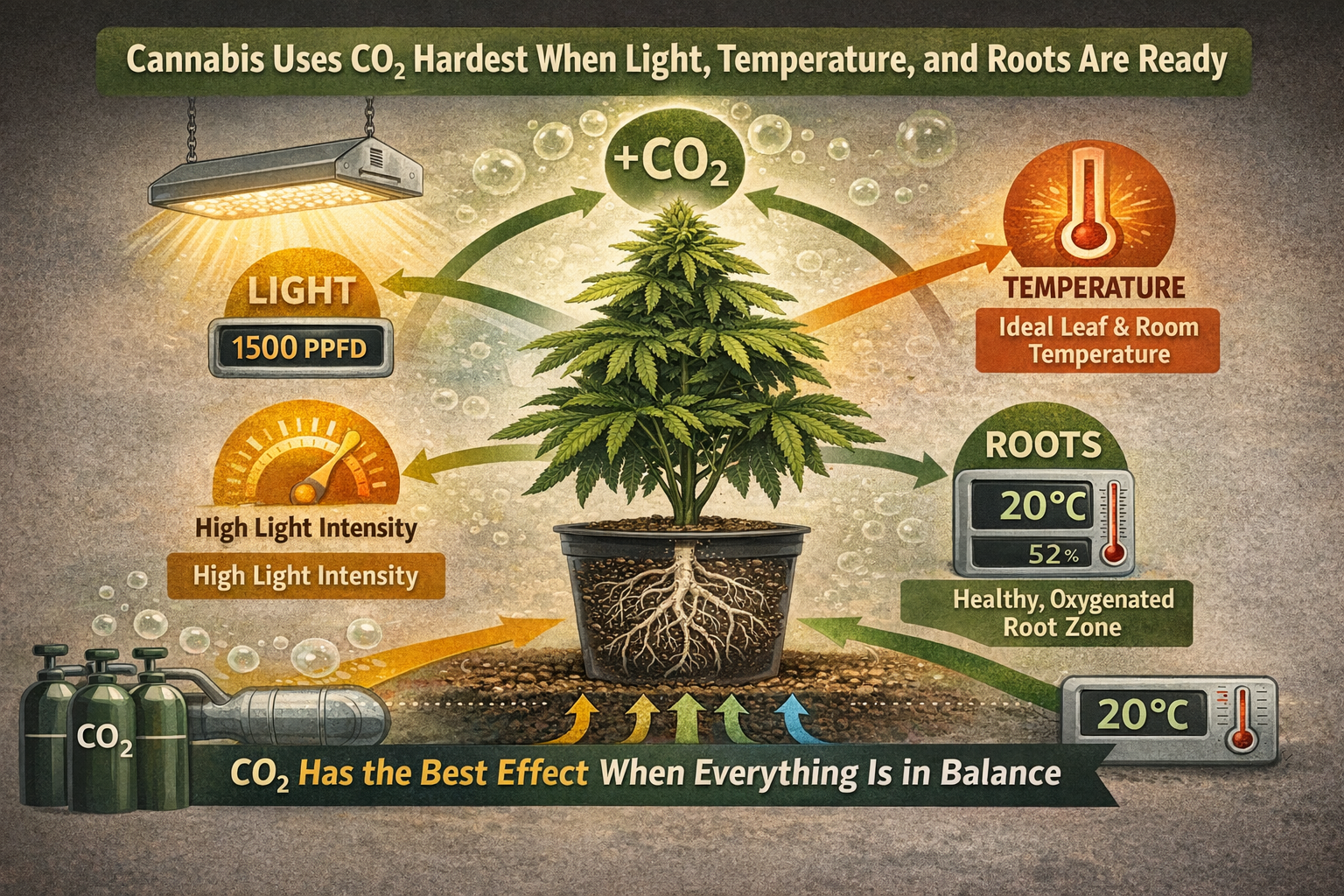
CO₂ is not a standalone lever. It is a multiplier. Cannabis research shows that photosynthesis responded strongly to CO₂, light, and temperature together, with an unknown max photosynthesis. Realistic observation and research suggests that 30°C/86F and 1,500 μmol m⁻² s⁻¹ PPFD and 1500PPM CO2 might be the maximum level of sustained assimilate throughput...after this level the returns appear to be much smaller than the cost of the inputs and system management. We also know that temperatures above 30°C began to hurt photosynthetic performance and water-use efficiency even while transpiration continued to rise, so it becomes a fine line of maximum uptake and realistic delivery without compromising plant health. That is a critical cultivation lesson: CO₂ can support harder driving, but only inside a temperature window the plant can still use efficiently.
So yes, enriched CO₂ often justifies warmer productive rooms than ambient-air cultivation, but “warmer” is not “hotter without consequence.” Once leaf temperature climbs too high, stomatal behavior, water-use efficiency, and quality begin to work against you. This is why CO₂ has to be coordinated with leaf temperature, not just room setpoint. It also has to be coordinated with root-zone performance. If the roots are cold, oxygen-limited, or inconsistent, the plant cannot support the water movement and nutrient flow needed to capitalize on elevated carbon. CO₂ does not rescue a weak hydraulic system. It exposes it.
CO₂ and yield are directly connected, but only under the right ceiling of control

The practical yield case for CO₂ is real. There is plenty of research and commercial experience noting that 800–1,000 ppm can increase cannabis yields by 10–25%. This is reflected with new high yield benchmarks of 75grams/sf in multitiered and 100+grams/sf in singl tier. The gap between those two numbers is important: short-term leaf photosynthesis often increases more than long-term yield because whole-crop yield is limited by everything else that can bottleneck the plant. Short-term leaf-level responses can overestimate long-term whole-plant growth and yield response unless the system can be consistently maintained and measured.
That is one of the cleanest ways to explain CO₂ as terroir. Elevated CO₂ does not create yield by itself. It raises potential. The realized yield increase depends on how well the room converts that potential into sustained gas exchange, transpiration, nutrient delivery, and flower-site productivity. In other words, CO₂ is strongly correlated with yield and weight, but it only cashes out when the rest of the room behaves like a coordinated system.
CO₂ also influences expression, but the effect is indirect and system-dependent
It is tempting to say CO₂ directly increases terpene and cannabinoid expression, but the science is more nuanced than that. The strongest direct evidence is that CO₂ increases carbon assimilation and thereby increases plant growth and metabolism. Because secondary metabolites are built on primary carbon metabolism, it is reasonable to infer that better carbon supply can support stronger secondary metabolite production when light intensity, plant health, and sink demand are also high. What is not yet as strong in the literature is a universal cannabis rule that “more CO₂ equals more terpenes” but we know it increases assimilate uptake to support the production of secondary metabolites.
CO₂ changes expression by changing the room’s metabolic bandwidth. It can support denser flowers, more aggressive bulking, and stronger overall biomass formation, which may improve total cannabinoid or terpene yield per room even if concentration changes are cultivar and environment dependent. That is still a major commercial win. Expression is not just about percent on a test result. It is about what the whole room is able to build, repeatedly, with the environmental signature you designed.
Suggested CO₂ targets by stage

A practical framework, consistent with cannabis industry guidance and the limited cannabis-specific research base, is to treat CO₂ as a staged lever.
Propagation and early veg usually do not need aggressive enrichment because root mass and canopy demand are still limited. Moderate enrichment may help, but this is rarely where the best ROI sits.
Vegetative growth often responds well in the 800–1,000 ppm range, especially once the canopy is established and the room is supporting meaningful gas exchange. Flowering commonly lives in the 1,000–1,400 ppm range in commercial practice, with the strongest returns typically seen when PPFD is high and airflow, temperature, and fertigation are all aligned. Many cultivators target roughly 900–1,200 ppm in flower and point out that levels above 1,500 ppm are generally not economic.
That is the right operational takeaway: do not chase the highest ppm the controller allows. Maintain the ppm the room can actually use.
CO₂ has to be matched to gas exchange at the stomata
This is where crop steering becomes real. Stomata do not respond to ppm in isolation. They respond to light, leaf temperature, VPD, root status, and airflow. Elevated CO₂ can improve water-use efficiency because plants can maintain strong carbon fixation with somewhat less stomatal opening, but that does not mean transpiration stops mattering. In fact, in a high-performance room, transpiration still has to carry nutrients, cool the plant, and support the entire hydraulic side of production. CO₂ is not a substitute for water movement; it is a reason to optimize water movement.
This is why the best CO₂ rooms do not merely enrich. They enrich while sustaining conditioned, moving air at the canopy during the highest-light hours of the day, when the plant can convert carbon most aggressively. CO₂ should be thought of as a midday throughput tool, especially in dense flowering rooms where the crop is being asked to run hard and fast. The goal is not just to have CO₂ in the room. The goal is to match concentration, leaf temperature, airflow velocity, and root-zone readiness so the crop can use that carbon as hard as the room intends.
Safety is part of the engineering, not an afterthought
CO₂ is useful to plants and hazardous to people at high enough concentrations. OSHA lists an 8-hour TWA permissible exposure limit of 5,000 ppm. That makes commercial cannabis enrichment workable, but only with proper controls, alarms, distribution design, and purge strategy. This is another reason distribution and sequencing matter so much: the same gas that helps the crop has to remain inside safe operating boundaries for the facility and its workers.
So a real CO₂ strategy is not just enrichment. It is enrichment plus room integrity, monitoring, shutoff logic, and life-safety design. The better the room is sealed and the better the gas is delivered to the crop, the easier it is to get useful plant performance without drifting into unnecessary waste or safety risk.
The financial conclusion
CO₂ is one of the clearest examples of indoor terroir having a balance sheet. If delivered poorly, it is an expensive leak. If delivered well, it can materially raise the productive ceiling of a room. The financial case is strongest when a facility already has high light, stable climate control, good airflow, and reliable fertigation; because those conditions allow the crop to convert extra carbon into extra saleable flower instead of extra operational stress. Industry guidance pointing to 10–25% yield improvement at effective enrichment levels is meaningful, but it should be treated as a system outcome, not a gas-only outcome.
That is why CO₂ is a terroir factor and not just a utility. It leaves an imprint on harvest cycle time, weight, morphology, and consistency, but only when it is delivered correctly from tank to ductwork to room to leaf. Mastered, CO₂ becomes a competitive advantage. Mismanaged, it becomes one more number on a screen that never truly reaches the plant.