
The hydraulic engine that turns environment into plant performance
If you strip indoor cultivation down to first principles, the whole game is moving water on purpose. Water is not just an input. It is the hydraulic engine behind turgor, transpiration, nutrient delivery, evaporative cooling, drybacks, root-zone oxygen dynamics, and the latent load your HVACD system must remove. AROYA’s crop-steering framework puts water movement at the center of steering because drybacks, root-zone EC, and plant response all depend on how water is stored, moved, and removed. Most popular cannabis irrigation guidance makes the same point from the substrate side: irrigation events do not just hydrate media, they create plant responses, and the timing and amount of water directly influence crop behavior.
That is why water belongs in any serious indoor terroir discussion. Water quality at the source matters. Water treatment matters. Storage matters. Plumbing and pressure matter. Fertigation uniformity matters. Runoff interpretation matters. Standing water matters. Biofilm in tanks and lines matters. And most importantly, the amount of water you can push through the crop is limited by the environment’s ability to pull it through the plant and remove it from the room. If water does not move through the plant, nothing else really moves with it.
Water is root-zone management
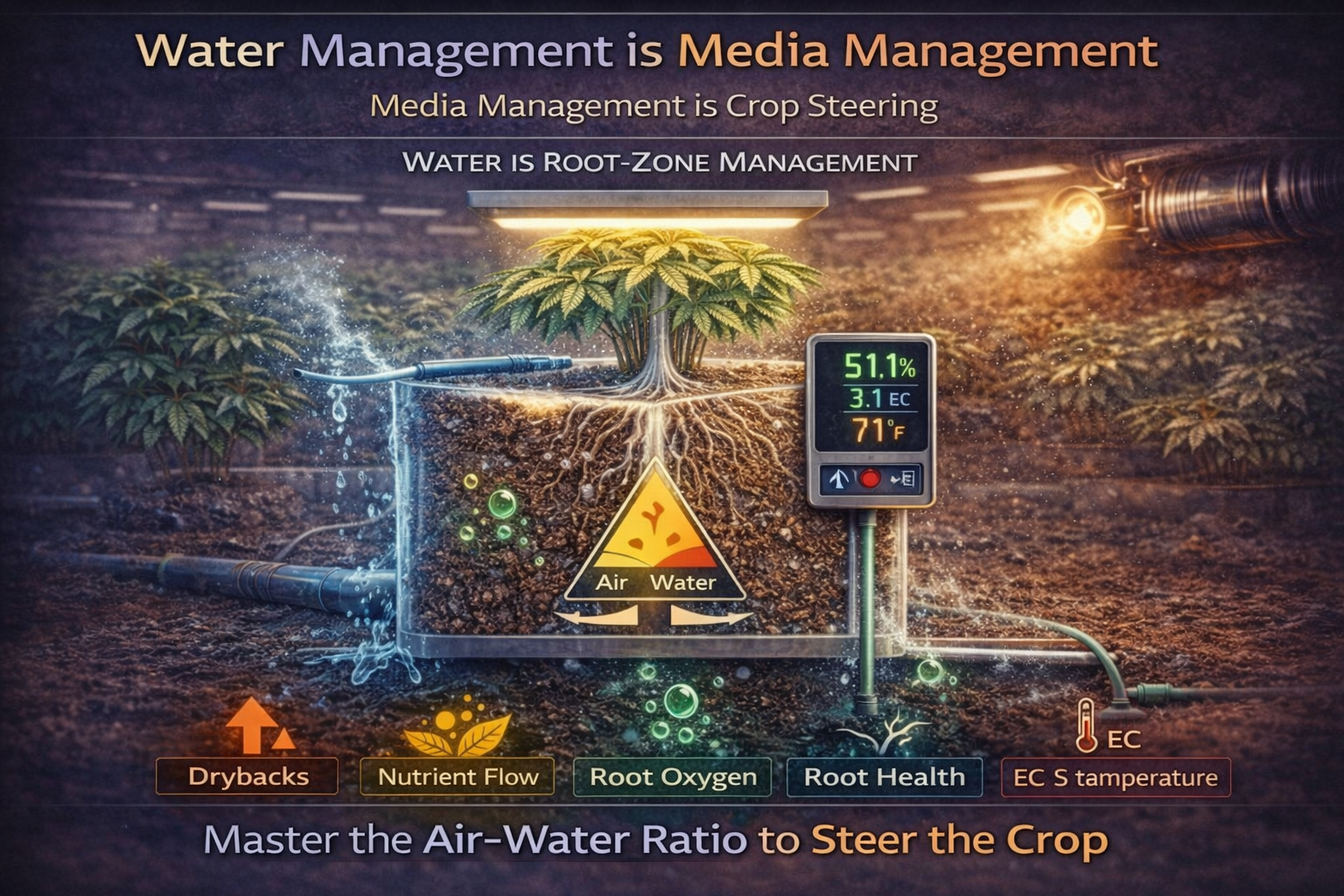
The root zone is not “wet media.” It is an air-water-temperature system. AROYA, Growlink, Gordan and others explicitly describe drybacks as the decrease in substrate water content between irrigations and emphasizes that they promote root growth, oxygen availability, and crop steering outcomes. Their dryback guide also recommends irrigating thoroughly to runoff to ensure uniform moisture distribution before tracking the subsequent dryback. That is an important nuance: saturation is not the enemy. Poorly timed, poorly drained, or environmentally unsupported saturation is the problem.
This is why water management is more than deciding “how much” and “how often.” It is about maintaining a productive air-to-water ratio inside the media. Too dry and the plant loses momentum, uptake slows, and growth stalls. Too wet and the root zone loses oxygen, the plant’s willingness to transpire drops, and the conditions for microbial trouble become much more favorable. Grodan’s irrigation materials emphasize that maintaining proper water content in the root zone is critical and that irrigation strategy has to protect both hydration and root-zone function, not merely add volume.
Start at the source: not all water is “water”

Before fertilizer is ever mixed, the source water has already defined part of the crop’s future. Water quality varies significantly by source and region and points growers to “good quality” standards for production. Reverse osmosis can remove nearly all metals and impurities and make difficult sources usable, but its wasteful and not cheap. Various levels of sediment filtration, UV treatment, and novel technology has been applied to treat and store water for cannabis production over the years. This speaks to the fact that municipal water, well water, and blended sources may all be called “water,” but they are very different agronomic starting points.
The practical questions are straightforward. What is in the water and how much is there? Minerals? Metals? Poisons? Chloramine? Does this create long-term media stress? Potential test failure? Are iron and manganese present at levels that create precipitation or biofouling risk? Does the chemistry vary seasonally? Those questions matter because they affect pH stability, mixing behavior, emitter reliability, media accumulation, and the repeatability of every feed you deliver. Most growers have experienced issues with suspended solids, minerals, algae, and microbial contamination as core water-quality issues, which has made water life cycle management an important topic of modern cannabis cultivation. The inputs, the flow and the outputs of water tell a story of efficiency, waste, and consistency.
Treatment is strategy, not just sanitation
A common treatment stack starts with sediment filtration then usually reverse osmosis, then disinfection for holding and redistribution to meet the requirements scale. Each layer solves a different problem. Physical filters remove suspended particles and debris, while reverse osmosis removes high concentrations of dissolved ions. Micro-irrigation systems almost always require filtration because suspended solids, precipitates, algae and biofilms can clog systems and degrade performance.
Chloramine deserves special respect because it is more persistent than free chlorine and typically requires more contact time or a more intentional treatment strategy.
Reverse osmosis is the reset button. It can produce clean, low-mineral water that is easier to build a recipe on top of, but it also removes much of the source water’s buffering. The cost and operational burden are real...once you strip water down, you inherit the job of rebuilding stability through disciplined nutrient formulation and pH control.
UV is valuable, UV can reduce microbial contamination in-flow, and recent work has examined its usefulness in nutrient solution without adding chemical residues. But UV is a point treatment, not a storage residual. EPA’s UV disinfection fact sheet emphasizes exposure time and water quality requirements, and notes that suspended solids and turbidity reduce UV effectiveness because the light must penetrate the water. That means UV can sanitize passing water, but it does not keep a storage tank, clogged line, or downstream hose end biologically clean after the fact.
Nanobubbles are worth considering because they offer a smarter way to improve the root-zone environment, especially in hydroponic, coco, and rockwool systems where oxygen availability can quietly become a limiting factor. By increasing dissolved oxygen in irrigation water, holding tanks, line sets and nutrient solution, oxygenated nanobubbles may support stronger root respiration, better nutrient uptake, healthier microbial balance, and greater resilience against the stress that comes with saturated media or poorly aerated irrigation events. In controlled-environment agriculture, the technology is being studied for its potential to improve crop productivity, resource-use efficiency, and root-zone disease management. For cannabis, the cleanest takeaway is not that nanobubbles are magic, but that they may be a valuable tool when the goal is to create a more oxygen-rich, more biologically favorable root zone that supports consistency and control.
Storage and plumbing: where clean water becomes biology
This is one of the most overlooked parts of indoor cultivation. You can start with clean water and still end up delivering biology if storage and distribution are sloppy. If you have irrigation pipes, filters, or tanks, you have biofilm, and it can contribute significantly to plant-disease pressure. The same document notes that biofilm can form across a wide range of water sources and conditions. Exposed hose ends, nozzles, tank walls, benches, and other wetted surfaces can all become biofilm sites.
That means water storage is not just a utility issue. It is a sanitation issue and a consistency issue. Warm stagnant tanks, low-turnover storage, standing water, exposed fill points, and dirty mixing vessels can all turn “clean water” into a biological delivery system. If you store water, you need turnover, cleaning discipline, protected plumbing, and a sanitation plan. Water that sits in lines and fertigation hoses is not neutral. It is a potential pathogen hotspot and a hidden drift mechanism. Whether the choice is chemical, physical, mechanical or magical control of water flow is key to consistent success.
Water pressure is cultivation infrastructure
Once the water is treated and mixed, it still has to be delivered evenly. At scale, irrigation becomes a plumbing-design problem as much as a cultivation problem. Pressure stability, line length, emitter selection, and zoning all affect whether one room or lane gets the same shot as another, especially when micro-irrigation delivery systems clog and deliver inconsistent flow. That same logic applies to fertigation uniformity: the best recipe in the world is meaningless if distribution is uneven.
Batch-tank versus inline injection is part of this same systems choice. A batch approach can simplify consistency because a whole mix is homogenized before delivery, but it requires disciplined tank management and sanitation. Inline injection can be elegant and responsive, but it demands accurate injector calibration, stable pressure, and verification at the point of delivery. Either system can work. Neither system forgives sloppy engineering. What is important is that you have enough water, when you need it, to execute your fertigaion/dryback/crop steering goals for each room.
Saturation is not overwatering
This is one of the most important distinctions in modern steering. Field capacity is the point after or during irrigation at which a substrate can no longer hold additional water. Foundational dryback knowledge requireswatering thoroughly to runoff, then measuring post-irrigation water content and tracking the decline from that fully wetted point. That means proper saturation is often the start of precision, not a mistake. Managing the total saturation of the media as it ranges through vegetative to generative with steering targets along the way is one of e fudations of crop steering.
In practical terms, field saturation and subsequent dryback targets must be tied to media size, media type, rooting stage, and environmental capacity. A small coco pot does not behave like a large rockwool slab, and neither behaves the same if room humidity and leaf temperature are different. And if the fertigation can't keep up... you have to dim your lights and maybe CO2 in order to find a production zone within the limits of your mechanical systems.
How much water per room? Start with media, then environment
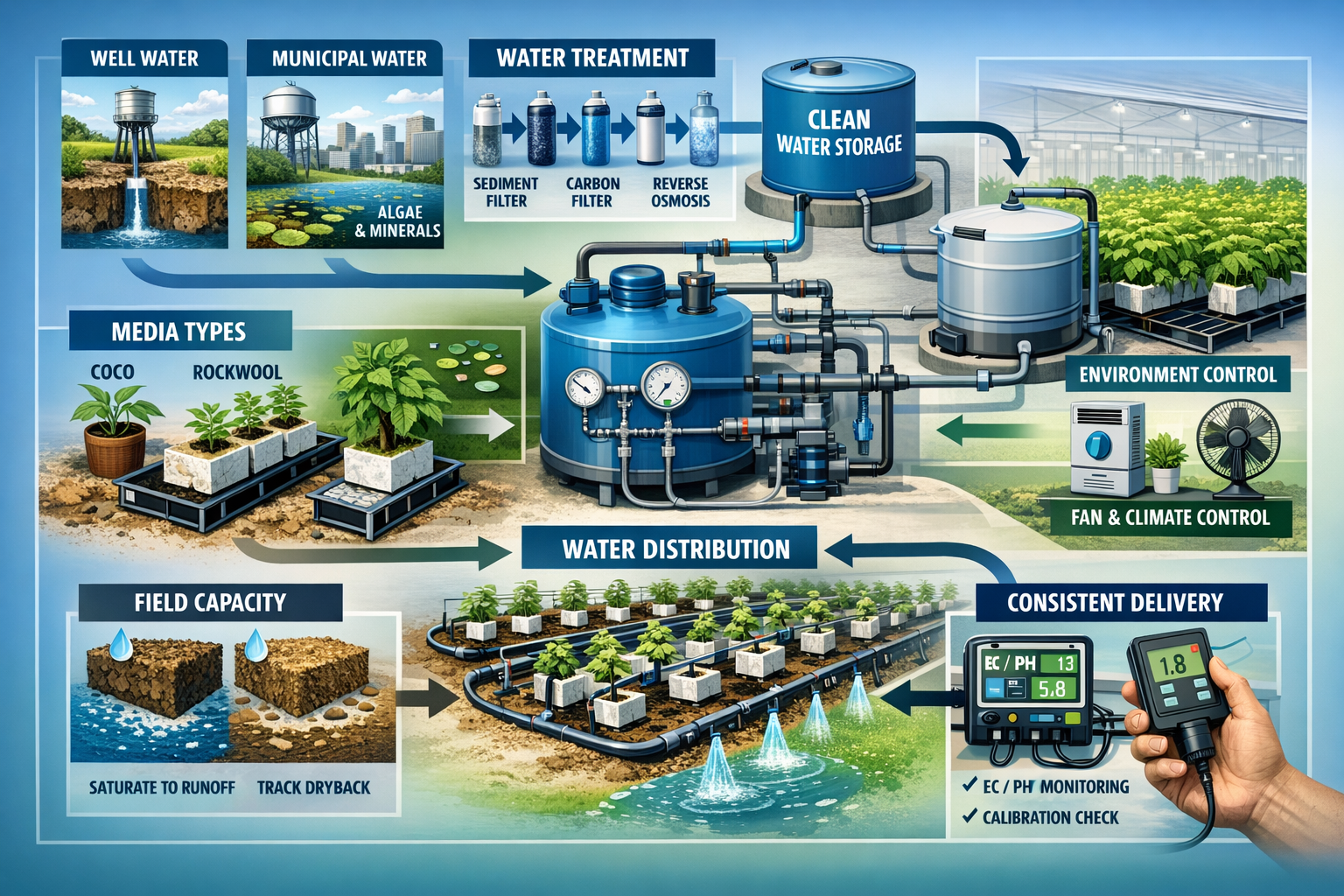
The right water volume for a room is not a universal recipe. It depends on media size, field capacity, irrigation strategy, canopy size, leaf area index, genetics, CO2 nd airflow, available light intensity, and how much transpired water the room can remove. AROYA’s basic steering guide defines dryback as the drop in VWC from the day’s maximum saturation to the next day’s minimum, which makes media-specific field saturation the practical starting line. Grodan’s cannabis irrigation guides similarly tie shot strategy to media water content and growth stage rather than one fixed irrigation volume.
That leads to a useful systems rule: water demand should be estimated from both the substrate and the factors that impact transpiration in the room. From the substrate side, you need enough volume to reach the desired wetting pattern and reset the profile. From the room side, you need enough dehumidification and temperature control to let the plant pull that water through the system on schedule. If either side is wrong, the crop becomes reactive instead of steerable.
Runoff is your free diagnostic lab

Runoff is not just waste. It is information. Substrate water content and EC as core steering metrics, and runoff or leachate measurements can help reveal how the root zone is behaving relative to what you are supplying. If runoff EC is stacking, salts may be accumulating faster than the crop is using them with lockout inevitable. If runoff pH is drifting nutrients may be binding or showing bacterial or fungal growth. If one zone’s runoff looks different from another’s, the room may have a distribution issue, a climate issue, or a root issue hiding under the canopy.
The caution is that one runoff number is not truth by itself. Trend matters. Timing matters. Sampling method matters. Media type matters. Rockwool, coco, and soil can all show different “normal” behavior. The value of runoff comes from repeatable method and comparison over time, not from chasing one isolated reading.
Water is the plant’s coolant
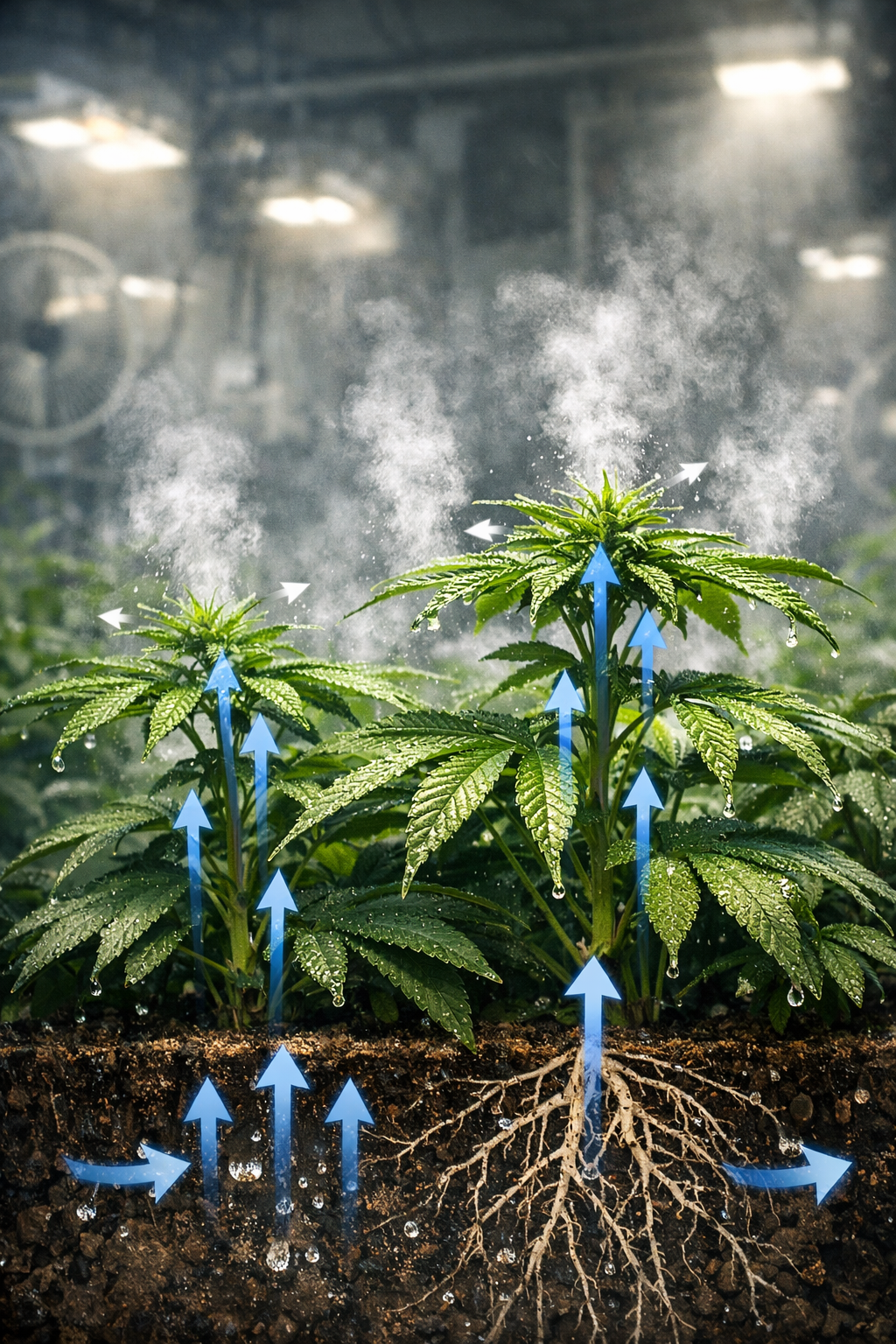
Water does more than carry nutrients. It cools the plant. Transpiration is the mechanism by which water moves from the root zone, through the xylem, and out through the leaf surface. Convective cooling occur when air passes by the wet leaf surface. This is one of the main reasons growers measure anywhere from 3F-10F differenc between the ambient temperature and leaf temperature. When thinking about VPD relative to leaf temperture, transpiration is central to water movement, nutrient delivery, and plant cooling. That means water strategy is inseparable from temperature strategy.
This is also why turgor pressure matters so much. Water is what keeps the plant hydraulically confident. It supports cell expansion, posture, stomatal function, and growth. If water movement becomes inconsistent, the plant is not just thirsty. It becomes physiologically hesitant. And when the plant becomes hesitant, every expensive upstream input becomes less efficient.
The HVACD connection: water only works if the room can accept it
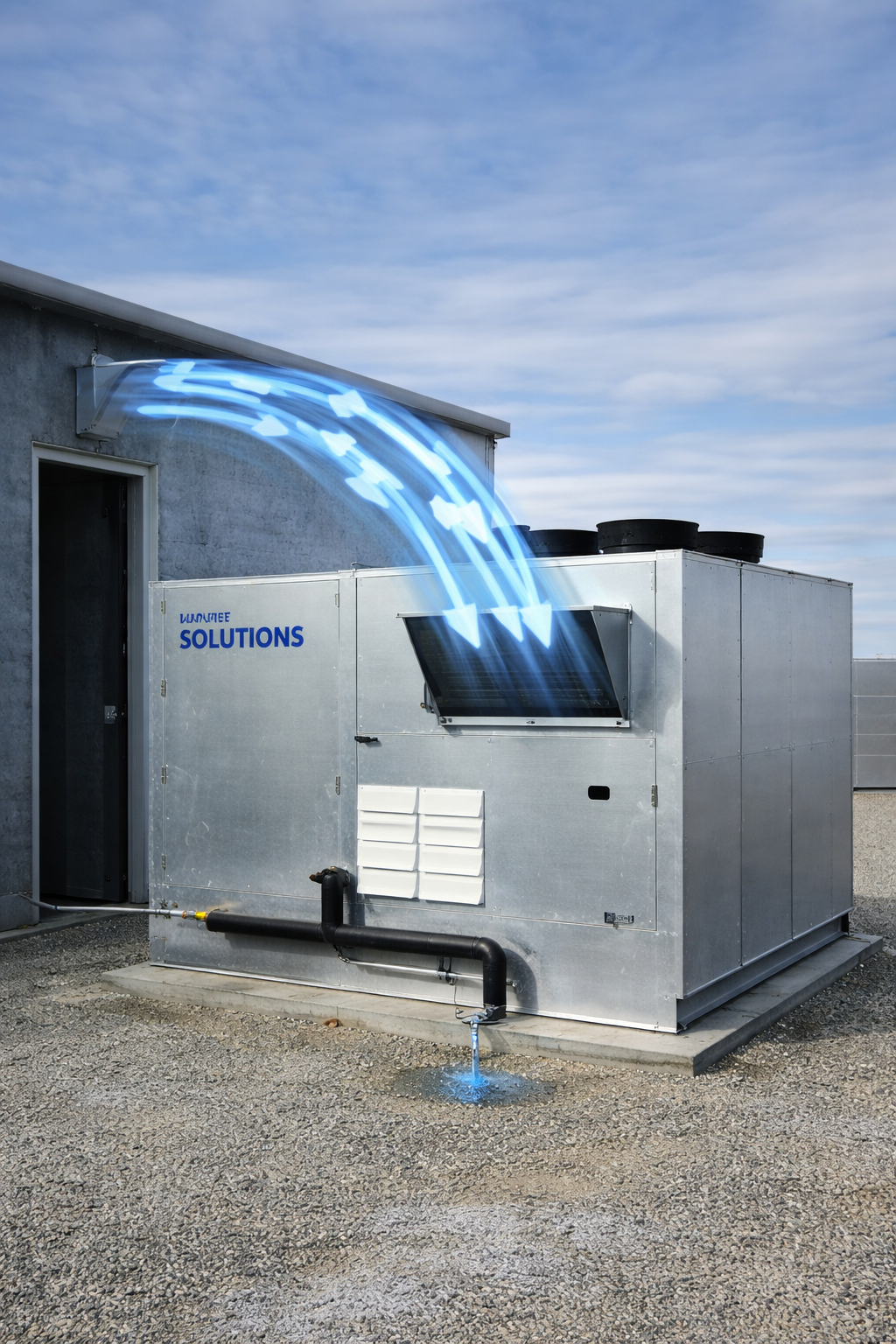
Here is the systems truth that ties water directly to climate: dehumidification capacity sets the upper boundary on water throughput. Plants move water into the air through transpiration. HVACD has to remove that water through latent load management. If moisture removal cannot keep up, humidity rises, VPD falls, transpiration slows, and the irrigation strategy you thought was precise starts looking like overwatering. Crop-steering guidance and dryback framework both depend on the room’s ability to support consistent water movement through the plant, not just moisture targets in the substrate.
If the room cannot condense that water back out consistently, the plant cannot keep pulling water the way your program assumes. Fertigation reduction is a popular response, which leads to deceased yields. Without moisture management the plants lives in the pathogen outbreak zone and powdery mildew is encouraged to grow on the leaves while pythium thrives in he root zone.
Water is also IPM, sanitation, and microbial risk
Water does not only arrive through drippers. It arrives through foliar and IPM applications, wet floors, unsleadd walls, poor drainage, and unsealed floors. Those water sources matter because they create non-productive moisture reservoirs where microbes can persist and spread. Any wetted irrigation or handling surface can become a biological habitat. In a cultivation facility, that means hose ends, tanks, drains, flood floors, runoff trays, and standing-water areas should all be treated as sanitation-critical zones, not afterthoughts.
So water is both a performance driver and a pathogen hotspot. That duality is what makes it so powerful and so dangerous. The same input that drives nutrient delivery and cooling can also become the medium for root disease, slime, emitter fouling, and microbial amplification when it is allowed to stagnate.
Water quality, treatment, mixing, delivery, drainage, feedback
Water comes into the building with a chemistry profile. It is filtered, treated, sometimes stripped by RO, sometimes sanitized by UV, then stored, mixed, injected, pressurized, and delivered. It moves into the media, through the plant, and out to the air. Some leaves through transpiration. Some leaves as runoff, which becomes feedback. Some unfortunately remans as puddles, poor drainage, or biofilm if discipline breaks down. Indoor cultivation becomes high performance only when that entire loop is engineered, measured, and maintained.
The business conclusion
Water is the easiest input to oversimplify and one of the fastest to punish sloppiness. If source water is inconsistent, storage is dirty, injection drifts, pressure is uneven, runoff is ignored, or dehumidification cannot keep pace, the crop becomes inconsistent. And inconsistency is expensive. It forces growers to back off irrigation, back off light, run safer setpoints, accept weaker drybacks, and tolerate weaker expression because the facility cannot support peak throughput.
But when water is treated as a closed-loop system...chemistry, sanitation, storage, mixing, pressure, distribution, drainage, and feedback; it becomes one of the clearest paths to repeatability. Stable water supports stable root-zone air/water ratios. Stable root zones support predictable uptake and drybacks. Predictable uptake lets light, CO₂, airflow, and humidity actually pay back. Water is not just what keeps cannabis alive. It is what lets it perform.
The good news is that growers do not have to figure this out alone. Experienced cannabis fertigation design and support is available from Demeter Design, Open Source Horticulture and others. Platforms like AROYA, GroSens, Trollmaster and Growlink can help you dial in your media mangment with dashboards and actionable data. And Riococo, Gordon and Cultiwool are great examples of clean and consistent substrate providers that are helping push the industry toward more measurable, repeatable cultivation by giving operators better visibility into water content, EC, temperature, media behavior, and steering response. The common thread across all of them is simple: better data and better substrate understanding create better decisions. That is how indoor terroir becomes intentional instead of accidental.