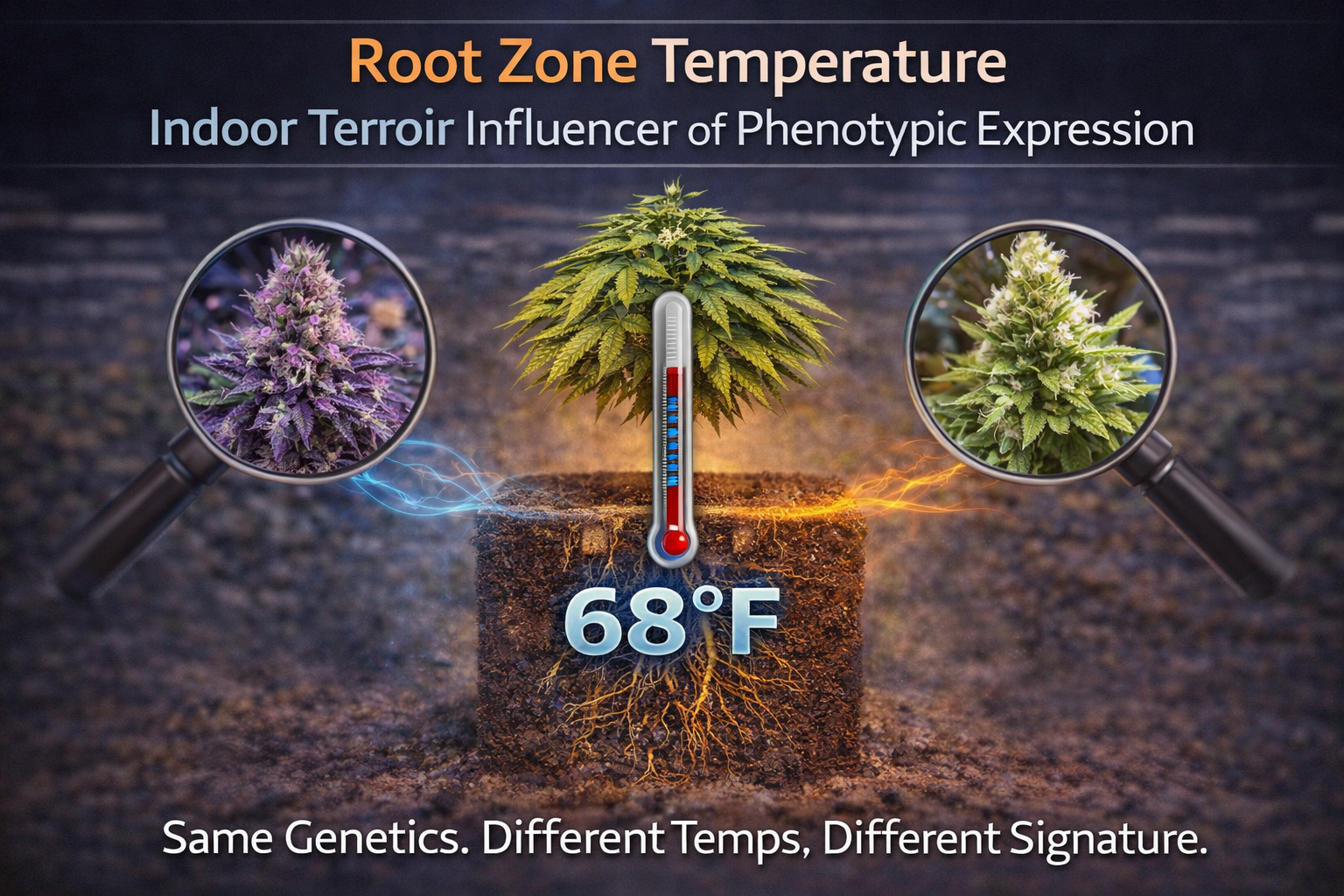
The underground climate that decides how the whole plant behaves
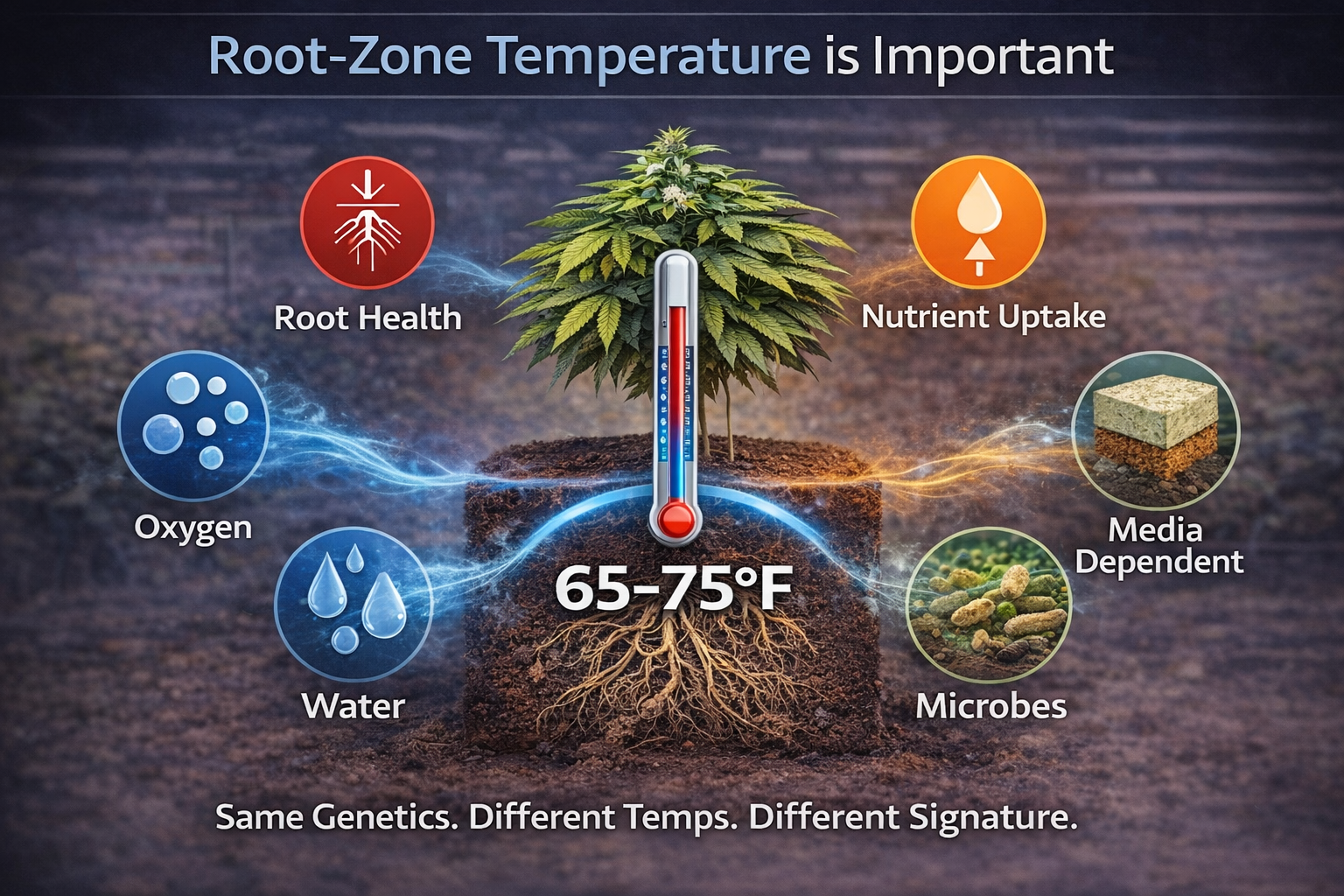
Root-zone temperature is one of the most under-managed levers in indoor cannabis, and it touches nearly everything growers care about: root growth, dryback behavior, oxygen availability, nutrient uptake, microbial pressure, plant confidence, and the consistency of expression room to room and table to table. Crop-steering guidance from AROYA puts root-zone temperature alongside water content, EC, and oxygen availability as a core variable in effective root-zone management, and they cite a practical target band of roughly 65–75°F (18–24°C) for nutrient absorption and root metabolism.
That range matters because the root zone is not simply “wet media.” It is an air-water-temperature system. When root-zone temperature is stable and appropriate, water uptake is steadier, oxygen dynamics are more favorable, and the plant is better able to keep pace with the aerial climate you are trying to create. When it drifts too cold, the crop often slows down below the surface before the canopy tells you why. When it runs too warm, oxygen availability falls and microbial risk can rise. The plant may still look superficially okay for a while, but the whole system becomes less forgiving.
Bigger roots, bigger fruits is not just a slogan
Root-zone temperature influences root growth rate, branching behavior, water uptake velocity, nutrient uptake, and the pace at which the media turns over between irrigations. Broader controlled-environment plant research shows that root-zone temperature materially affects growth, photosynthesis, nutrient dynamics, and pigment accumulation, even when the shoot environment is held constant. In other words, the plant is not only reacting to what is happening above the media. It is constantly integrating signals from below it.
That is why a “perfect room” can still produce inconsistent plants. The canopy may look uniform, but if some root zones are cooler because they sit in a stronger airflow lane, closer to a cold slab, near a supply throw, or on a wetter irrigation circuit, then the plant responses will drift. Same recipe, same light, same room, different root-zone behavior. Indoor terroir shows up underground long before it shows up in the jar.
The root zone is not water. It is air, water, and temperature.
The root zone should be thought of as a dynamic physical system, not just a container holding moisture. Temperature changes how fast water redistributes through the media, how much dissolved oxygen the solution can carry, how quickly oxygen is consumed, and how active the rhizosphere becomes. AROYA’s crop-steering guidance explicitly links successful root-zone management to water content, EC, temperature, and oxygen availability together, not separately. Grodan makes the same systems argument in its root-zone management content, emphasizing that oxygen availability, water management, and sensor-informed monitoring are central to plant resilience and performance.
That is one reason drybacks do not behave the same way in every room, even when irrigation timing is identical. A cooler, wetter, less oxygenated root zone may hold moisture longer and dry back differently than a warmer, more active one. So when growers think they are seeing an irrigation problem, they may actually be seeing a root-zone temperature problem that is changing the media’s behavior and the plant’s willingness to pull.
Water temperature is root-zone temperature, at least for a while

Every fertigation shot is a thermal event. If your irrigation water is materially warmer or cooler than the substrate, you are creating repeated temperature oscillations in the root zone. This matters most in smaller media volumes, propagation, early veg, and any production style where root mass is still limited and the media has lower thermal inertia. AROYA’s and other leaders in indoor cultivation highlight the importance of media size and saturation points, substrate choice and behavior, EC and air/water ratio management through irrigation strategy to drive performance because substrate environment is such a strong governor of how the plant responds.
At scale, this becomes a consistency issue. Long line runs, water holding conditions, exposed irrigation lines, proximity to hot or cold surfaces, and zone-specific plumbing layout can all create real water-temperature differences by the time solution reaches the crop. That means “same recipe” does not automatically mean same plant experience. With consistent and appropriate water and room temperature management, root metabolism and drinking behavior will be consistent, predictable and optimizable.
Airflow controls the root zone too
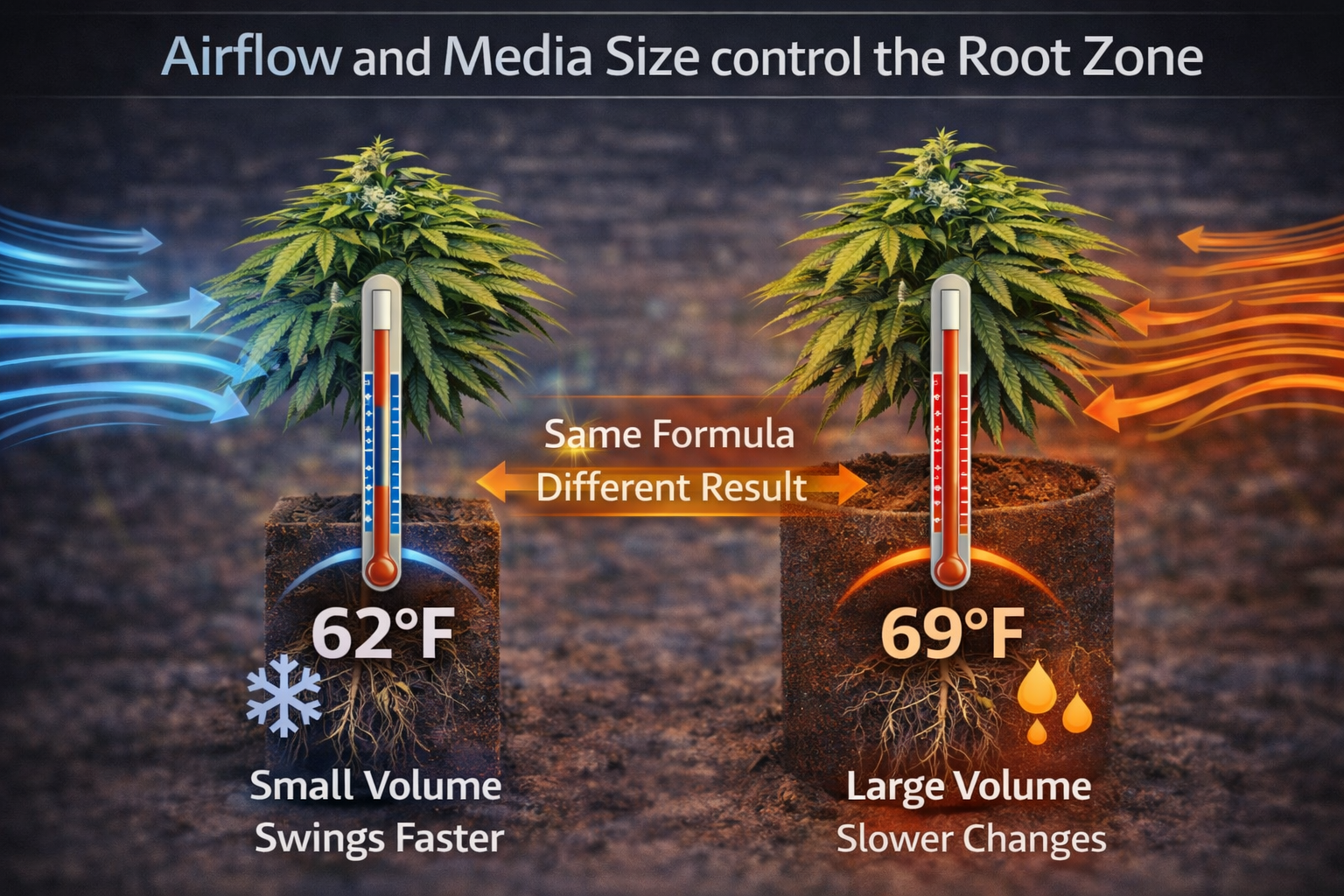
Growers usually think of airflow as a canopy issue, but airflow absolutely influences the substrate and container environment. It changes convective cooling at the pot or block surface, affects evaporation from upper media layers, and influences how quickly the top profile dries relative to the lower profile. If under-canopy or lane-level airflow is uneven, root-zone temperature and dryback behavior can become uneven too. That is one reason airflow and root-zone management should not be treated as separate conversations.
This is also where indoor facilities can borrow an important greenhouse lesson: root-zone climate is often too expensive or too sensor-sparse to measure everywhere, so environmental uniformity has to do some of the work. If you cannot afford dense root-zone sensing across an entire room, then HVACD delivery, pot-level airflow, irrigation-water temperature, and slab or bench conditions become part of your root-zone strategy whether you intended that or not. Airflow also factors into transpiration rate and potentially media dry backs so inconsistent airflow will create microclimates where not all the plants drink the same; ultimately leading to different media saturation levels and root zone conditions.
Media, container, and volume change the thermal behavior
Rockwool, coco, and soil do not behave the same thermally or hydraulically. Grodan’s cultivation materials emphasize that stone wool is especially compatible with precision irrigation and crop steering because it offers consistent water-content behavior and can be monitored continuously with tools, which track water content, EC, and substrate temperature 24/7. That consistency is valuable because it makes environmental cause-and-effect easier to see.
Container style matters too. Fabric pots, rigid pots, bags, slabs, distance from light, and bench height all change heat exchange. Media volume matters because thermal mass matters. Small blocks and small pots can change temperature quickly and are highly sensitive to irrigation-water temperature and local airflow. Larger volumes change more slowly, but they can also conceal persistent cold or wet pockets longer. In practice, that means small media volumes can swing faster, while larger ones can hide problems better. Finding best practices to manage the variables takes some visibility into the root zone by stage of growth.
Measuring root-zone temperature: powerful, necessary, and still incomplete
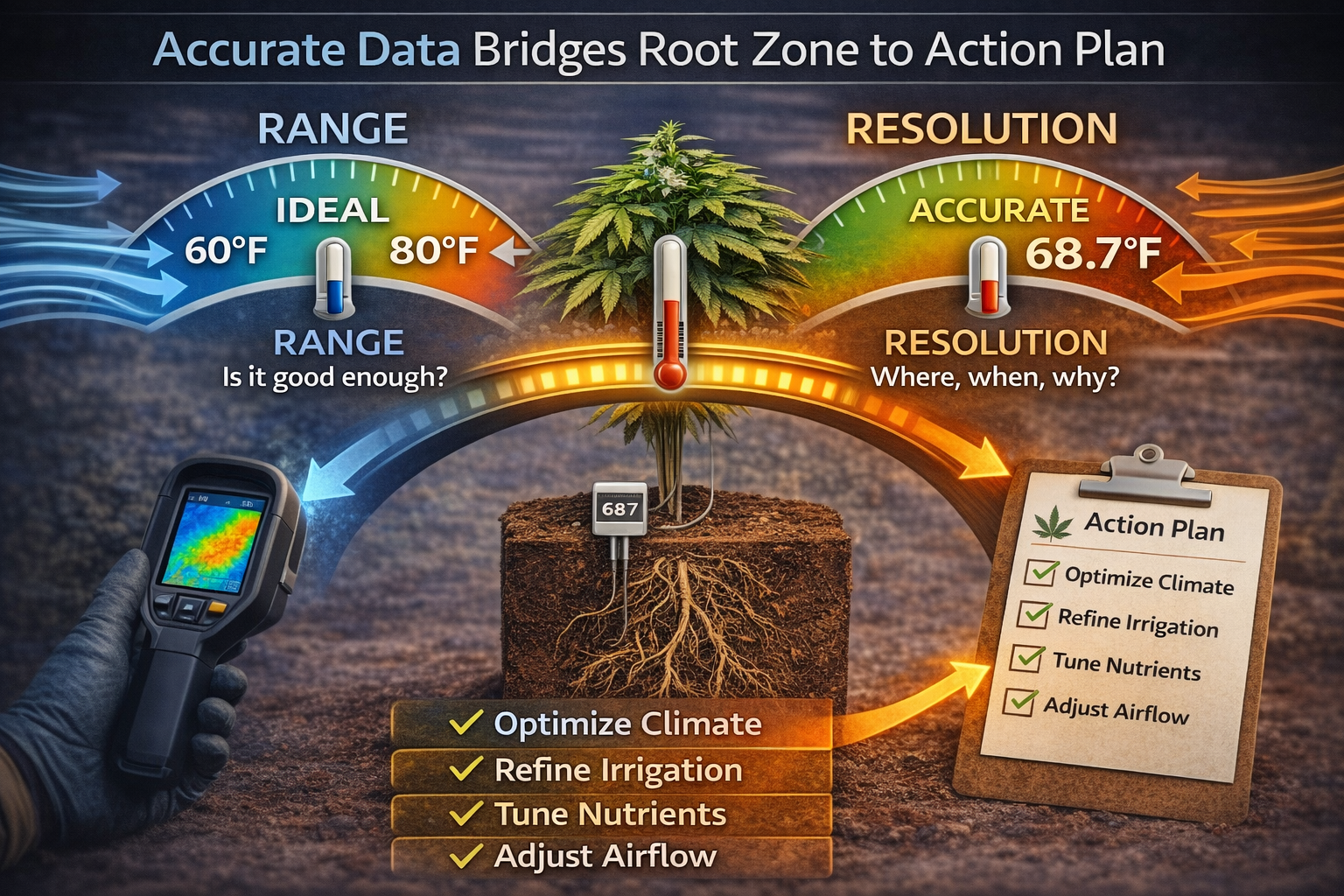
This is where modern sensing has changed the conversation. Various platforms specifically track environmental data and root-zone data and which includes substrate temperature as a tracked variable inside the media, not just in the room. Their crop-steering guide is clear that successful growers are using sensor-based feedback to manage root-zone conditions in real time.
Sensors and data interpretation have come a long way but its always important to consider the sensor accuracy, calibrate regularly, and trust but verify. These tools are valuable because root-zone temperature is invisible otherwise. They let growers correlate irrigation, dryback, climate, and plant response instead of guessing from symptoms alone.
That said, the limitation is density. Even excellent sensors only tell the truth about where they are placed. One of the hardest realities in cultivation is that you almost never have enough sensors to fully represent a large room. Front versus back, edge versus center, higher-airflow lane versus calm lane, top slab versus bottom slab, bench versus floor — all of these can behave differently. So substrate sensors are best understood as powerful truth points, not complete truth everywhere. They are essential for spot-checking, trend building, and identifying representative zones, but they do not eliminate the need to manage the room mechanically and thermally as a whole. This is why integrated environmental control is so important because controlling root zone environment is connected to water, transpiration, VPD, airflow, and room temperature.
Calibrated spot checking still matters
Because sensor density is limited, calibrated spot-check tools still matter. Thermal imaging can reveal row to row differences that fixed sensors miss, and a disciplined handheld measurement routine can help validate what permanent sensors are saying. This is especially useful when you are trying to determine whether a sensor is representative, whether one bench is colder because of supply-air interaction, or whether one irrigation zone is receiving solution at a different rate than another.
The larger point is that root-zone temperature management is part direct measurement, part good sampling, and part mechanical design. You measure enough to see the trend, and then you use HVACD, airflow, meda behavior, irrigation-water temperature, and room uniformity to reduce the reasons the trend would differ elsewhere.
Root-zone temperature is the bridge between fertigation and climate
A lot of cultivation frustration is really a systems mismatch. The irrigation strategy assumes the room can pull water through the plant. The climate may not support that. Or the root zone may be too cold, too wet, or too oxygen-poor to support the uptake pattern the grower is aiming for. Then drybacks miss target, EC stacks in unexpected ways, and the team starts reacting by changing shots rather than fixing the upstream constraint.
This is why root-zone temperature belongs in the same sentence as climate control. Most guides repeatedly frame crop steering as the combined management of climate and root-zone conditions, not irrigation in isolation. Root-zone temperature is not a side note to fertigation. It is one of the conditions that determines whether the irrigation strategy behaves as intended in the first place.
Pathogens and “stagnation biology” start below the surface too
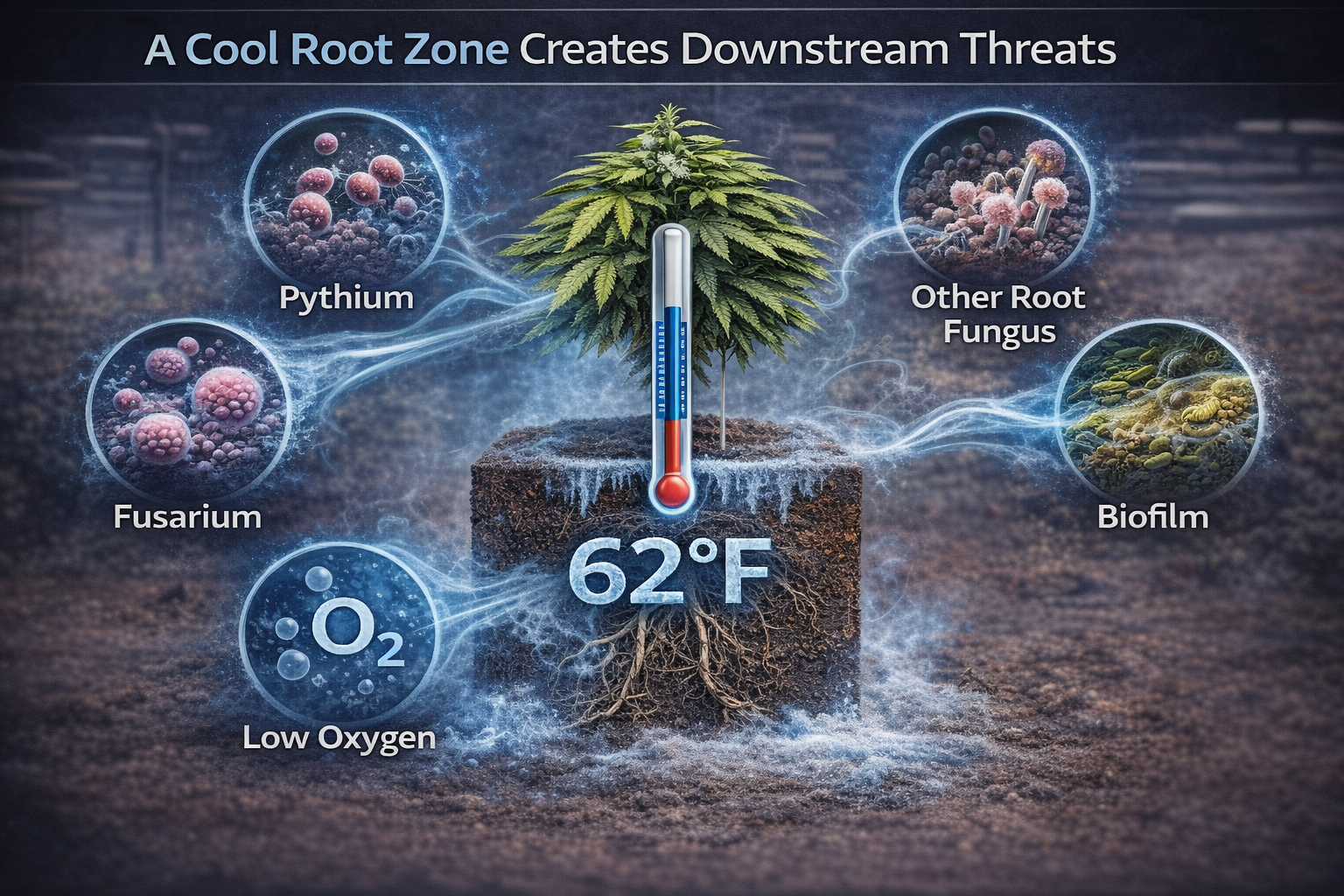
A cold, wet, under-oxygenated root zone is one of the most common upstream conditions that supports poor root health and microbial opportunity. Proper root-zone management content emphasizes that oxygen availability, water management, and microbial balance are core to plant resilience. That lines up with what cultivators see in the field: when root zones become biologically stagnant, canopy symptoms often show up later and get misdiagnosed as nutrition, irrigation timing, or "tired" genetics.
Indoor terroir becomes very real here. A facility can develop repeatable weak lanes, not because of random bad luck, but because root-zone temperature, saturation, and airflow remain subtly wrong in the same parts of the room run after run. Those repeatable weak zones are often silent yield taxes.
The lesson from large-scale facilities
In large facilities, growers cannot rely on sensor density alone to manage every square foot. That is why once a facility gets large enough, root-zone temperature becomes an engineered variable, not just an observed one. When you cannot measure everywhere, you have to design for uniformity everywhere.
Indoors, the same principle holds even when the tools are different. We are controlling the root zone all the time, whether we admit it or not; by the temperature of the irrigation water, by the airflow at media level, by the HVACD supply pattern, by the room temperature at lights on and lights off, and by how evenly we remove latent load day and night.
Practical targets and operating guidance
A practical operating framework is to keep root-zone temperature generally within the 65–75°F band that AROYA identifies as useful for nutrient absorption and root metabolism, then tighten your own cultivar and media specific SOPs around that zone. Use substrate sensors in representative locations, but do not confuse representative locations with full room truth. Track root-zone temperature together with water content, EC, irrigation timing, and climate so you can see relationships rather than isolated numbers.
Use irrigation-water temperature intentionally. Avoid letting it become a hidden variable that changes by zone or time of day. Watch and measure the impact of under-canopy airflow so one lane is not significantly different from the next. And remember that root-zone control is a 24-hour job: day and night, lights on and lights off, irrigating and drying back, the underground climate keeps shaping the plant.
The business conclusion
Root-zone temperature is not a detail. It is a multiplier. It determines whether fertigation behaves consistently across the canopy, whether drybacks are steerable or chaotic, whether the root zone stays oxygenated and metabolically active, and whether the room expresses one cultivar signature or many. Substrate sensors from platforms are powerful because they make the invisible visible, but no one should pretend sensors alone solve the problem. Large rooms will always require a combination of sensing, spot-checking, and disciplined mechanical control with a maintenined HVACD system.
When you stabilize root-zone temperature, you do more than reduce problems. You unlock one of the foundations of YOUR indoor terroir.