
The most familiar but often misunderstood lever

Temperature is the parameter every grower feels they understand. It is the first number most teams look at when they walk into a room, and the first number most controllers display. But temperature is often oversimplified because the number on the wall is not the same thing as the number the plant experiences. In a real cultivation room, temperature exists at several layers at once: room air temperature, leaf temperature, root-zone temperature, irrigation water temperature, and the temperatures of walls, floors, ductwork, and mechanical surfaces that quietly shape condensation risk and equipment behavior. When those temperatures drift apart, the crop does not experience one environment. It experiences several.
That is why temperature belongs in any serious discussion of indoor terroir. It governs metabolic pace, transpiration demand, CO₂ assimilation, nutrient movement, pathogen risk, and mechanical performance. Too hot and the crop can lose composure fast: higher VPD, greater evaporative demand, terpene risk, reduced quality, and a room that may begin outrunning its own dehumidification capacity. Too cold and the crop slows down: metabolism softens, uptake becomes less aggressive, moisture lingers longer in the canopy, and disease pressure becomes easier to engineer by accident. Temperature is powerful not because it is dramatic, but because it quietly influences almost everything else.
Room temperature is not the plant’s experience. Leaf temperature is.

This is the first principle that separates basic environmental control from real crop steering. Cannabis runs on leaf temperature, not thermostat temperature. Photosynthesis, stomatal behavior, transpiration, and enzyme activity are all experienced at the leaf. The classic cannabis photosynthesis work from Chandra and colleagues found that Cannabis sativa could be efficiently cultivated in the range of about 25–30°C under high light, and later work comparing varieties found strong photosynthetic performance around 30°C, with declines emerging as temperatures moved toward 35–40°C. That gives a credible scientific basis for the common operational instinct that productive cannabis tends to like warm—but not too warm—leaf conditions during active bulking phases.
Translated into practical cultivation language, that is why many high-performance rooms aim for leaf temperatures in roughly the 78–82°F range during high-throughput bulking phases, especially when PPFD and CO₂ are elevated. That range is not a universal law, and it is not a substitute for cultivar-specific work, but it aligns with the 25–30°C temperature-response literature and with the physiological reality that warmer leaves support faster metabolism up to a point. As temperatures climb beyond that useful zone, the crop can start losing efficiency or quality.
Late in flower, many operators intentionally move cooler. A practical target is often 70–75°F leaf temperature in finishing stages, especially when the goals shift from raw throughput to tighter expression, more stable finishing, color development in responsive cultivars, and better protection of volatile aroma. The direct peer-reviewed cannabis evidence here is more limited and more genotype-dependent than the bulking-phase temperature data, so it should be framed honestly as a common operational target rather than a universal scientific optimum. What the literature does support is that cooler temperatures can increase anthocyanin accumulation in hemp/cannabis genotypes, although the strongest color responses in published work occurred at temperatures much colder than most commercial flowering rooms would ever run. In other words, cooler finishing can influence color pathways, but extreme cold is not a practical template for production cannabis.
Why two rooms with the same thermostat can produce different flower
Because air temperature is only one part of the leaf energy balance. Leaf temperature is shaped by radiant load from lights, convective cooling from airflow, transpiration rate, humidity, CO₂ level, canopy density, and the temperature of the air being delivered to the plant. That means two rooms can both read 78°F and still produce different phenotypes if one room has better canopy airflow, more uniform supply delivery, lower hot-spot intensity, or better humidity control. One room may hold leaves in a productive range; the other may let some leaves run hot and others stay cool. That is not a small difference. That is a different crop.
This is also why supply and return design matters so much. Temperature control is not really about the thermostat. It is about whether conditioned air reaches the canopy evenly, whether hot air from lighting is mixed rather than layered, and whether the room avoids hot pockets, cold dumps, and edge-to-center gradients. A room can satisfy the sensor and still fail the crop.
Temperature is an amplifier for CO₂, water use, and nutrient movement

The most expensive inputs in indoor cultivation—nutrients, light and CO₂—only pay back when the plant’s metabolism can keep up. Temperature is one of the main governors of that pace. The Chandra work showed that elevated CO₂ increased net photosynthesis and water-use efficiency substantially in cannabis, but that response was still being measured in a temperature window centered on productive plant function rather than heat stress. Put simply: CO₂ works best when temperature is appropriate for the plant to use it. Hotter is not automatically better, and cold can suppress the very throughput CO₂ was supposed to unlock.
Temperature also changes water use. As leaf temperature and VPD rise, transpiration demand generally rises too. That can be helpful when the crop is healthy and the room is mechanically capable, because transpiration supports cooling and nutrient movement. But it can also become expensive or destabilizing if the increase in water movement is not matched by increased photosynthetic return. More transpiration without more biomass is not smart steering. It is simply more latent load, more dehumidification burden, and often more operational cost.
Nutrient movement is tied into the same story. Warmer, actively transpiring plants usually move more water and therefore can move more dissolved nutrients. Cooler plants generally slow that movement. Plant physiology literature outside cannabis shows that low temperature and elevated CO₂ can both reduce respiration, translocation, and nitrate reduction, while higher temperature and lower CO₂ can increase them. Cannabis-specific nutrient studies do not yet map every one of these temperature interactions in detail, but the systems logic is clear: temperature changes the speed at which the whole hydraulic and metabolic network operates.
Root-zone temperature is the quiet governor of uptake
A root zone at 60°F does not behave like a root zone at 70°F, and a root zone at 85°F is another world entirely. Root-zone temperature affects water uptake, oxygen solubility, nutrient mobility, and microbial activity around the roots. There is surprisingly little peer-reviewed cannabis-specific work that defines an exact commercial “perfect” root-zone temperature range, so it is important not to pretend otherwise. But plant-environment research broadly shows that controlling root-zone temperature changes growth, pigments, and plant performance, and commercial horticulture has long treated root temperature as a real lever rather than a secondary detail.
That is why irrigation water temperature matters more than many teams realize. Every fertigation event is also a thermal event. It can warm or cool the substrate, influence dissolved oxygen behavior, change uptake dynamics, and alter how ready the plant is to respond to the aerial climate above it. In practice, root-zone temperature is one of the reasons a crop can seem “off” even when room air looks acceptable. The air may be right while the roots are slow, hot, oxygen-limited, or inconsistent.
Temperature and terpene preservation: where production meets quality
Growers know this one intuitively: hot rooms can ruin beautiful flower. The literature supports the basic premise that cannabinoids and terpenes are temperature-sensitive compounds, though much of the strongest thermal-degradation literature involves postharvest or analytical conditions at temperatures far above cultivation setpoints. That means caution is needed in how we talk about terpene loss during production. It is fair to say that excessive heat raises risk for volatile aroma preservation and can push the plant into stress responses that degrade commercial quality. It is not scientifically clean to claim that every warm afternoon directly “boils off terps.” The better framing is that heat stress, unstable leaf temperature, and hot finishing conditions can compromise the processes and chemistry that support premium expression.
This is exactly why late-stage cooling is so common operationally. Growers are not only trying to reduce disease risk or push color. They are also trying to slow metabolism, protect finishing quality, and keep the crop from outrunning its own chemistry in the final stretch. The exact temperature target depends on cultivar, airflow, humidity, and brand goals, but the logic is sound: high-output bulking and premium finishing are not always served by the same temperature strategy.
Measuring temperature correctly: the leaf, not the wall
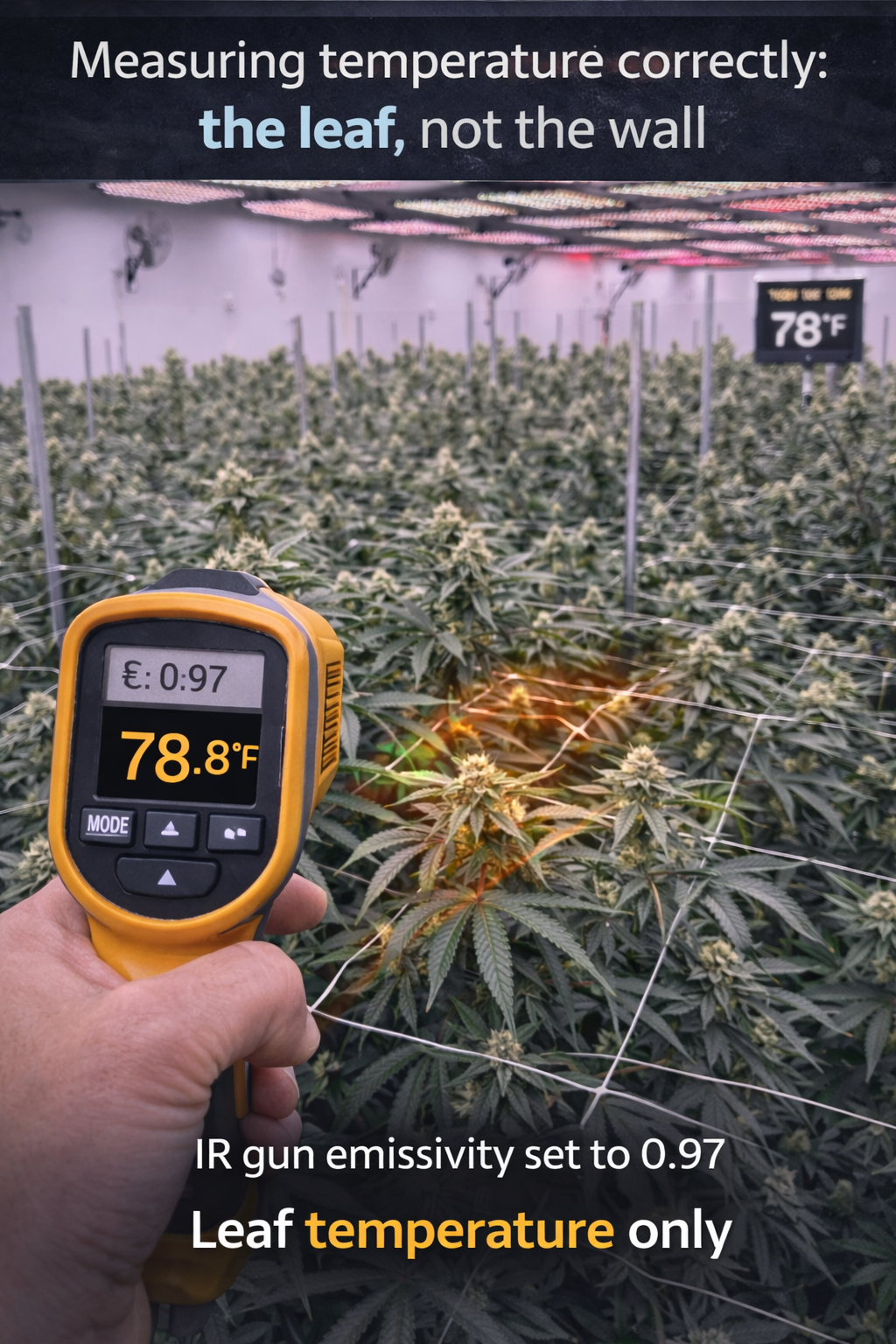
If temperature is going to become a true steering variable, then it has to be measured at the plant. Thermal cameras and IR tools are extremely useful because they show what the canopy is actually experiencing. They help identify hot spots, cold dumps, edge effects, uneven airflow, and supply/return problems that a single room sensor will never reveal. They also help bridge cultivation and HVACD by showing whether mechanical changes actually altered leaf conditions instead of just changing the average room air temperature.
For spot checks, an emissivity-adjustable IR gun is a valuable tool, and a working emissivity around 0.97 is a defensible setting for leaf measurements. Published thermography work on leaves and canopies commonly uses values in the 0.97–0.99 range, and one plant-physiology paper explicitly reports infrared leaf measurements with emissivity set to 0.97. That is close enough to support your operational guidance without pretending there is one magic value for all surfaces and conditions.
A FLIR or similar thermal camera adds another layer because it can reveal patterns, not just points. One hot leaf may be a curiosity. A strip of hot canopy under a poorly distributed light zone or weak airflow lane is a design problem. One cold patch may be coincidence. A repeating cold dump at supply discharge is a control problem. Thermal imaging turns temperature from a guess into a map.
Outside ambient temperature matters because the equipment lives in the weather
Temperature is not only a plant story. It is also an equipment story. Outdoor ambient conditions affect condensing pressure, compressor behavior, and the operating range of air-cooled equipment. Manufacturers routinely publish low-ambient controls and operating envelopes because performance changes with outdoor temperature, especially for condensing units and packaged systems. Carrier and AAON both note low-ambient features or operating ranges in their commercial equipment literature, and AAON explicitly ties modulating hot gas reheat to more stable dehumidification under low sensible heat conditions. That matters because the same room setpoint can be easier or harder to hold depending on what is happening outside the building and how the system is configured to handle it.
This is where growers sometimes misread temperature problems as cultivation problems when they are partly mechanical problems. A room that is stable in spring may hunt in winter. A room that finishes beautifully at one site may struggle at another because the outdoor design conditions and equipment strategy are different. Temperature, then, is not just a room setpoint. It is a relationship between plant demand, internal loads, and the ability of the mechanical system to reject or manage heat under real site conditions.
Temperature and humidity are inseparable
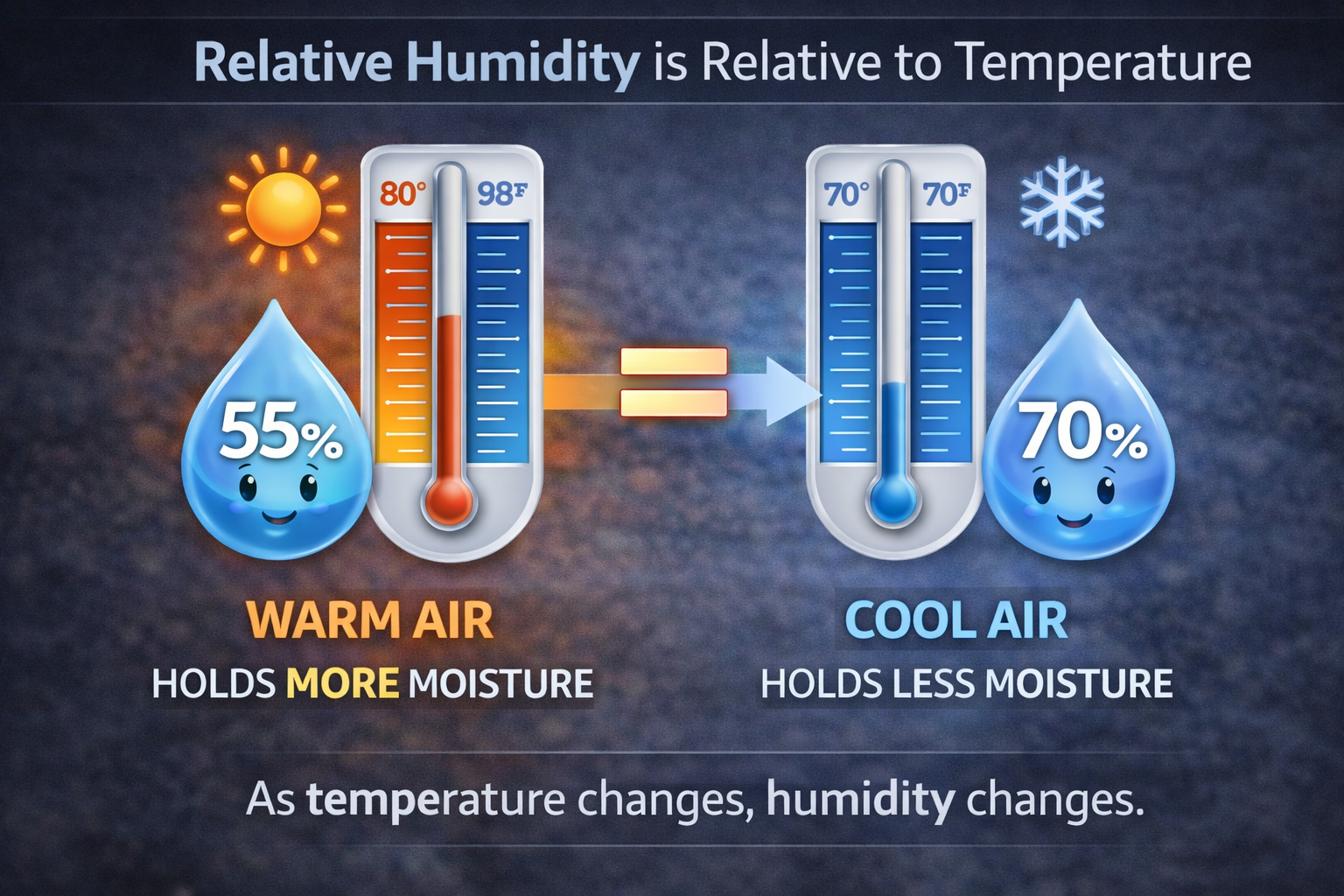
Relative humidity is relative to temperature. That means every temperature decision changes the moisture picture of the room, and every humidity-control challenge is partly a temperature-control challenge. Warmer air can hold more moisture, and depending on the equipment sequence and plant stage, slightly warmer operating conditions can sometimes help a room tolerate moisture load more gracefully. But that is not a blank check to “solve humidity with heat.” The plant still has to like the leaf temperature, the product still has to protect quality, and the dehumidification system still has to remove the actual latent load.
This is why the best temperature strategies are coordinated strategies. They consider leaf temperature, dew point, airflow, latent capacity, and crop stage together. A colder room is not inherently better. A warmer room is not inherently more productive. The winning condition is the one where the plant stays metabolically productive, the room stays mechanically stable, and the product finishes with the expression the brand is chasing.
Practical stage targets
A realistic framework looks like this:
During aggressive vegetative growth and bulk flower under high PPFD and enriched CO₂, target productive leaf temperatures around 78–82°F as a practical range that aligns with the published cannabis optimum of roughly 25–30°C for photosynthetic performance. This is the phase where warmer leaf conditions can support throughput, provided airflow, humidity, and root-zone management keep the plant balanced.
During finishing and late flower, many teams deliberately pull leaf temperatures into roughly the 70–75°F range to protect quality, shape color in responsive cultivars, tighten finish behavior, and reduce the risk that the crop outruns aroma preservation. Treat this as a practical commercial target rather than a universal scientific optimum, because the literature for exact late-flower drug-type cannabis temperature targets is still thinner than growers would like.
For root zones, the safest statement is that consistency matters and extremes hurt. Avoid letting irrigation water or substrate temperature become an unmeasured source of stress. Root temperature belongs on the dashboard, not in the blind spot.
The business conclusion
Temperature is the most familiar lever in cultivation, and that familiarity is exactly why it gets underestimated. In modern indoor cannabis, temperature is not one number. It is the combined control of leaf temperature, root-zone temperature, delivered air temperature, surface temperature, and outdoor conditions that shape equipment performance. It is what determines whether photons and CO₂ become biomass, whether transpiration stays in a useful range, whether nutrient movement keeps pace, whether the room holds together mechanically, and whether the crop finishes with real quality.
Get temperature right and it unlocks almost everything else. Get it wrong and you can spend heavily on light, CO₂, fertigation, and genetics only to produce mediocre, inconsistent flower. Temperature is indoor terroir with a thermostat—but only if you respect the difference between what the room says and what the plant feels.