The invisible input that makes every other input work
Most growers treat airflow like a comfort setting: leaves are moving, so the room must be fine. Engineers often treat it like a duct problem: there is supply air, return air, and enough CFM, so the room must be fine. Both views miss the real point. Airflow is not decoration, and it is not a side effect of HVACD. Airflow is the mass-transfer engine that determines whether light, CO₂, temperature, humidity, irrigation, and dehumidification are actually experienced by the plant the way the setpoints suggest.
At the leaf surface, airflow controls the thickness of the boundary layer: the thin sheath of slower, more saturated, CO₂-depleted air that clings to the leaf. When that layer is thick, heat, water vapor, and CO₂ exchange slow down. When it is thinned by deliberate air movement, gas exchange improves, transpiration can keep pace with photosynthetic demand, and leaf temperature becomes more predictable. That is why airflow is not just a disease-control tool. It is a photosynthesis tool, a temperature tool, a CO₂-delivery tool, and a steering tool.
This matters even more in cannabis because modern facilities are trying to stack high PPFD, enriched CO₂, tight VPD targets, aggressive dry-back strategies, and dense canopies into the same room. Under those conditions, weak or uneven airflow does not merely reduce comfort. It creates invisible non-uniformity. Two plants in the same room can experience different leaf temperatures, different stomatal behavior, different evaporative demand, and different CO₂ access simply because the airstream is different at the leaf surface. That is how one room produces multiple phenotypes.

Airflow is how CO₂ actually gets delivered
CO₂ is not valuable because a sensor says the room is at 1,000 or 1,200 ppm. It is valuable only when that CO₂ is delivered in the moving airstream to the leaf surface quickly enough to replenish what photosynthesis is consuming. Fluence notes this directly in cannabis: the plant can only absorb the CO₂ immediately surrounding leaf tissue, and inadequate airflow can create canopy CO₂ depletion even when ambient room concentration is on target. UMass makes the same point from greenhouse science: moving air replaces the CO₂-depleted boundary layer with fresher air, and when CO₂ is being added, better air movement can allow lower enrichment levels to achieve the same plant response.
That is the key mental shift for growers and engineers alike: CO₂ is not just injected into a room. It is delivered through an airflow pattern. If the supply, return, circulation fans, rack geometry, and canopy resistance do not work together, then CO₂ is being purchased in bulk air but not delivered efficiently to stomata.
The target everyone argues about

There is not yet a single peer-reviewed cannabis paper proving one universal “perfect” canopy velocity across all cultivars, room geometries, and lighting intensities. What the broader controlled-environment literature does show is that canopy-level air velocity is a major driver of gas exchange and growth, that inner-canopy air speeds should stay above roughly 0.2 m/s for adequate exchange, and that air current above the canopy may need to exceed 1.0 m/s to maximize gas exchange in closed chambers. At the same time, peer-reviewed chamber work found that biomass was maximized around 0.3–0.5 m/s in that crop and system, while higher values could depress growth, which is a useful reminder that "more air" is not automatically better but consistent airflow is paramount.
Cannabis-specific commercial guidance tends to land higher than lettuce because cannabis is commonly grown under higher PPFD, higher transpiration demand, and denser flowering canopies. Early research recommends at least 0.2–0.4 m/s within the inner canopy which I a guidepost fo those embracing under copy lighting. The Cannabis Reseach Coalition and PIPP hoticulture partnered for an airflow study that show increased transpiration at 2m/s and yield gains with increase d velocity and control. Cannabis Business Times reports that many growers operate between 0.35 and 1.0 m/s at the canopy surface. Resource Innovation Institute, citing practical experience from vertical cannabis systems, notes that many experts reference 0.3–0.5 m/s as a minimum to remove the saturated boundary layer, while cannabis rooms in practice may need velocities up to 1.5 m/s depending on canopy density and load. That is why 0.8–1.0 m/s is a strong flowering commissioning target in high-light cannabis rooms: not because it is a universal law, but because it is a defensible, aggressive, real-world target that sits above the “just enough to move leaves” mindset while staying below clearly stressful wind regimes.
A useful way to say it is this: 0.8–1.0 m/s is often a very good place to start in flowering cannabis, but uniformity matters more than the headline number. An average of 0.9 m/s means very little if part of the room is at 0.2 and another part is being blasted at 1.6. Airflow is not an average problem. It is a distribution problem.
Airflow is three different metrics, and confusing them leads to bad design
Air velocity is what the plant feels, usually expressed in meters per second or feet per minute. Volumetric flow is what fans move, expressed in CFM or m³/s. Air exchange rate is how many times per hour the room volume is turned over. These are related, but they are not interchangeable.
The core relationship is simple:
Q = v × A
Where Q is volumetric flow, v is air velocity, and A is cross-sectional area.
And for room turnover:
ACH = (Q × 3600) / Room Volume
These formulas explain why “we added more fan” so often fails. If the air pathway is wrong, if the canopy is acting like a porous resistance, or if supply and return are poorly located, added CFM becomes turbulence, bypass, or short-circuiting instead of usable canopy exchange.
Measuring airflow in a cultivation room requires more than trusting wall sensors or whatever the HVACD controller is reporting. Room sensors and unit-mounted sensors are useful for trend data, setpoint verification, and identifying when the space is drifting, but they do not tell you how air is actually moving through the canopy. They tell you what the room is averaging, not what the plant is experiencing. That is why direct field measurement matters. Thermal hot-wire anemometers are built for low air-velocity work, and manufacturer guidance specifically distinguishes probe choice by airflow behavior: use a unidirectional probe when the airflow direction is known, and an omnidirectional probe when airflow is unknown or turbulent.
For cultivation, vane anemometers are often less useful in the low, highly variable airspeeds found inside and below the canopy. Product specs from Kanomax show vane probes typically start at higher measurable velocities than hot-wire probes, while hot-wire instruments are designed to resolve much lower airspeeds that are common in crop zones. In practice, a unidirectional hot-wire anemometer is preferred when you want to quantify directional canopy airflow and velocity, while an omnidirectional probe is valuable for finding weak-mixing zones, eddies, and low-airflow pockets where stale air can persist. Used correctly, these tools help explain why sensor data may look acceptable even when plant performance is uneven, and they let growers and engineers refine airflow strategy, verify design assumptions, and make smarter financial decisions about fan placement, HVACD adjustments, and capital allocation.

Supply and return configuration determine whether airflow reaches the plant or bypasses it
This is where many cultivation rooms quietly lose performance. Supply and return placement should not be treated as a drafting exercise after tonnage is selected. They define the flow loop. If supply air can travel directly to return without properly interacting with the canopy, you have short-cycling. The room may have respectable total airflow on paper while still leaving stagnant canopy zones and fake confidence in room-average sensors. Acta Horticulturae work on plant-factory air distribution showed that poorly designed systems exhibited short-circuiting behavior and stagnant shelf zones, while better-localized air distribution improved canopy air speed and uniformity. More recent vertical-farm CFD studies likewise show that the location and configuration of air supply and exhaust materially change air uniformity, crop-zone conditions, and energy use.
For cannabis, that means airflow patterns must be considered together with supply throw, return capture, rack spacing, corridor width, and canopy density. A room with ceiling supply and high return may look elegant on plans while effectively bypassing the lower canopy. A room with too little space around racks can be “choked out,” preventing mixing no matter how many fans are added. Air delivery has to be designed as a loop that conditions bulk air, pushes that air through or across the canopy, delivers CO₂ in that airstream, and then pulls the changed air back through returns without immediate bypass.
Why airflow is a crop-steering lever
Airflow changes boundary-layer conductance. That means it changes how fast the plant can shed heat, how fast water vapor leaves the leaf, and how quickly CO₂ is replenished at the stomata. In practical terms, that means airflow changes leaf temperature, transpiration rate, irrigation demand, nutrient mass flow, and the degree to which VPD targets are real at the leaf surface rather than just on a wall sensor.
This is why airflow interacts with crop steering. Increase airflow, and you usually increase convective exchange and reduce leaf-to-leaf temperature variability. That can allow the plant to keep up with higher light and higher CO₂. It can also increase transpiration demand and dry the medium faster, forcing irrigation strategy and root-zone oxygen strategy to adapt. Push too little air, and the plant falls behind the room. Push too much air, especially in warm or already stressful conditions, and you can drive excessive transpiration, mechanical stress, or stomatal changes that do not serve yield. Recent review work suggests even small wind-speed increases in greenhouse-like environments can boost photosynthesis, but it also warns about possible downsides including excessive transpiration and mechanical effects.
In other words, airflow is not a standalone dial. It is a coupling parameter. It determines whether temperature, humidity, CO₂, and irrigation setpoints are actually felt by the plant the way the controller says they are.
Airflow, leaf temperature, and what the HVACD system can really do
Leaf temperature is the plant truth. Increasing air movement thins the boundary layer and increases convective exchange, which is one reason wind can improve CO₂ uptake and, under some conditions, improve water-use efficiency through more efficient cooling. Practically, better canopy airflow reduces leaf-temperature stratification and can keep leaf temperature closer to the intended target rather than letting isolated hot leaves run away from the room average.
That matters for HVACD because plant temperature and room dry-bulb are not the same thing. In a well-mixed room, stronger canopy airflow can sometimes let growers run a slightly warmer room while holding acceptable leaf temperature, which can be useful when trying to maintain plant function without overcooling the room. But the next step is crucial: whether that warmer room translates into better latent performance depends on the equipment and the control sequence. Trane’s dehumidification guidance shows that lower airflow through the coil can improve moisture removal because reduced airflow lowers supply-air temperature and condenses more moisture, and colder supply air can also dry the space more effectively. So the right lesson is not simply “more room temperature equals more dehumidification.” The lesson is that canopy airflow strategy and HVACD fan/coil strategy have to be designed together.
That is also why not all fans are created equal. EC fans are inherently more efficient than traditional centrifugal fans and are fully speed controllable, which matters when airflow needs to be tuned by stage, by tier, or by latent demand rather than left fixed at one blunt setting. In facilities that run circulation continuously, fan efficiency and controllability are not small details. They are operating-cost and uniformity decisions.
Airflow is also a disease and quality lever
Everyone already knows airflow helps reduce mold risk, but the more useful framing is that dead zones are usually engineered, not random. When canopy sections repeatedly sit in wetter, less mixed air, those locations become predictable outbreak sites. UMass notes that moving air removes canopy moisture and reduces foliar disease risk. A recent cannabis greenhouse review reports that maintaining air movement at roughly 0.5–1.0 m/s appears to be an effective target for microbial suppression, and experimental work cited there found that enhanced airflow around maturing cannabis inflorescences reduced microbial populations in tissue samples.
In commercial terms, this is not just about passing a microbial test. It is about preserving sellable biomass, reducing trim waste, keeping maturation uniform, and protecting brand consistency.
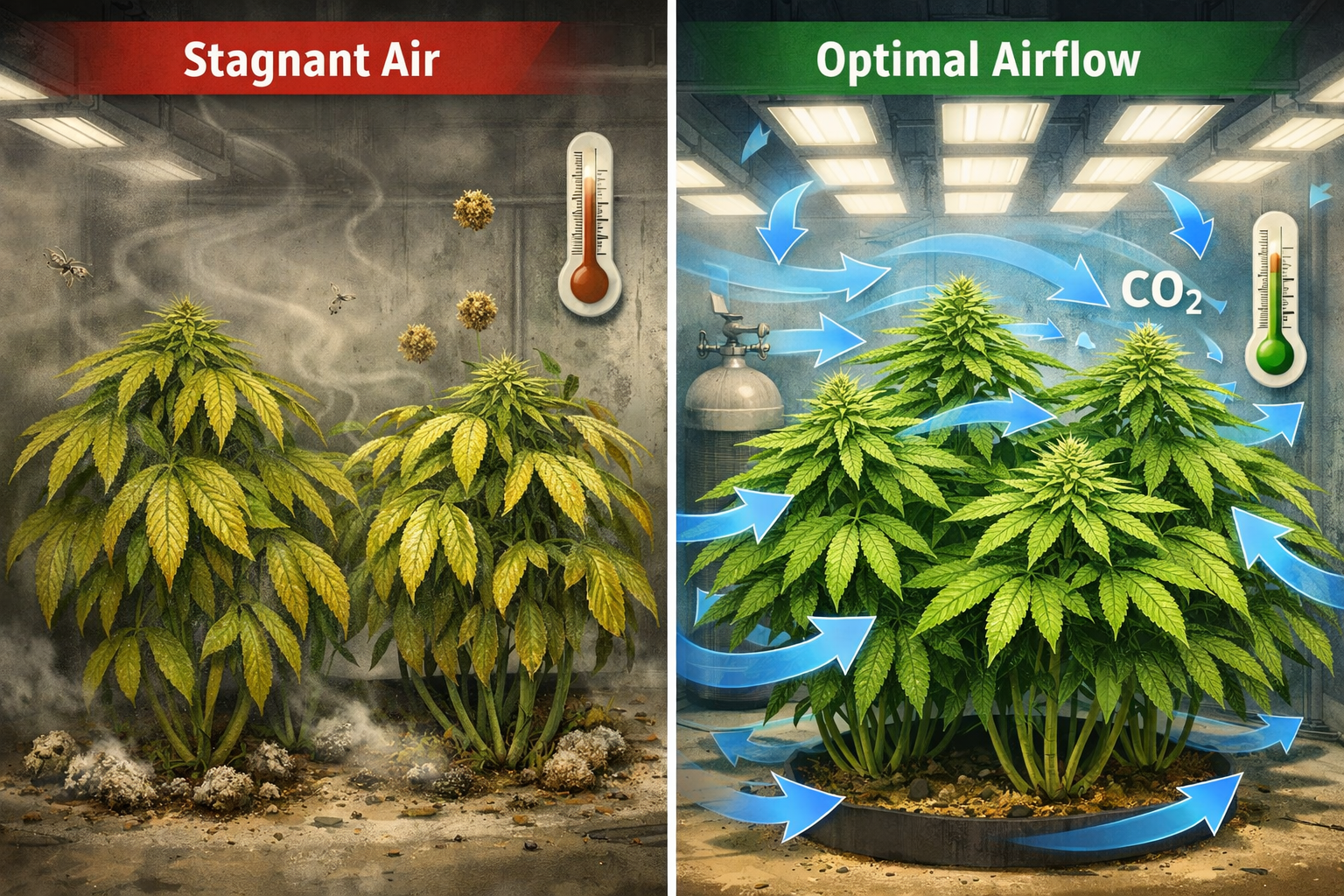
Air Cycling: Why Total Airflow Means Nothing If the Whole Room Does Not Participate

Air cycling is one of the most misunderstood concepts in cultivation room design. A room can have a high calculated air exchange rate on paper and still perform poorly in reality. Why? Because total volume moved is not the same thing as total volume engaged.
What matters is not just how much air is moving, but how much of the room is actually being cleared, mixed, and reconditioned during each cycle. If a system is effectively cycling only 70–75% of the room volume while the remaining portion lingers in dead zones, corners, under benches, behind racks, or in weak canopy pockets, then stale air is being allowed to persist. That stale air often carries elevated humidity, depleted CO₂, localized heat, and compound pathogen pressure. In other words, you may be moving a lot of air without actually resetting the room.
This is why airflow modeling matters, and also why modeling has limits. CFD can help predict likely flow behavior, identify probable short-circuiting between supply and return, and guide better design decisions before construction. But once a room is built, loaded with plants, irrigation lines, benches, racks, lights, dehumidification equipment, and real canopy resistance, the actual airflow behavior often changes. The true map of stagnant zones is usually revealed only after commissioning, smoke testing, hot-wire anemometer readings, and leaf-temperature mapping in a live room.
That is where the concept of air cycling becomes practical. The goal is not simply air exchange. The goal is complete room participation.
Top-down airflow and bottom-up airflow each serve different purposes.
Top-down airflow is a homogenization strategy. It helps mix the bulk room air, smooth temperature gradients, offset radiant heat from lighting, and reduce stratification from ceiling to canopy. This is especially important in high-light environments where upper-canopy leaf temperature can drift above target even when the room sensor looks acceptable. Proper top-down movement helps pull that heat off the canopy and blend the room into a more uniform condition.
Bottom-up airflow is more of an exchange strategy. It applies airflow more directly to the underside of the leaf, where stomata are concentrated, helping strip away the boundary layer and improve gas exchange. This is where airflow becomes a true crop-steering tool. Done correctly, it improves CO₂ delivery, transpiration, and evaporative cooling at the leaf surface. Done poorly, it can create localized stress, excessive transpiration, or mechanical fatigue.
The best rooms do not choose one or the other. They combine both intentionally. Top-down airflow conditions and homogenizes the room. Bottom-up airflow activates the plant.
That is the larger lesson for both growers and engineers: how much air you move is just as important as where you move it. A system that moves large volumes inefficiently may still leave a room biologically unstable. A system that moves air with direction, coverage, and purpose can create more consistent plant expression, better pathogen suppression, tighter environmental control, and more honest use of every other input in the room.
Air cycling is not about fan activity. It is about environmental renewal. If the entire room is not being engaged, then the entire crop is not being treated equally.
Envelope integrity has to be part of the airflow conversation because the room is only as controllable as the box that contains it. Every hole, unsealed penetration, poorly sealed duct joint, pipe chase, cable entry, door gap, or weak panel seam becomes a leak path that disrupts pressure relationships, steals conditioned air, and weakens the intended airflow pattern. It is the same logic as a straw: the more holes you punch in it, the less effectively it pulls. A cultivation room works the same way. If the envelope leaks, the system loses its ability to direct air where it is needed, maintain pressure gradients, deliver CO₂ efficiently, and clear humidity predictably. That means HVACD capacity gets wasted compensating for uncontrolled infiltration and exfiltration instead of serving the canopy. In practical terms, poor envelope integrity can create microclimates, reduce dehumidification effectiveness, distort supply-and-return performance, and make a well-designed airflow strategy behave like a compromised system. Airflow, pressure, dehumidification, and envelope integrity are not separate issues—they are one system, and weak enclosure discipline will always show up as weak environmental control.
A formative airflow steering framework for cannabis
This is not a universal SOP. It is a starting framework for commissioning and crop steering that should be validated by cultivar, PPFD, CO₂ level, irrigation style, rack geometry, and mechanical capacity.
Propagation / early vegetative: target gentle but measurable canopy movement, roughly 0.25–0.5 m/s, with no direct blasting of tender tissue. The goal is uniformity, gentle hardening, moisture removal from the leaf surface, and early prevention of stagnant pockets.
Vegetative growth under moderate-to-high light: push toward roughly 0.5–0.8 m/s at canopy and maintain at least 0.2–0.4 m/s within the inner canopy. The goal is to keep CO₂ delivery and transpiration from becoming limiting as PPFD increases.
Transition and stretch: a strong working target is roughly 0.7–1.0 m/s at the upper canopy, provided irrigation frequency and root-zone oxygen are adjusted to match the higher evaporative demand. This is where airflow starts acting like a real steering tool by stabilizing leaf temperature, supporting rapid gas exchange, and reducing the chance that high-light, high-CO₂ programs outrun the plant’s exchange capacity.
Bulk flower under high PPFD and enriched CO₂: 0.8–1.0 m/s is a strong commissioning target for many high-light cannabis rooms, with measured inner-canopy movement preserved rather than sacrificed. This is where airflow most directly protects the ROI of photons and CO₂ by thinning the boundary layer and keeping canopy conditions homogenized.
Late flower / high disease-risk periods / dense finishing canopy: some operators push above 1.0 m/s, and industry experience in cannabis has stretched as high as 1.25–1.5 m/s in certain aggressive, high-light contexts. Treat that as an advanced move, not a default. The scientific literature is clear that higher wind can help gas exchange but can also create excessive transpiration or mechanical stress if pushed too far. Increase only when leaf temperature, irrigation cadence, flower integrity, and cultivar response all justify it.
The main takeaway is simple: airflow should rise and fall with crop goals, not remain fixed year-round. If your light intensity, CO₂ concentration, canopy density, and disease risk change, your airflow strategy should change too.
Commissioning and measurement: stop guessing
Airflow cannot be managed by leaf flutter alone. The best mapping protocol is done during steady-state operation, with measurements taken at corners, center, supply side, return side, top canopy, and inner canopy. In vertical systems, repeat by tier. Pair airflow mapping with leaf-temperature checks and smoke visualization so you can identify dead zones, short-cycling, and supply-to-return bypass.
Do not commission to averages. Commission to spread. If the mean looks good but the range is bad, the crop will tell you long before the controller does. Understand the tools of the trade and use them to verify and validate your actions.

The real standard
The industry standard should not be “the leaves are dancing.” The standard should be this: measurable, repeatable, stage-specific airflow delivered through a deliberate supply-and-return loop that carries CO₂ in the airstream to the canopy, prevents short-cycling, maintains inner-canopy exchange, and supports the latent work of the HVACD system rather than fighting it.
Airflow is the invisible input that makes every other input work. If the airstream is wrong, your photons are less valuable, your CO₂ is less available, your VPD is less real, your irrigation strategy is less predictable, and your plant expresses the limitations of the room instead of the potential of the genotype. Get airflow right, and the entire facility becomes more honest. The sensors match the plant more closely. The crop becomes more uniform. The steering becomes more intentional. And terroir, in an indoor room, stops being luck and starts being engineering.