
Grow Room Automation Is Not Autopilot
Automation is often misunderstood in cultivation. People hear the word and imagine a “set it and forget it” facility where software replaces grower judgment and everything runs on its own.
That is not what real automation looks like.
In a high-performance grow, automation does not replace expertise. It amplifies it. It gives operators the ability to be more precise, more nimble, and more consistent by redirecting labor and attention toward the tasks that actually require human skill. Instead of spending hours hand watering, manually checking thermostats, or reacting late to drift, teams can focus on crop health, plant steering, maintenance priorities, scouting, sanitation, and process improvement.
At its best, automation is not autopilot. It is a decision-support and execution system that helps the entire facility perform at a higher level.
What Grow Room Automation Really Means
Grow room automation is the use of sensors, controls, software, and integrated equipment to execute repeatable tasks, collect passive data, and maintain target conditions with greater consistency than manual intervention alone.
That can include automating irrigation events, coordinating lighting schedules, managing CO2 delivery, controlling HVACD equipment, tracking room trends on dashboards, or enforcing standard operating procedures through digital gate checks and logged metrics.
The key word is integrated.
Monitoring by itself is not enough. A dashboard that only displays information is helpful, but it does not create control. Real automation connects information to action. It links sensors, equipment, and control sequences so that the facility can respond consistently to changing conditions instead of relying on delayed human reaction.
Platforms such as Growlink and TrolMaster helped push the industry forward by making monitoring and controls more accessible. Bringing data onto one pane of glass is powerful. But no grower should confuse visibility with certainty. Sensors drift. Probes fail. Calibration gets skipped. Data can lie if it is not verified.
That is why strong automation programs still require disciplined operators who validate readings, spot check equipment, calibrate sensors, and confirm that the system is performing the way the dashboard says it is.
Automation should increase confidence, not blind trust.
Why Automation Matters
Indoor cultivation is a game of repetition. The best operators are trying to create consistent environmental conditions, consistent irrigation timing, consistent root-zone behavior, consistent labor execution, and consistent crop outcomes across rooms, runs, and seasons.
Manual systems make consistency harder. Automation makes consistency scalable.
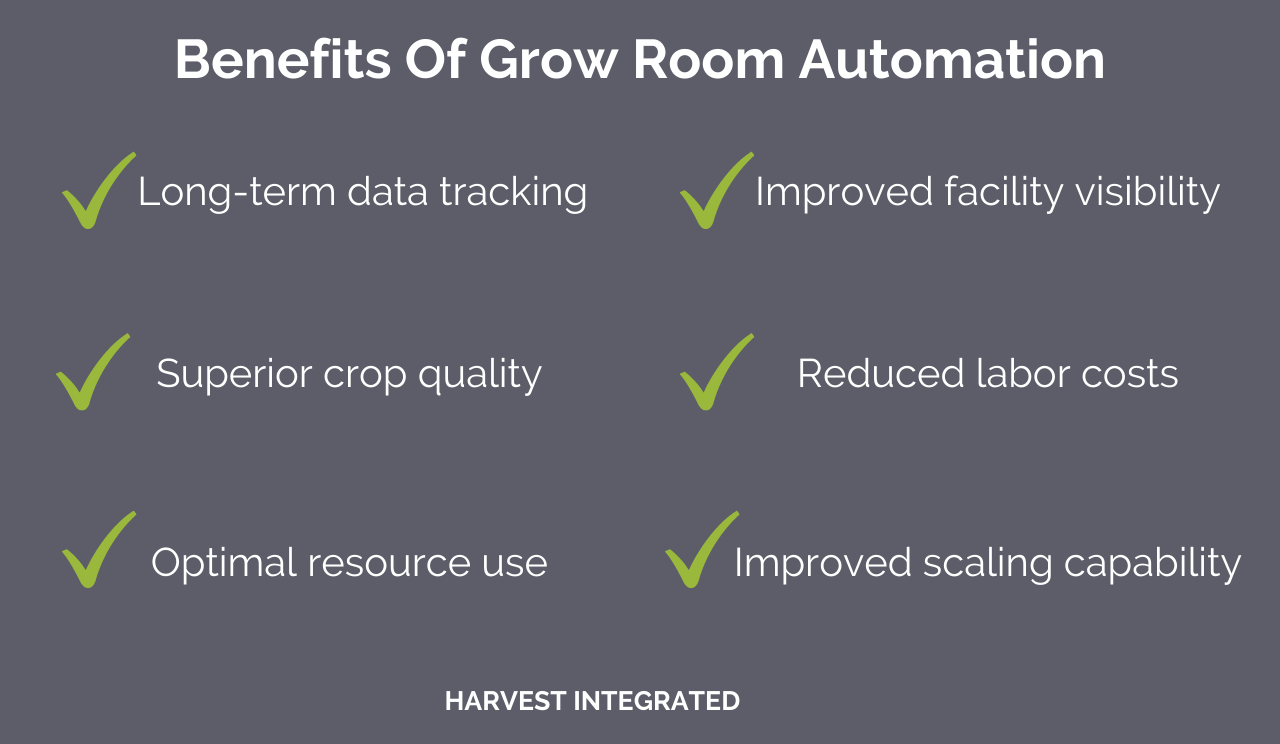
When used correctly, automation improves:
- crop quality
- irrigation precision
- labor efficiency
- environmental stability
- data visibility
- maintenance planning
- resource use
- operational discipline
The result is not just convenience. The result is a better crop and a more durable business.
Better Irrigation Precision and Crop Steering
One of the clearest examples of valuable automation is irrigation.
Hand watering can work in small facilities or specialty applications, but it is labor-intensive, inconsistent, and difficult to scale. Even strong team members introduce variation. Start time drifts. Shot size varies. Dryback targets get missed. One employee waters by feel, another waters by habit, and the crop ends up responding to labor inconsistency instead of intentional strategy.
Automated irrigation changes that.
With the right sensors, controls, and validation process, teams can hit tighter irrigation windows, more consistent shot timing, and more repeatable media behavior. This is especially important when crop steering in high-frequency fertigation systems where precision matters. Steering generative versus vegetative growth requires accuracy. Automation helps execute the plan rather than approximate it.
That does not mean the grower becomes irrelevant. It means the grower can make better decisions and trust that those decisions are carried out with greater consistency.
Environmental Automation Creates Repeatable Rooms
Environmental control is another major area where automation creates value.
Indoor crops are highly sensitive to changes in temperature, humidity, VPD, airflow, irrigation timing, and CO2 availability. If those conditions drift too far or too often, the crop responds. Growth rate changes. Transpiration changes. Morphology changes. Disease pressure changes. Quality and yield follow.
Automating environmental itineraries allows operators to establish repeatable room behavior across the full crop cycle. Instead of relying on a person to constantly chase conditions, integrated controls can manage setpoint transitions, coordinate equipment staging, and reduce swings that lead to stress or inconsistency.
This is where automation becomes especially powerful: not as a replacement for strategy, but as the mechanism that faithfully executes strategy.
A room plan only matters if the room can actually follow it.
Passive Data Collection Improves Decision-Making
A major benefit of automation is passive data pickup.
Every room is producing information all day long. Temperature trends. Humidity swings. Irrigation events. Run times. CO2 usage. Differential pressure. Drain percentages. Equipment alarms. Water content changes. Substrate EC drift. The question is whether that information is being captured, organized, and used.
Automation makes it possible to collect operational and crop data continuously without assigning someone to stand in the room with a clipboard. That data can be displayed on dashboards, reviewed historically, and compared room to room or run to run.
This kind of visibility helps teams make faster and better decisions. It helps identify when a room is drifting, when an irrigation strategy is underperforming, when equipment is cycling abnormally, or when a pattern is developing before it becomes a major issue.
But again, data is only valuable when it is verified. Good teams trust their systems enough to use them, but not so much that they stop checking reality. Calibration, validation, and spot checks remain essential.
Labor Is Not Eliminated. It Is Reallocated
One of the biggest misconceptions around automation is that it exists to remove labor.
The real opportunity is to redirect labor.
When repetitive and highly repeatable tasks are automated, skilled people can spend more time where they create the most value. That may mean better scouting, more disciplined sanitation, tighter fertigation reviews, more proactive maintenance, more detailed crop observation, stronger cloning practices, or better post-harvest execution.
In other words, automation should help a facility do more with the same team, not just fewer people.
That distinction matters. Great operators do not want a facility that runs without people. They want a facility where people are not buried in low-value repetition while higher-value work gets neglected.
An important element of a grow room’s sustainability is its environmental sustainability.
One of the biggest issues when it comes to grow room sustainability is high energy consumption, particularly the consumption connected to grow lights and HVAC systems. Automation helps address this issue.
For example, by automating grow lights, cultivators can dramatically reduce energy demand. Instead of guessing the required amount of lighting at any given time, cultivators can make decisions based on real-time data for increased efficiency.
Energy is a huge contributor to greenhouse gas emissions. Therefore, the increased energy efficiency brought about by automation will play a significant role in promoting sustainability.
Besides lights, grow room automation also helps optimize the use of other resources such as water. For example, cannabis, one of the crops popularly grown in grow rooms, is water-intensive. With automation, growers can ensure that the plants get only the water they need, not more.
Automation increases an operation’s sustainability as well. A big contributing factor to this sustainability is the reduction in operating costs. When you operate in an industry where profitability relies on maximizing efficiency, cutting costs is mandatory for business sustainability.
Automation Improves Accountability and SOP Adherence
Automation is not just about turning things on and off. It can also help ensure that processes are followed.
Digital checklists, logged observations, alarm acknowledgments, irrigation verification, environmental trend reviews, and maintenance thresholds all create accountability. Instead of relying on memory or assumption, facilities can build gate checks into daily operations and make metrics visible.
This is especially valuable in larger facilities where inconsistency often comes from process drift rather than bad intentions. Automation helps standardize execution across shifts, rooms, and employees.
That consistency is a competitive advantage.
Better Visibility Into Equipment and Maintenance
Automation also improves the mechanical side of facility performance.
Integrated systems can help operators track run hours, alarm histories, temperature deltas, pressure behavior, and equipment trends that may indicate service needs before a failure becomes catastrophic. This supports preventative maintenance instead of reactive maintenance.
That matters because cultivation facilities rarely lose money from equipment issues only when something fully breaks. They lose money when systems underperform quietly. A room that slowly loses dehumidification capacity, drifts off setpoint, or cycles inefficiently can reduce crop performance long before anyone calls it a mechanical failure.
Automation helps teams spot those problems earlier.
That leads to more planned service, less emergency downtime, and fewer expensive surprises.
Smarter Resource Use
Automation also supports more responsible use of energy and water.
Lighting schedules can be executed precisely. Irrigation can be matched more closely to crop demand. HVACD equipment can respond to actual room conditions rather than rough guesswork. Fans, dehumidification, and other systems can be coordinated to reduce waste and improve room stability.
This is not just about sustainability language. It is about operational efficiency.
Indoor cultivation has thin margins and high utility loads. Every unnecessary lighting hour, every poorly timed irrigation event, every uncontrolled humidity spike, and every inefficient equipment cycle costs money. Automation helps reduce those losses by making the facility more intentional.
Done correctly, sustainability is not a branding exercise. It is the byproduct of tighter control and fewer wasted inputs.
Automation Helps Facilities Scale Without Losing Consistency
Manual systems may work when a facility is small and the head grower can personally touch everything. But scale exposes inconsistency.
As canopy expands, more rooms come online, more staff are added, and more systems interact, it becomes harder to maintain control through human memory and manual routines alone. Automation helps preserve repeatability as complexity increases.
That is one of its greatest benefits. It allows operations to scale without immediately losing precision.
The goal is not to remove growers from the grow. The goal is to make sure the grower’s intent can still be executed accurately at scale.
The Most Important Caveat: Automation Still Requires Expertise
No matter how advanced the system, automation is only as good as the strategy behind it and the discipline supporting it.
Bad setpoints automated are still bad setpoints. Poor irrigation logic automated is still poor irrigation logic. Uncalibrated sensors feeding a control system can create false confidence and real damage.
This is why the best cultivation teams treat automation as part of a larger operational framework that includes:
- sensor calibration
- field verification
- equipment commissioning
- control sequence review
- SOP discipline
- data interpretation
- periodic human spot checks
Automation without validation can become expensive complacency. Automation with validation becomes operational leverage.
Automation for the Win
Grow room automation is transforming indoor cultivation, but not because it puts the facility on autopilot.
It matters because it improves execution.
It gives cultivators tighter irrigation control, better environmental consistency, better visibility into room and equipment performance, stronger SOP adherence, better maintenance planning, and a more efficient use of labor and resources.
Most importantly, it allows talented teams to spend less time repeating tasks and more time making high-value decisions.
That is the real promise of automation.
Not fewer growers.
Better growers.
Better data.
Better control.
Better outcomes.
And in a competitive market where consistency, quality, and cost discipline determine survival, that kind of leverage is no longer optional.