
A lot of growers talk about upgrading their facility, but too often that means buying new gear without first understanding what is limiting performance.
The best facility upgrades are not cosmetic. They are not random. They are not driven by hype.
They are driven by one question:
What is currently limiting your ability to produce quality cannabis, at scale, with consistency and profit?
As markets mature, cultivation is becoming more competitive, more transparent, and less forgiving. You cannot hide behind excuses forever. If the room is inconsistent, the crop will be inconsistent. If the system is underpowered, the crop will underperform. If the team does not know what success looks like, the facility will drift.
The future belongs to facilities that can deliver on four pillars:
Quality
Quantity
Consistency
Operational efficiency
Here are the 10 upgrades that matter most.
1. Upgrade Environmental Control First
This is number one all day.
Environment is the foundation of cultivation performance. If you cannot control temperature, humidity, airflow, and dehumidification, then every other input is compromised.
Environment drives transpiration. It drives nutrient movement. It drives plant temperature. It drives morphology, disease pressure, drybacks, and metabolic performance. In practical terms, it drives a massive portion of phenotypic expression.
Too many growers blame genetics, nutrients, or labor when the real problem is that the room does not have the control or mechanical capacity to support the crop.
If the HVACD system is undersized, poorly maintained, or poorly controlled, you will never fully win. You will spend your time reacting instead of steering.
The first upgrade is simple:
Get control of the environment.
That may mean:
- adding capacity
- replacing outdated mechanical systems
- improving controls
- improving maintenance
- sealing leaks
- improving airflow delivery
- adding monitoring and diagnostics
Until the room is under control, everything else is guesswork.
2. Upgrade Lighting Based on HVACD Capacity
Lighting is not just a lighting decision. It is a climate decision.
Before upgrading fixture intensity, spectrum, or total installed wattage, you need to understand what the room can actually support. Sensible cooling capacity determines how much heat you can remove. Latent capacity determines how much water the room can handle as transpiration rises.
That means HVACD tells you what your lighting limitations are.
Can you go from 700 PPFD to 1000 PPFD? Maybe. But only if the room can handle the increased sensible load, increased transpiration, and increased latent removal requirement.
Lighting upgrades should be tied to:
- room sensible capacity
- latent removal capacity
- crop irrigation capacity
- CO₂ strategy
- airflow capacity
- target DLI
- leaf temperature targets
Done correctly, lighting upgrades increase yield and improve consistency. Done incorrectly, they overload the room and create stress.
3. Upgrade Fertigation Control and Delivery Capacity
Fertigation is only as good as your ability to match nutrient delivery to plant demand.
If the environment is driving strong transpiration, the nutrient front can move with the plant. If the environment is weak or inconsistent, the entire irrigation strategy begins to break down.
A real fertigation upgrade is not just a better doser. It is better control of:
- irrigation timing
- shot size
- delivery uniformity
- runoff strategy
- drainage management
- water temperature
- nutrient mixing accuracy
- root zone response
This is also where substrate data becomes powerful. Tools from platforms like Aroya, Growlink, or other tensiometer and sensor systems can show whether the plant is actually drinking the way the strategy assumes.
Once the room is behaving predictably, media management becomes clearer. Drybacks make more sense. EC trends become more meaningful. The response to irrigation becomes easier to interpret.
The best fertigation programs are not manual routines. They are measured systems.
4. Upgrade Airflow Strategy
Airflow is one of the most misunderstood variables in cultivation.
Fans alone are not an airflow strategy. Airflow is about how air moves through the room, through the canopy, across the leaf surface, and back to the mechanical system.
Airflow controls:
- convective cooling
- leaf temperature
- boundary layer resistance
- transpiration support
- CO₂ distribution
- microclimate suppression
- moisture removal from dense canopy zones
Bad airflow leads to stagnant conditions, anaerobic zones, poor mixing, inconsistent VPD, and increased disease pressure.
A serious airflow upgrade means understanding:
- air changes and cycling rate
- supply placement
- return placement
- throw and velocity
- canopy penetration
- room length effects
- fan selection and control
- how airflow changes with canopy density
Airflow saves crops. It also makes every other system work better.
5. Upgrade Your Decision-Making Process
A lot of facilities do not fail because they lack equipment. They fail because they lack a decision framework.
Who decides what gets changed? Based on what data? What metric matters most? What does success actually look like?
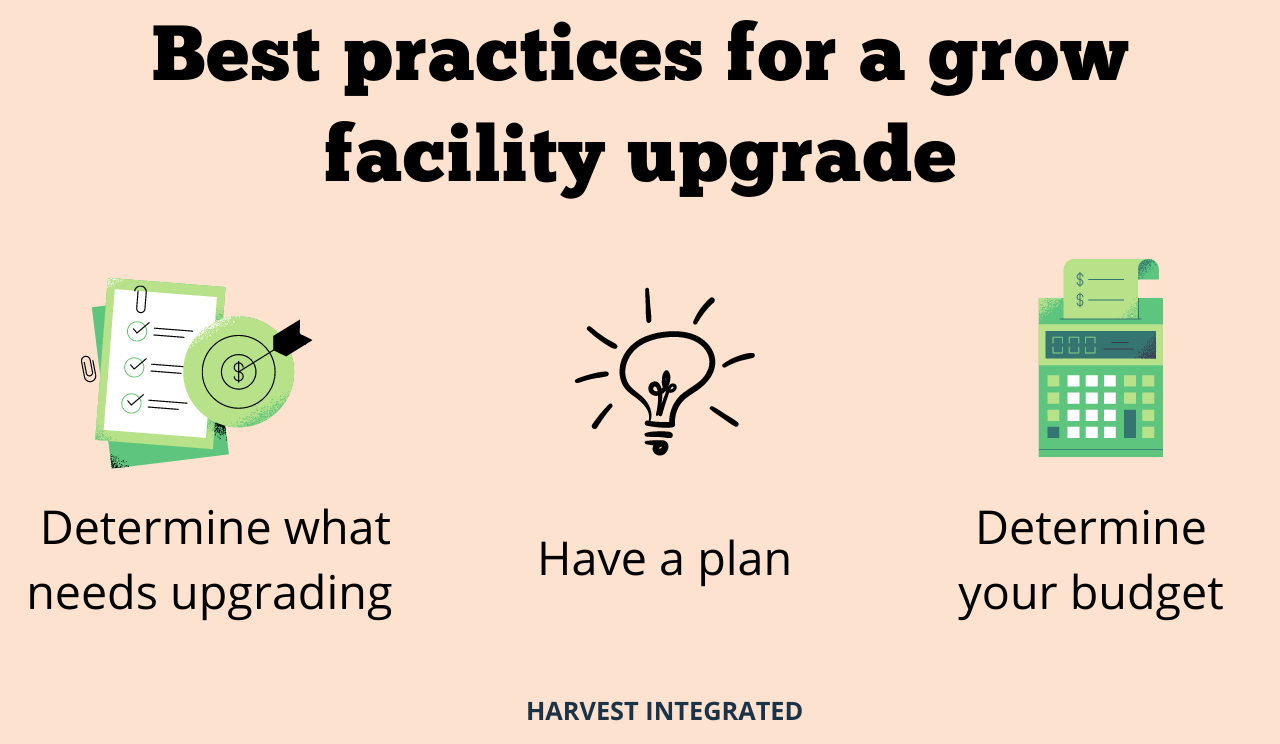
Before spending money on upgrades, define:
- the problem
- the target
- the budget
- the timeline
- the KPI
- the expected ROI
- who owns the result
This should not be vague.
If you are doing a retrofit, ask:
- Are we trying to increase grams per square foot?
- Are we trying to improve terpene content?
- Are we trying to reduce cost per pound?
- Are we trying to support higher PPFD?
- Are we trying to reduce labor?
- How will we know if the upgrade worked?
A disciplined decision-making process prevents expensive random acts of engineering.
6. Upgrade Training and Execution
Facilities drift when standards are not trained, repeated, and reinforced.
Turnover is real. People forget steps. New employees inherit half-explained SOPs. Tasks get rushed. Details get missed. Inconsistent execution becomes normalized.
That inconsistency shows up in:
- plant quality
- irrigation timing
- defoliation quality
- sanitation
- IPM performance
- harvest timing
- post-harvest handling
A strong facility upgrade includes operational training.
That means:
- clear SOPs
- repeatable checklists
- role ownership
- escalation paths
- visual standards
- onboarding systems
- regular review
Training is not soft. It is operational infrastructure.
7. Upgrade Monitoring and Data Collection
You cannot improve what you do not measure consistently.
Most facilities have more environmental drift than they realize because they do not collect enough useful data, or they do not interpret it in time.
Good monitoring gives visibility into:
- setpoint adherence
- room transitions
- equipment behavior
- transpiration trends
- dryback patterns
- CO₂ performance
- airflow consistency
- alarm conditions
- outlier events
This is where the facility starts to become proactive instead of reactive.
When you monitor well, you can identify:
- open doors
- load-ins
- defoliation events
- clogged coils
- fan failures
- compressor degradation
- irrigation issues
- lighting control mistakes
Data collection should support action, not just reporting.
8. Upgrade CO₂ Strategy
CO₂ is not just a setpoint. It is a production tool.
If the room is tight, the air is moving correctly, the light intensity is sufficient, and the plant is metabolically active, CO₂ can materially improve productivity.
But CO₂ only works well when the rest of the room is ready for it.
A worthwhile CO₂ upgrade includes:
- room sealing
- injection method
- distribution quality
- control logic
- life safety planning
- monitoring
- integration into supply air where appropriate
- alignment with temperature, light, and transpiration
Poor CO₂ strategy wastes money. Good CO₂ strategy increases output.
9. Upgrade Curing and Post-Harvest Control
A lot of growers work hard to produce quality flower and then lose value after harvest.
Post-harvest is part of production. If drying and curing are inconsistent, the room can grow great flower that the process later degrades.
A curing upgrade should focus on:
- temperature control
- humidity control
- airflow management
- water activity targets
- drying consistency
- speed to safe microbial ranges
- preservation of terpenes and visual quality
If cultivation creates the potential, post-harvest protects it.
This is especially important in mature markets where the difference between “good” and “great” determines which products create loyalty.
10. Upgrade for Market Reality, Not Ego
The future of cultivation is more competitive, more measured, and less romantic.
Facilities will increasingly need to hit real performance benchmarks. Single-tier rooms may need to approach around 100 grams per square foot. Double-tier facilities may need to push toward around 75 grams per square foot. Cost of production may need to stay under $250 per pound in many markets to remain truly competitive.
Quality targets will keep rising too. Strong TAC. Strong terps. Strong wash returns for extract. Better consistency batch to batch.
At the same time, the market will split.
Some flower will become commodity product feeding extraction, beverages, gummies, and consumer packaged goods. Other flower will remain an experience-driven product defined by cultivar uniqueness, terroir expression, and brand storytelling.
That means growers need to stay flexible.
The next iconic cultivar may come from anywhere. The market will chase what is unique, until it chases something new. Great flower will always have a home, but it must still be produced efficiently.
You cannot run from economics.
You can, however, control your environment, your systems, your process, and your consistency.
Final Thought
A grow facility upgrade should not start with equipment catalogs.
It should start with clarity.
What is limiting performance? What is costing margin? What is creating inconsistency? What can be measured? What can be improved? What will actually move the business forward?
The best facilities in the future will not be the ones with the fanciest gear.
They will be the ones that combine:
- environmental control
- operational discipline
- data-backed decisions
- efficient workflows
- repeatable quality
Because in the end, quantity pays the bills, consistency keeps the operation stable, and quality creates the customer.
And the facilities that can deliver all three—profitably—will be the ones that survive mature markets.